

AI CERTS
3 hours ago
Meta Tracking Every Click, Keystroke, and Movement—A Wake-Up Call for AI Skills in the Workforce
This isn’t just a story about surveillance. It’s a story about the future of work, the value of human behavior as data, and the urgent need for structured AI training.
Turning Human Behavior into AI Intelligence
Meta is rolling out tracking software across employee work devices in the United States to capture detailed interaction data everything from keyboard shortcuts to mouse navigation patterns. The goal? To train AI systems that can mimic how humans interact with computers and perform tasks autonomously.
This initiative is part of a broader transformation within the company to build “agentic AI”—systems capable of executing real-world tasks without constant human input.
In simple terms, Meta isn’t just building AI that responds—it’s building AI that acts. And to do that, it needs something incredibly valuable: real human workflow data.
The logic is straightforward. AI models today struggle with seemingly simple actions like navigating menus, selecting tools, or using shortcuts. By learning directly from employees’ daily digital behavior, Meta aims to bridge this gap and create systems that replicate human efficiency.
The Bigger Shift: From Employees to AI Supervisors
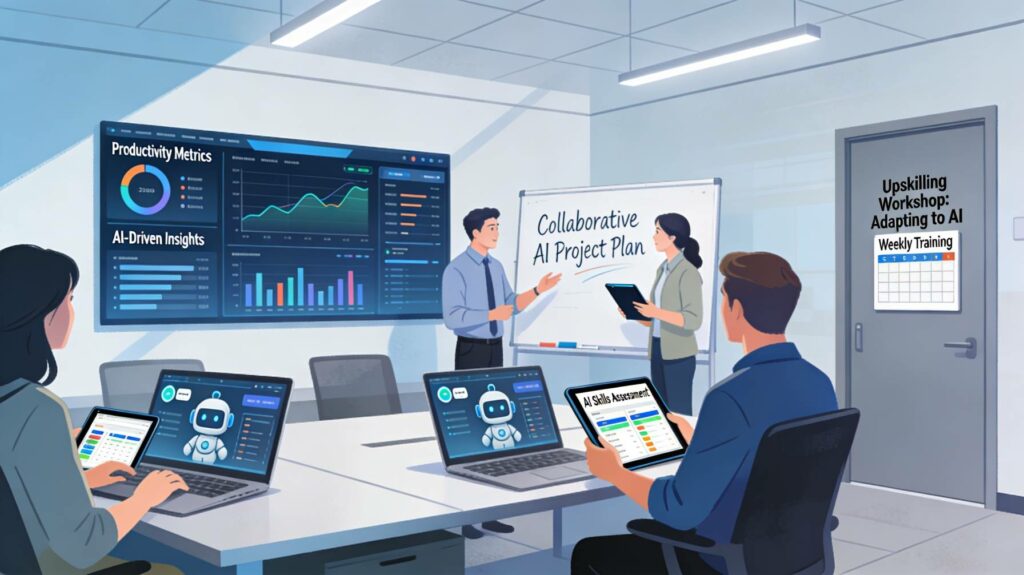
This move signals a deeper shift in workplace dynamics. Employees are no longer just contributors, they are becoming data sources and, eventually, supervisors of AI systems.
Internal communication reportedly suggests that roles will evolve, with employees increasingly responsible for overseeing AI agents that perform the bulk of operational work.
This transformation reflects a broader industry trend. Companies are not just adopting AI tools, they are restructuring entire workflows around them. The traditional “doer” role is gradually being replaced by a “manager of machines.”
But here’s the catch: supervising AI requires a completely different skill set.
Without proper training, professionals risk being sidelined in an AI-first workplace.
The Privacy Debate: Innovation vs. Intrusion
Unsurprisingly, the move has sparked internal and external backlash. Employees have raised concerns about constant monitoring, especially since there is reportedly no opt-out option on company devices.
While Meta maintains that safeguards are in place and the data will not be used for performance evaluations, the ethical concerns remain significant.
This raises critical questions. Where do we draw the line between data collection for innovation and employee privacy? How transparent should companies be? And how will regulations evolve, especially in stricter regions like Europe?
The reality is, as AI becomes more powerful, the demand for high-quality, real-world data will only increase. And organizations will continue exploring new ways to obtain it.
Why This Matters: Data Is the New Workforce Currency
What Meta is doing highlights a fundamental truth about AI: it is only as good as the data it learns from.
Human behavior, how we think, click, decide, and navigate is becoming one of the most valuable datasets in the world.
This shift has two major implications. First, companies that can access and leverage such data will gain a massive competitive advantage. Second, professionals who understand how AI uses this data will be far more valuable than those who don’t.
In other words, the future workforce isn’t just competing with AI—it’s collaborating with it.
But collaboration requires understanding.
The Skills Gap: Why AI Training Is No Longer Optional
Here’s where things get critical.
Most professionals today are using AI tools but very few truly understand how they work, how they are trained, or how to manage them effectively.
This creates a dangerous gap.
On one side, companies like Meta are accelerating AI adoption at an unprecedented pace. On the other, the workforce is struggling to keep up.
This gap leads to what experts call “model misuse” or even “model collapse,” where poorly trained or poorly managed AI systems fail to deliver value—or worse, create risks.
To stay relevant, professionals must move beyond basic AI usage and develop deeper capabilities, such as understanding AI workflows, interpreting outputs, managing AI-driven processes, and ensuring ethical use.
The Role of Structured Learning: Enter Authorized Training Partners (ATP)
This is where structured AI education becomes essential.
Programs like the Authorized Training Partner initiative by AI CERTs are designed to bridge this exact gap. Instead of generic, outdated courses, ATPs deliver industry-aligned, practical training that prepares professionals to work alongside AI systems in real-world scenarios.
The key difference lies in application.
Rather than just teaching theory, these programs focus on how AI is actually used in business environments, how to integrate it into workflows, how to supervise AI agents, and how to make data-driven decisions.
In a world where companies are literally using employee behavior to train AI, professionals need training that helps them understand both sides of the equation: the human and the machine.
The Future: A Workforce Rewritten by AI
Meta’s move is not an isolated experiment. It is a glimpse into the future of work.
We are entering an era where AI systems will handle execution, and humans will focus on strategy, oversight, and innovation. But this transition won’t happen automatically.
It will require a workforce that is not just AI-aware, but AI-ready.
Companies will prioritize professionals who can adapt, learn, and lead in this new environment. And those who invest in AI training today will be the ones shaping tomorrow’s workplace.
Adapt Now or Be Automated Later
Meta’s decision to track employee interactions may raise eyebrows, but it also delivers a powerful message.
AI is evolving faster than ever, and companies are willing to rethink everything—from workflows to workforce roles to stay ahead.
For professionals, the takeaway is clear. The question is no longer whether AI will impact your job. It’s how prepared you are for that impact.
Those who understand AI will lead it. Those who don’t may find themselves replaced by it.
The choice lies in learning and the time to start is now.
FAQs
What exactly is Meta tracking from employees?
Meta is collecting data such as mouse movements, clicks, keystrokes, and navigation patterns on work devices to train AI systems that can replicate human-computer interactions.
Why does AI need this kind of data?
AI models struggle with real-world computer tasks. By learning from human behavior, they can better perform actions like navigating menus or using shortcuts effectively.
Is this data being used to evaluate employee performance?
Meta has stated that the data will be used only for AI training and not for performance reviews, though concerns about privacy still exist.
What does this mean for the future of jobs?
Jobs will increasingly shift toward supervising and managing AI systems rather than performing repetitive tasks manually.
How can professionals prepare for this shift?
By investing in structured AI training programs, such as those offered through Authorized Training Partners, professionals can develop the skills needed to work effectively with AI systems and stay competitive.


