

AI CERTS
2 months ago
Why Multi-Agent AI Is Reshaping Cybersecurity and Why Workforce Training Can’t Wait
The Rise of Agentic SOC: A New Era in Cyber Defense
Cybersecurity has always been a race against time. Traditional SOCs rely heavily on human analysts to detect, investigate, and respond to threats. But with the exponential rise in attack surfaces and data complexity, this model is struggling to keep up.
Enter Agentic SOC—a system powered by multi-agent AI orchestration. According to EY, this approach fundamentally redefines how security operations function by enabling multiple AI agents to work together seamlessly. These agents specialize in different tasks—one detects anomalies, another triages alerts, while others coordinate responses—all under a unified orchestration layer.
This isn’t just automation; it’s intelligent collaboration. Multi-agent orchestration allows systems to break down complex cybersecurity workflows into smaller, specialized tasks handled by dedicated agents. Each agent operates with a defined role, but together, they create a highly adaptive and scalable defense mechanism.
Faster Detection, Smarter Response
The biggest advantage of Agentic SOC lies in speed and precision. Traditional systems often generate overwhelming volumes of alerts, many of which are false positives. Human analysts spend valuable time sorting through noise before identifying real threats.
Agentic systems eliminate this inefficiency. AI agents can instantly analyze vast datasets, identify patterns, and prioritize risks with remarkable accuracy. They don’t just detect threats—they understand them in context and act accordingly.
EY highlights that Agentic SOC enables faster threat detection, smarter triage, and coordinated response mechanisms, all while keeping humans in the loop for oversight and decision-making. This hybrid model ensures that AI enhances human capability rather than replacing it.
The result is a cybersecurity environment where response times shrink dramatically, and organizations can proactively mitigate risks instead of reacting to breaches after the fact.
From Tools to Teams: The Shift to AI Collaboration
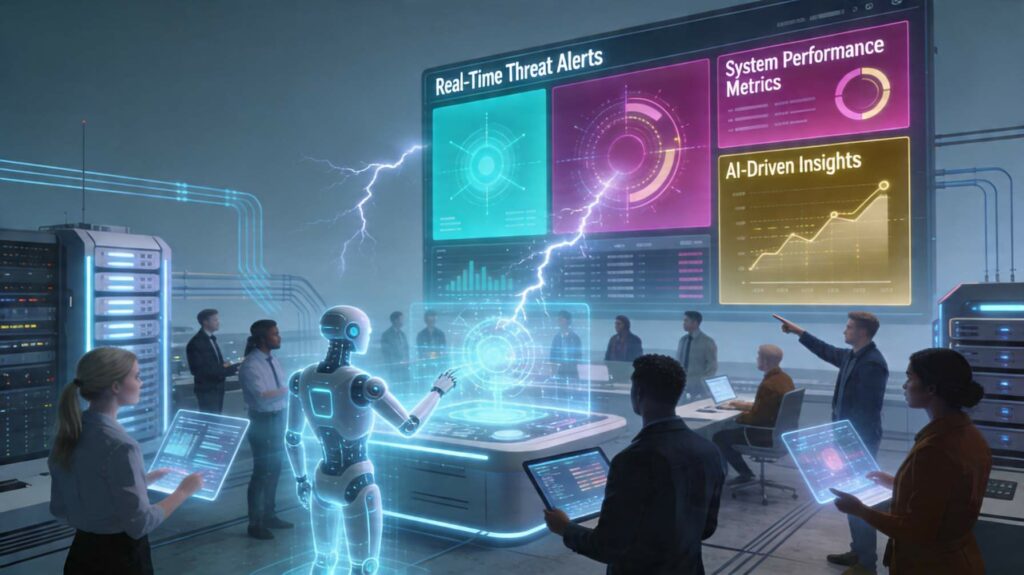
What makes Agentic SOC truly revolutionary is its shift from single AI tools to collaborative AI ecosystems. Traditional AI systems operate in isolation—processing inputs and generating outputs independently. But modern cyber threats are too complex for siloed intelligence.
Multi-agent systems change this dynamic entirely. Each agent focuses on a specific function—data analysis, decision-making, execution, or validation—while an orchestrator ensures alignment and coordination.
This model mirrors how high-performing human teams operate. Instead of one system doing everything, multiple specialized agents work in parallel, improving efficiency and scalability.
Research shows that such systems can significantly enhance operational efficiency and reduce response latency, making them ideal for enterprise-scale cybersecurity environments.
The Talent Gap: Technology Is Moving Faster Than Skills
While the technology is advancing rapidly, the workforce is struggling to keep pace. The shift to agentic AI systems is not just a technical upgrade—it’s a complete redefinition of roles within organizations.
New job functions are emerging, such as AI orchestrators, AgentOps managers, and AI governance specialists. These roles require a blend of technical expertise, strategic thinking, and domain knowledge.
At the same time, traditional entry-level roles are evolving. As AI takes over repetitive tasks, professionals must develop higher-order skills like critical analysis, oversight, and decision-making.
Even industry leaders acknowledge this shift. EY’s multi-agent AI rollout is expected to transform workflows significantly, requiring employees to adapt to new ways of working and learning.
The message is clear: the future of cybersecurity isn’t just about deploying AI—it’s about understanding and managing it.
Why AI Training Is No Longer Optional
This transformation underscores an urgent need for structured AI education. Organizations cannot simply implement advanced AI systems and expect immediate results. Without proper training, these systems risk being underutilized—or worse, mismanaged.
AI training equips professionals with the skills needed to design, deploy, and oversee multi-agent systems effectively. It also helps organizations build internal capabilities, reducing dependency on external expertise.
This is where programs like the Authorized Training Partner (ATP) initiative by AI CERTs become critical. The ATP program enables training providers, institutions, and organizations to deliver industry-aligned AI education, ensuring that professionals are equipped to handle emerging technologies like Agentic AI.
By becoming an ATP, organizations can bridge the skill gap within their workforce, create new revenue streams through AI training, and position themselves at the forefront of technological transformation. More importantly, they can ensure that their teams are not just users of AI—but confident operators and innovators.
The Road Ahead: Human-AI Collaboration as the New Standard
Agentic SOC represents more than just a technological advancement—it signals a fundamental shift in how organizations approach cybersecurity. The future lies in seamless human-AI collaboration, where machines handle complexity and scale, while humans provide judgment, ethics, and strategic direction.
But this future cannot be realized without investment in people. As AI systems become more autonomous, the need for skilled professionals who can guide, manage, and optimize these systems will only grow.
Organizations that prioritize AI training today will not only enhance their cybersecurity capabilities but also gain a competitive edge in an increasingly AI-driven world.
The question is no longer whether to adopt AI—but whether your workforce is ready for it.
FAQs
What is an Agentic SOC?
An Agentic SOC is a next-generation security operations center that uses multiple AI agents working together to detect, analyze, and respond to cybersecurity threats in real time.
How is multi-agent AI different from traditional AI?
Traditional AI systems operate independently, while multi-agent AI systems involve multiple specialized agents collaborating under an orchestration framework to solve complex problems more efficiently.
Will AI replace cybersecurity professionals?
No, AI is designed to augment human capabilities. While it automates repetitive tasks, it also creates new roles that require human oversight, strategy, and decision-making.
Why is AI training important for organizations?
AI training ensures that employees can effectively use, manage, and optimize AI systems, reducing risks and maximizing return on investment.
What is the AI CERTs Authorized Training Partner (ATP) program?
The ATP program allows organizations and training providers to deliver certified AI courses, helping professionals gain practical, industry-relevant AI skills needed for emerging technologies like agentic AI systems.
Disclaimer: Some content may be AI-generated or assisted and is provided ‘as is’ for informational purposes only, without warranties of accuracy or completeness, and does not imply endorsement or affiliation.


