

AI CERTS
3 hours ago
How Paterson School’s Google–UPenn AI Training Signals a Global Urgency for Educator Upskilling
The collaboration between Google, the University of Pennsylvania, and Paterson Public Schools is more than a regional education upgrade, it is a blueprint for how institutions worldwide must rethink teaching in the age of AI.
A Strategic Leap into AI-Powered Education
Paterson Public Schools have joined a specialized training initiative designed to help educators understand, implement, and responsibly use artificial intelligence in classrooms. This program is part of a broader effort led by the University of Pennsylvania’s Graduate School of Education, supported by Google’s philanthropic arm, to build structured AI capabilities in K–12 systems.
At its core, the initiative focuses on equipping teachers, school leaders, and administrators with the knowledge to integrate AI into lesson planning, student engagement, and decision-making. Unlike isolated tech experiments, this is a system-wide transformation that emphasizes ethical use, equity, and practical classroom application.
For a district like Paterson serving tens of thousands of students across dozens of schools this shift represents a significant modernization of public education infrastructure.
Why This Matters: AI Is Already in the Classroom
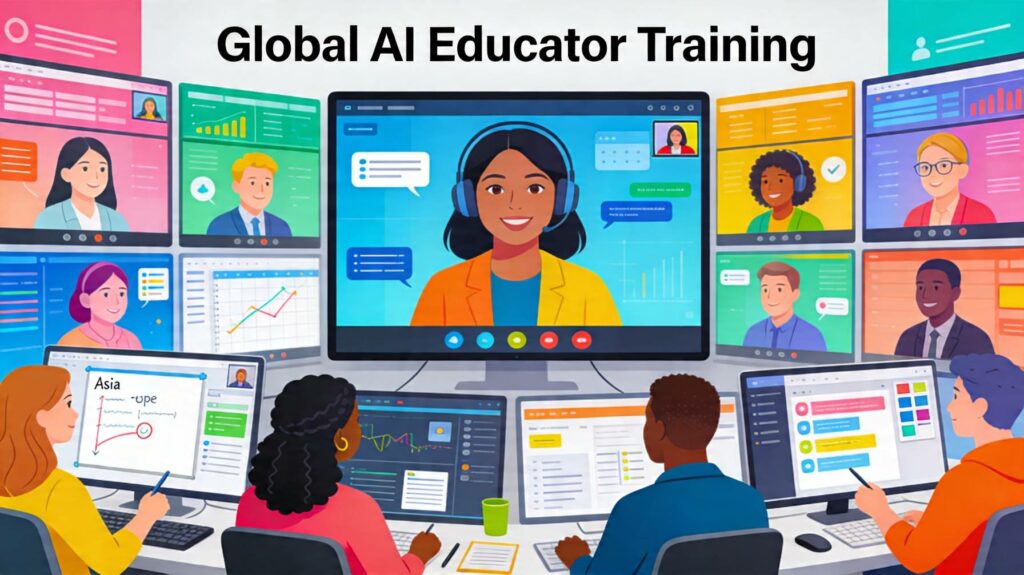
Artificial intelligence is no longer a futuristic concept in education. From automated grading to personalized learning pathways, AI tools are already influencing how students learn and how teachers teach. Yet, the gap lies in preparedness.
Many educators are still navigating AI without formal training, leading to inconsistent usage and missed opportunities. Programs like this aim to close that gap by offering structured, research-backed learning pathways that empower educators rather than overwhelm them.
The Penn-led initiative follows a three-tier model—targeting district leaders, school administrators, and teachers—to ensure alignment across all levels of the education system. This is crucial because AI adoption without coordination can lead to fragmented learning experiences and policy confusion.
The Google Factor: Scaling AI Literacy
Google’s involvement underscores the scale and seriousness of this transformation. Through funding and strategic support, the initiative is being expanded across multiple districts, making AI training accessible at no cost to participating schools.
This democratization of AI education is critical. Without it, only well-funded institutions would have the resources to experiment with emerging technologies, widening the digital divide. By contrast, this model ensures that public school systems often serving diverse and underserved communities—are not left behind.
The result is not just AI adoption, but AI equity.
Beyond Tools: Building Responsible AI Leaders
One of the most significant aspects of the program is its emphasis on responsible AI use. Educators are not just being trained to use tools they are being guided to think critically about ethics, bias, and long-term implications.
This is particularly important in K–12 environments, where early exposure to AI can shape how future generations perceive technology. By embedding ethical considerations into training, the program ensures that AI is used as a tool for empowerment, not dependency.
Moreover, the initiative focuses on building internal capacity within school systems. Instead of relying on external consultants, schools develop their own AI champions—educators who can lead, train, and innovate from within.
The Bigger Picture: A Global Call for AI Training
What’s happening in Paterson is not an isolated story—it’s a signal. Across the world, education systems are grappling with the same question: how do we prepare students for a future dominated by AI?
The answer increasingly points to one thing—training the trainers.
Without equipping educators with AI literacy, even the most advanced tools will fail to deliver meaningful outcomes. This is why structured training programs are becoming the backbone of AI adoption in education.
And this is where initiatives like the Authorized Training Partner (ATP) ecosystem come into play.
Bridging the Gap with AI CERTs ATP
While institutional collaborations like the Paterson initiative are driving change at the school level, there is a parallel need for scalable, industry-aligned AI training frameworks. This is where the Authorized Training Partner (ATP) program by AI CERTs becomes highly relevant.
The ATP model enables training institutes, educators, and organizations to deliver standardized, globally recognized AI certification programs. It ensures that learners—from educators to professionals—receive consistent, high-quality training aligned with real-world AI applications.
In a world where AI skills are rapidly becoming foundational, ATP programs serve as a bridge between knowledge and implementation. They empower institutions to not just adopt AI, but to sustain and scale its impact.
For educators inspired by initiatives like Paterson’s, ATP offers a pathway to deepen expertise, validate skills, and become part of a global AI training ecosystem.
A Turning Point for Education Systems
The collaboration between Paterson Public Schools, Google, and the University of Pennsylvania marks a turning point. It demonstrates that AI in education is no longer about experimentation—it’s about execution.
It also highlights a critical truth: technology alone cannot transform education. People can.
By investing in educators, this initiative ensures that AI becomes a tool for better teaching, not a replacement for it. It reaffirms the role of teachers as facilitators of critical thinking, creativity, and human connection—qualities that no algorithm can replicate.
The Road Ahead
As more school systems observe the outcomes of this program, similar initiatives are likely to emerge across regions and countries. The challenge will not be whether to adopt AI, but how quickly and effectively it can be integrated.
The Paterson model provides a clear roadmap—collaboration, training, ethical grounding, and scalability.
And perhaps most importantly, it reminds us that the future of education is not just digital it is deeply human, guided by educators who are equipped, empowered, and ready to lead in an AI-driven world.
FAQs
What is the main goal of the Paterson AI training initiative?
The initiative aims to equip educators with the skills and knowledge to integrate artificial intelligence into teaching, learning, and school leadership in a responsible and effective way.
Who is involved in this collaboration?
The program is a partnership between Paterson Public Schools, Google, and the University of Pennsylvania’s Graduate School of Education.
How will AI benefit students in classrooms?
AI can personalize learning, automate repetitive tasks, and provide data-driven insights, allowing teachers to focus more on student engagement and critical thinking.
Why is AI training important for educators?
Without proper training, educators may struggle to use AI tools effectively, leading to inconsistent outcomes. Training ensures confident, ethical, and impactful use of AI in education.
What is the role of AI CERTs ATP in AI education?
AI CERTs’ Authorized Training Partner program provides structured, industry-aligned AI training and certifications, helping educators and organizations build scalable AI expertise.


