

AI CERTS
5 hours ago
Display Innovation: Sony’s True RGB TV Sets New Color Benchmarks
This article unpacks the technology, performance claims, competitive landscape, and lingering uncertainties. Additionally, it outlines professional opportunities arising from this shift. Each section adheres to verified data from press releases and hands-on reports. However, final retail specifications remain elusive until Sony confirms shipping models. Nevertheless, the groundwork already signals a pivotal year for premium television engineering.
RGB Backlight Breakthrough Details
Pioneering color at the light source sets True RGB apart from white-LED backlights. Instead of filtering white light, red, green, and blue LEDs illuminate the liquid crystal layer directly. Consequently, spectral purity improves before the panel's color filters even engage. Sony pairs the dense LED grid with a dedicated 96-bit control processor co-developed with MediaTek. Moreover, ROHM drive ICs maintain precise current for every channel while Sanan supplies the diode arrays.
Together, these components yield peak brightness exceeding 4,000 nits, according to the March 2025 press release. In contrast, most mini-LED televisions peak around 2,000 nits with lower color saturation. These shifts underpin a second Display Innovation counted by analysts: meaningful color volume at high luminance.
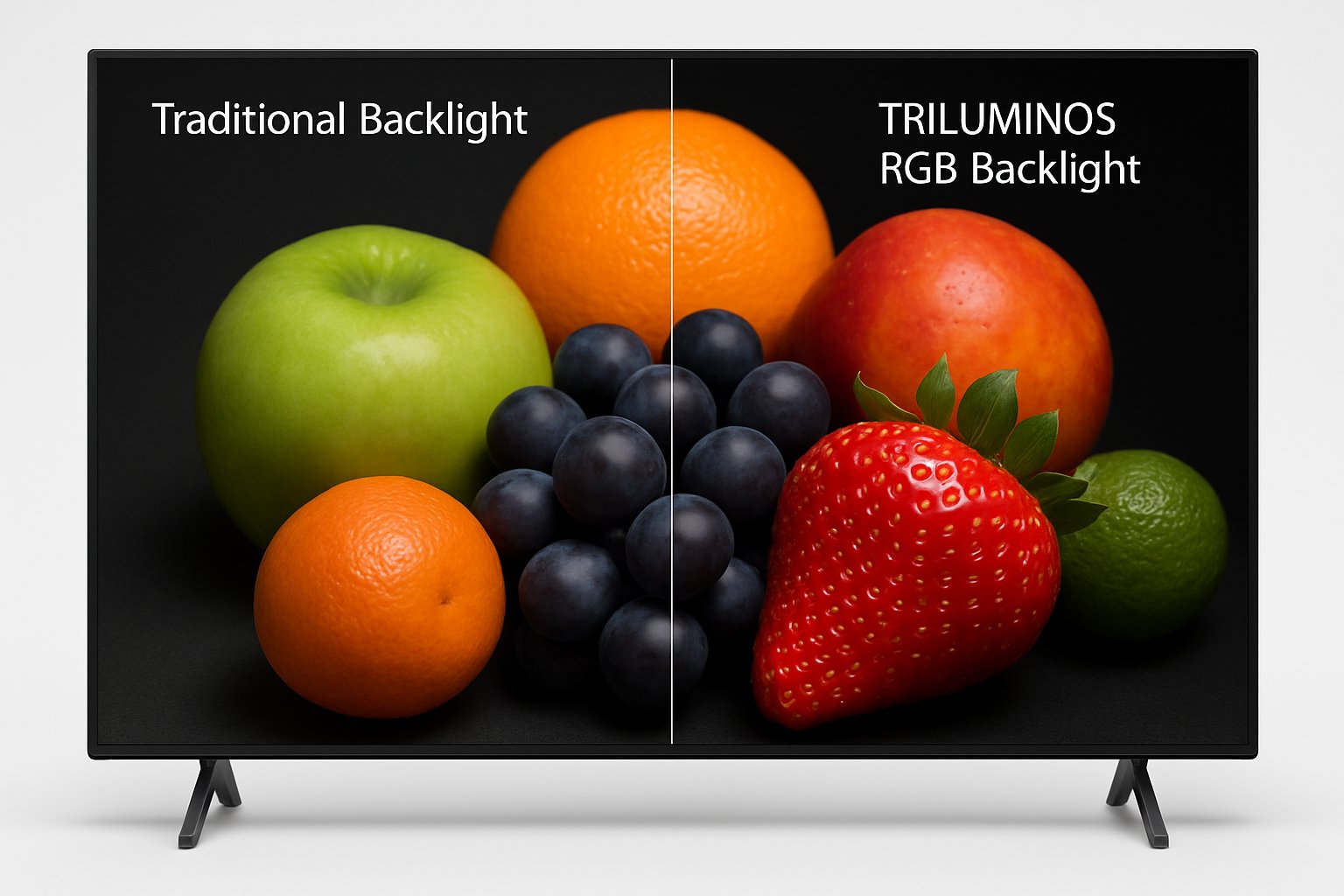
True RGB attacks legacy backlight limitations through colored diodes and massive processing power. Therefore, early metrics look compelling. Meanwhile, objective measurements of color coverage reveal how far the concept pushes industry boundaries.
Color Volume Metrics Explained
Sony's laboratory charts report 99 percent DCI-P3 coverage for this Display Innovation and roughly 90 percent BT.2020. Furthermore, reviewers at What Hi-Fi corroborated wide gamut retention during bright HDR test loops. Color volume multiplies gamut by luminance, so retaining saturation above 3,000 nits is rare. Therefore, the claimed 4,000-nit ceiling, married to deep reds and greens, outstrips many QD-OLED sets. Wired reporters noticed the backlight alone produced recognizable colored images, underscoring that purity.
However, independent counts of dimming zones varied from 3,840 to 32,000, muddying bloom predictions. Reporters covering the new tech noted its visual immediacy during demos. Additionally, the prototype display retained saturation even at off-axis positions.
Key published performance data appear below.
- >99% DCI-P3 coverage confirmed by Sony press release.
- ≈90% BT.2020 according to the same document.
- Peak brightness >4,000 nits on engineering samples.
- 96-bit signal pipeline for per-channel precision.
These numbers indicate a formidable Display Innovation for color fidelity and HDR punch. In contrast, rivals advertise bigger numbers but lack matching demos. Subsequently, comparisons with established OLED platforms clarify remaining trade-offs.
Comparisons With OLED Competitors
QD-OLED panels still enjoy pixel-level contrast that eliminates halo artifacts entirely. Nevertheless, their organic material limits sustained brightness and can desaturate at extreme peaks. Early True RGB prototypes showed colored halos that blended more naturally than the white glows of mini-LED sets. However, zone size remains larger than single pixels, so small stars may blur slightly. FlatpanelsHD writers emphasised this limitation after side-by-side gaming sequences.
Consequently, OLED retains an advantage in fine specular highlights, yet loses daylight punch. Reviewers still praised the display for consistent hues off axis. OLED supporters argue their panels remain a separate Display Innovation focused on contrast perfection.
True RGB narrows the gap by elevating brightness without halo distraction. Therefore, consumers will decide based on content preferences. Next, production realities could influence how quickly the promise reaches living rooms.
Production And Supply Challenges
Packing 96,000 tri-color LEDs behind a 75-inch panel stresses manufacturing tolerances. Additionally, every diode requires alignment within one millimeter to sustain the promised Display Innovation benefits. Yield losses climb quickly, raising bill-of-materials costs. Therefore, Sony partnered with Sanan Optoelectronics to secure reliable diode volume. Meanwhile, ROHM and MediaTek must synchronize firmware updates for the 96-bit pipeline. Analysts believe even minor firmware bugs could trigger flicker across thousands of backlight groups. Consequently, extended burn-in testing will delay mass rollout beyond the initial 2025 production start line.
Manufacturing complexity threatens timelines and pricing for this Display Innovation. However, strategic supplier alliances mitigate some risk. Retail uncertainty leads naturally to market timing analysis.
Market Timing And Uncertainties
Trademark filings suggest consumer branding will read 'True RGB' on 2026 Bravia televisions, marking a flagship Display Innovation launch. However, Sony has not announced model numbers, zone counts, or global launch dates. Industry insiders anticipate CES 2026 showcases followed by limited spring shipments. In contrast, Samsung and Hisense previewed rival RGB backlights, escalating competitive pressure. Consequently, price positioning could mirror early 8K rollouts, with premium markups above OLED flagships.
Analyst firm Omdia warns that marketing battles may confuse shoppers unless specifications become standardized. Therefore, clear disclosures on LED counts and effective zones will prove essential. Pricing will influence whether mainstream buyers embrace the advanced tech quickly.
Launch timing, pricing, and specification clarity remain open variables shaping adoption. Subsequently, professionals should assess how those variables affect career opportunities. The following section explores those professional angles.
Opportunities For Display Professionals
Every new hardware cycle creates demand for specialized skills. Moreover, color scientists must recalibrate mastering monitors and streaming workflows for higher luminance ranges. Firmware engineers familiar with 96-bit pipelines will command salary premiums. Consequently, product managers who understand both hardware and HDR content pipelines can bridge communication gaps. Professionals can enhance their expertise with the AI+ UX Designer™ certification. Additionally, marketing strategists need vocabulary around Display Innovation to translate specifications into consumer value. RGB TV experts will also advise retailers on demo loop creation, avoiding content that exaggerates halos.
Emerging roles include:
- Backlight algorithm developer.
- HDR color volume analyst.
- Retail training specialist for RGB TV.
Skill gaps align closely with upcoming product lifecycles and supply expansion. Therefore, early upskilling could secure leadership positions. Finally, we recap the core findings and next actions.
True RGB exemplifies how Display Innovation reshapes premium television without replacing LCD architecture. Furthermore, colored LEDs with 96-bit processing deliver record color volume and headline brightness. However, zone granularity, manufacturing yield, and uncertain pricing still temper early enthusiasm. Sony and competitors will face scrutiny as retail models emerge next year. Nevertheless, professionals mastering HDR workflows and certifications can lead upcoming projects. Consequently, monitor CES 2026 updates, verify final specifications, and position yourself as an RGB TV authority. Explore the linked credential now to future-proof your skillset.


