Sustainable Computing: Reducing Hyperscale Data Center Costs
IEA projects global data centers electricity demand could almost double within five years. Meanwhile, Gartner foresees nearly one terawatt-hour appetite by 2030. These forecasts convert once-abstract sustainability debates into urgent energy cost line items. Therefore, executives across hyperscale giants are rethinking site selection, tariffs, and technology investments. This article unpacks the numbers, the emerging risks, and the practical levers for Sustainable Computing. Readers will gain actionable insight for procurement, policy, and design decisions.
AI Load Reshapes Grids
AI training clusters require concentrated power unmatched by earlier web workloads. Moreover, each hyperscale campus can draw hundreds of megawatts once GPUs ramp. IEA estimates data centers could consume 945 TWh worldwide by 2030. In contrast, global rail systems used less electricity in 2024.
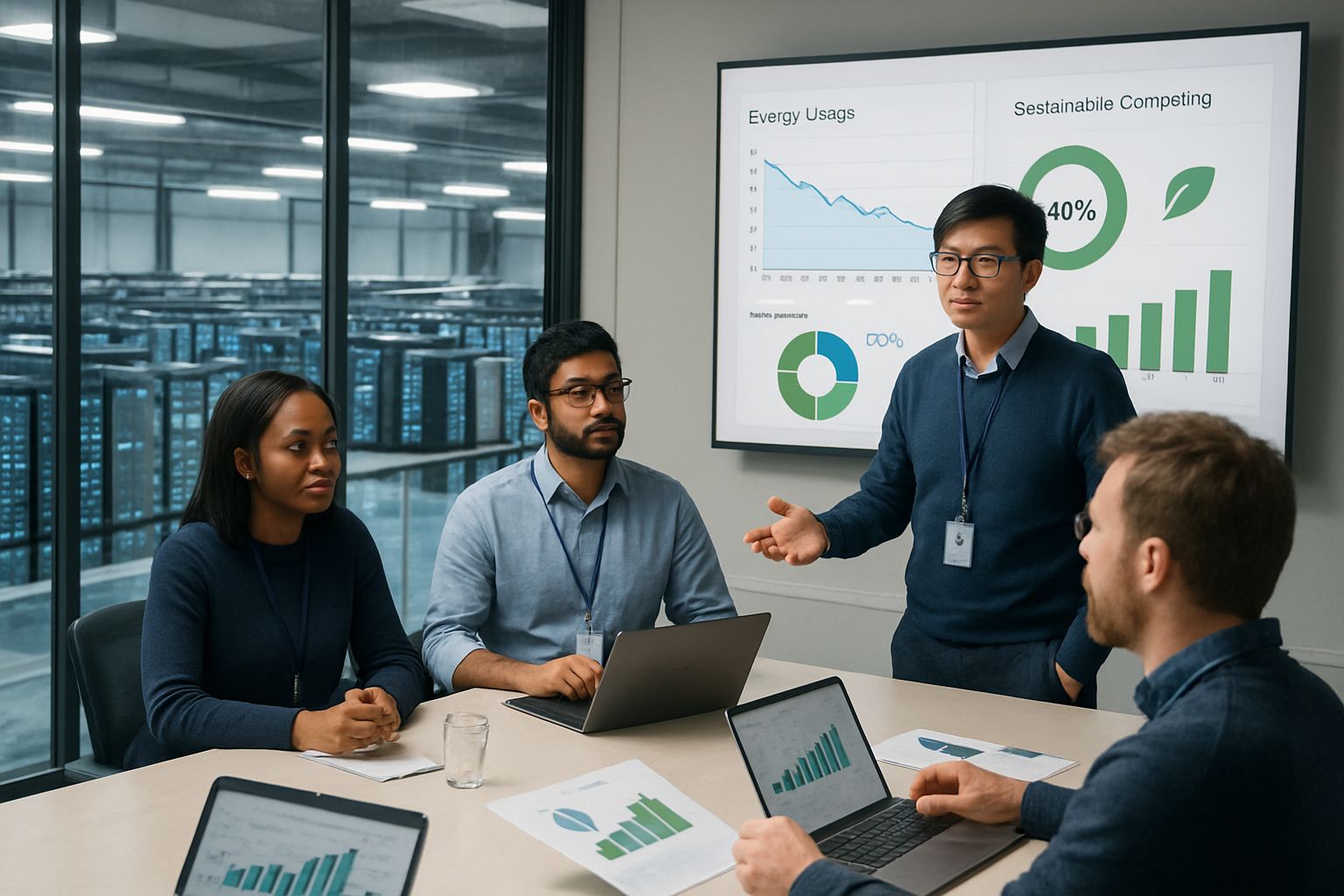
IT experts collaborate on sustainable data center operations.
Gartner places the figure even higher, citing 980 TWh in its latest scenario. Consequently, utilities now treat large compute contracts like steel mills of previous decades. Several regional grid operators report interconnection requests exceeding ten gigawatts annually.
EPRI warns United States consumption alone may reach nine percent of national generation. Therefore, electricity affordability has become the gating item for Sustainable Computing expansion.
AI loads are no longer niche. However, grid impacts redefine strategic planning.
Consequently, understanding unit cost drivers becomes essential.
Key Cost Drivers Explained
Total cost per compute cycle blends commodity price, power usage effectiveness, and capacity charges. PUE multiplies every kilowatt-hour, so efficiency directly lowers cash burn. Furthermore, demand charges or bespoke tariffs can exceed the energy commodity itself. Hyperscale operators often pay minimum capacity fees lasting a decade under new agreements.
IEA, LBNL, and market filings highlight five dominant cost factors:
Wholesale electricity price at site.
Cooling design and resulting PUE.
Utility demand or transmission surcharges.
Contract duration and escalation clauses.
On-site generation or battery hedges.
Moreover, site delays can inflate construction interest costs while PPAs remain unsigned. Therefore, finance teams now join facility engineers during early scouting trips. Sustainable Computing requires united financial and technical perspectives to capture savings.
Cost structures differ dramatically between regions. Nevertheless, clear levers exist for proactive teams.
Utility policy shifts provide the next critical context.
New Utility Tariffs Emerge
Ohio’s recently approved Data Center Tariff rewrites cost allocation rules. Under Schedule DCT, customers must pay for 85 percent of contracted load for twelve years. Consequently, data centers shoulder transmission upgrade risk rather than residential consumers. AEP Ohio expects similar structures in peer states watching the experiment closely.
Meanwhile, PJM interconnection backlogs push developers toward behind-the-meter setups. Utilities prefer long commitments before financing substations, which reshapes negotiation leverage. Therefore, tariff literacy now matters as much as transformer availability.
Industry advisors suggest modeling worst-case capacity payments alongside spot price forecasts. Nevertheless, politically driven revisions can arrive mid-project, surprising unprepared investors.
Tariffs convert volumetric risk into fixed obligations. However, corporate buyers retain several hedging tools.
Long-term PPAs are the most visible hedge today.
Corporate PPA Strategies Evolve
Meta’s twenty-year nuclear PPA illustrates the new playbook. Additionally, Microsoft and Google sign multi-gigawatt solar and wind blocks across continents. These deals lock predictable energy costs and guarantee carbon reporting benefits. Moreover, generators gain revenue certainty to reopen or extend low-carbon plants.
Contract terms often include flexible ramp rights supporting AI inference peaks. Hyperscale buyers increasingly bundle storage or demand response for grid services revenue. Consequently, Sustainable Computing becomes a partner, not antagonist, to system operators.
Professionals can deepen procurement expertise with the AI+ Cloud™ certification. Such credentials help analysts integrate finance, policy, and technical variables into risk models.
PPAs shift price exposure from markets to contracts. Nevertheless, efficiency gains still matter deeply.
Technology improvements provide the next savings frontier.
Efficiency Technologies Advance Rapidly
Lower PUE remains the simplest margin lever. Leading hyperscale fleets report averages near 1.1, far below enterprise norms. Furthermore, liquid cooling removes compressor loads and slashes water consumption. Consequently, facility energy drops while compute density rises.
AI-optimized workloads also benefit from dynamic frequency scaling and workload scheduling. In contrast, idle GPUs waste expensive electricity in unmanaged environments. CBRE notes that automation platforms now integrate weather forecasts with cooling setpoints.
Cutting-edge pilots demonstrate measurable returns:
Rear-door heat exchangers cut cooling energy 20 percent.
Moreover, operators are exploring small modular reactors for on-site baseload. Nevertheless, regulatory timelines keep those deployments late this decade. Sustainable Computing therefore still prioritizes immediate efficiency wins.
Efficiency projects deliver predictable payback periods. However, policy clarity will shape longer bets.
Regulatory direction warrants close monitoring.
Policy Outlook Moves Forward
Policymakers now acknowledge hyperscale electricity as critical infrastructure. Consequently, several states integrate data centers into formal resource adequacy plans. IEA urges synchronized planning between regulators, utilities, and cloud firms.
Federal incentives might soon reward demand flexibility alongside renewable procurement. Meanwhile, consumer advocates push cost causation principles to protect households. Therefore, corporate lobbyists propose performance-based tariffs instead of blunt demand charges.
Scenario modeling from LBNL shows policy changes can shift cost trajectories materially. Nevertheless, proactive engagement remains the safest hedge for Sustainable Computing stakeholders.
Policy remains fluid and region specific. However, early participation shapes favorable frameworks.
The final section distills actionable guidance.
Cloud growth will persist, but costs will diverge sharply between informed and passive operators. However, leaders that integrate tariffs, PPAs, and efficiency into one roadmap safeguard margins. Data centers that pursue Sustainable Computing also mitigate political backlash and carbon scrutiny. Furthermore, utility partnerships unlock faster interconnections plus reputational gains. Stakeholders should benchmark peer deals, model worst-case demand fees, and fund rapid efficiency upgrades. Consequently, embracing Sustainable Computing today secures competitive flexibility tomorrow. Professionals can gain deeper insight through the AI+ Cloud™ credential. Sustainable Computing knowledge will define the next decade of digital infrastructure leadership.
Disclaimer: Some content may be AI-generated or assisted and is provided ‘as is’ for informational purposes only, without warranties of accuracy or completeness, and does not imply endorsement or affiliation.