

AI CERTS
3 months ago
Election Audio Fraud dispute shakes Tamil Nadu campaign
Politicians from rival AIADMK quickly seized the material. Moreover, Edappadi K. Palaniswami cited the audio and demanded a probe into allegations about M. Karunanidhi. Meanwhile, DMK leaders called that move “politically uncivilised and dishonest”. The clash unfolded just weeks before Lok Sabha voting, raising fresh concerns about campaign disinformation. Therefore, technologists and regulators scramble to verify if voice cloning tools produced the clip or if edits misled listeners.
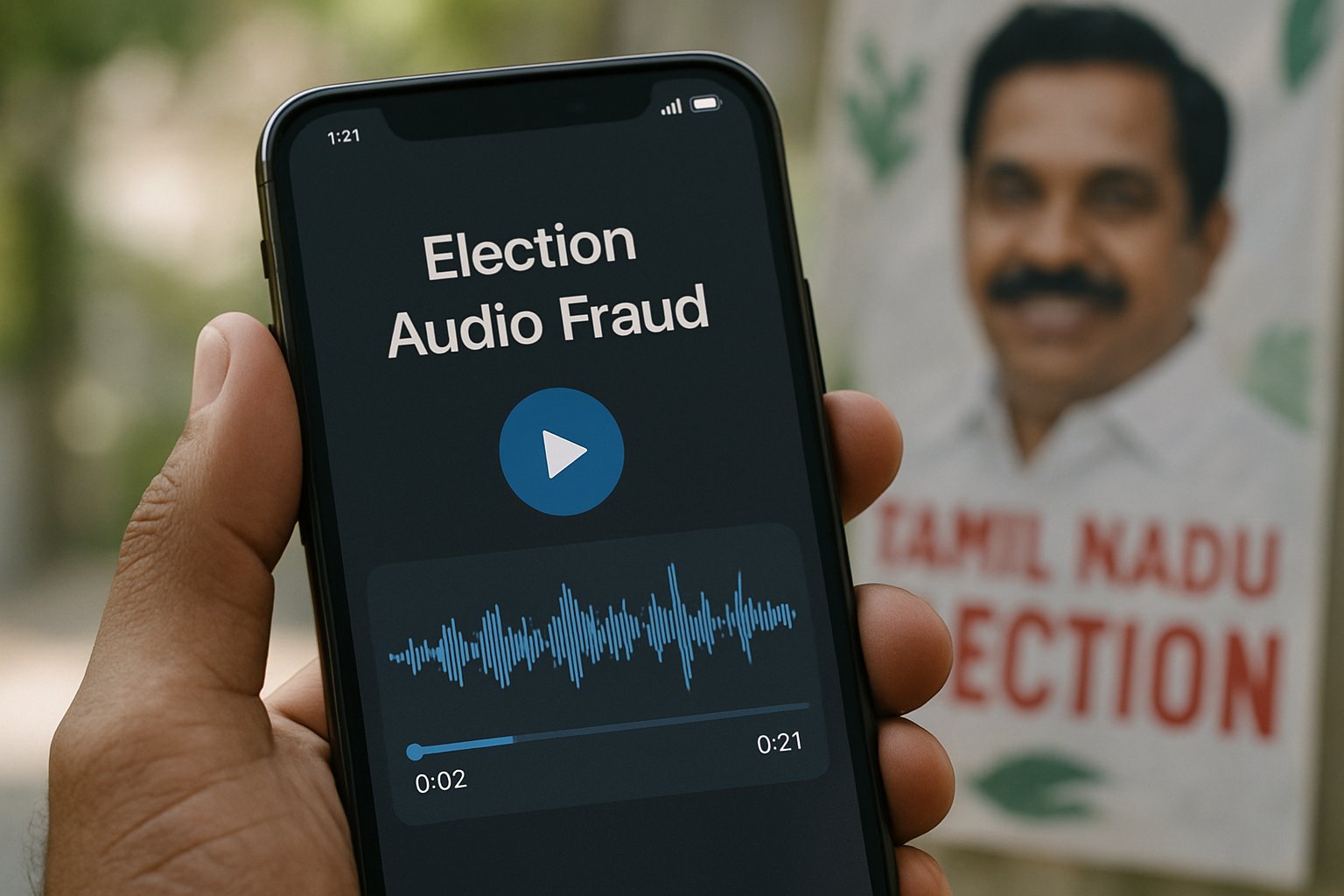
Crisis Sparks Verification Drive
Investigators first focused on provenance. Accordingly, A. Raja’s legal counsel requested YouTube remove the disputed upload and share metadata. They also demanded the channel preserve server logs for any future court review. In contrast, platform spokespeople have not publicly confirmed receipt of the notice. A. Raja insisted on full transparency throughout the verification process.
Meanwhile, rival campaign offices continued circulating excerpts on messaging apps. Such rapid reposting complicates takedown efforts because mirrored copies outrun moderation. The emerging narrative of Election Audio Fraud tested verification pipelines. Consequently, security analysts compared waveform fingerprints, looking for AI synthesis artefacts or spliced transitions. No independent lab has yet released its conclusions.
These early steps illustrate the difficulty of authenticating contested recordings. However, the process creates a roadmap for future cases. Therefore, attention shifts to election rules.
Regulatory Context Quickly Emerges
India’s Election Commission issued synthetic media advisories in late 2025. Regulators designed the 2025 guidelines precisely to deter Election Audio Fraud during campaigns. The rules mandate labels on AI content covering ten percent of any frame or announced within initial audio. Moreover, parties must archive original files and disclose creation methods upon request.
Consequently, failures can trigger notices under the Model Code of Conduct or even criminal prosecution. However, enforcement capacity remains limited because hundreds of clips emerge daily during campaigns. Tamil Nadu officials therefore prioritise complaints that carry potential voter harm. Digital-era Politics now intersects directly with AI regulations.
Regulators built guardrails, yet bandwidth constraints hamper consistent application. Nevertheless, current guidelines still influence ongoing investigations. Subsequently, technical realities compound the challenge.
Deepfake Audio Presents Challenges
Academic studies show humans misidentify synthetic voices almost half the time. Furthermore, automated detectors fare only slightly better, especially with low bitrate social media copies. Experts told PolitiFact that audio is easier to clone than video because datasets are vast and models generalise well.
Consequently, malicious actors gain a double advantage. They can fabricate statements quickly, yet victims struggle to disprove authenticity. Election-era Politics therefore becomes a contest of verification speed. In contrast, even legitimate speakers risk scepticism when real words feel indistinguishable from synthetic lines. This paradox drives what scholars call the liar’s dividend.
Deepfake accessibility therefore lowers evidentiary confidence in Election Audio Fraud investigations. Meanwhile, the Tamil Nadu dispute exemplifies that uncertainty. Next, we examine the immediate political fallout.
Political Fallout Rapidly Intensifies
The clip’s explosive claims concerned private conversations about the late M. Karunanidhi’s final days. Therefore, Palaniswami portrayed the material as proof of wrongdoing at the top of DMK leadership. He vowed an inquiry if AIADMK returns to power.
A. Raja responded forcefully, calling the allegations “politically uncivilised and dishonest”. Moreover, he argued that circulating unverified audio undermines respectful Politics and amounts to Election Audio Fraud. Consequently, both parties intensified rhetoric during televised debates across Tamil Nadu constituencies.
These exchanges demonstrate how synthetic media can recalibrate campaign agendas overnight. Nevertheless, reliable detection remains essential to settle factual disputes. Therefore, we turn to the tool landscape.
Detection Tools Remain Lagging
Independent laboratories employ spectral analysis, phoneme consistency checks, and machine learning classifiers. However, Nature Communications research finds accuracy drops when audio is compressed or mixed with real speech. Additionally, open-source detectors must balance false positives because career reputations hinge on precision.
Professionals therefore recommend a layered workflow for any suspected Election Audio Fraud incidents. Collect original files, analyse metadata, run multiple classifiers, and compare expert reviews. Consequently, results yield probabilistic confidence scores rather than binary verdicts. That nuance often confuses public audiences craving definitive answers in heated electoral moments.
Technical assessments thus require transparency about uncertainty levels. In contrast, sensational headlines rarely capture that complexity. Subsequently, journalists must adopt strict processes.
Responsible Reporting Practical Steps
Newsrooms covering Election Audio Fraud should implement pre-publication checklists. Firstly, verify file provenance with hashed archives. Secondly, seek at least two independent forensic evaluations. Moreover, disclose methodological limitations so readers understand margin of error.
Editors must also remain vigilant about the liar’s dividend. Therefore, they should avoid amplifying baseless denials while evidence is still under review. In contrast, complete silence can allow Disinformation to flourish unchecked.
- Retain original upload URLs with timestamps
- Record chain of custody for each clip
- Publish confidence scores alongside verdicts
- Link to relevant Election Commission advisories
These steps increase accountability and preserve audience trust. Nevertheless, professionals should continue skills development. Consequently, certification pathways offer structured learning.
Certification And Next Steps
Professionals can enhance their expertise with the AI Foundation™ certification. The program covers synthetic media fundamentals, detection workflows, and ethical guidelines relevant to Election Audio Fraud investigations. Moreover, holders learn to communicate probabilistic findings clearly to legal teams and the public.
Looking ahead, Tamil Nadu voters will demand verifiable evidence before believing sensational recordings. Therefore, parties and platforms must collaborate on provenance infrastructure and rapid clarification channels. Additionally, civil society can pressure regulators to publish enforcement dashboards tracking Disinformation and Election Audio Fraud cases.
Capacity building and shared protocols will strengthen election integrity. Consequently, the final outlook now depends on transparent forensic disclosure. Finally, we recap the dispute’s broader lessons.
Election Audio Fraud in Tamil Nadu underscores a modern information arms race. Moreover, the episode reveals how deepfake accessibility, limited detection, and partisan incentives intersect. Nevertheless, coordinated verification, regulatory diligence, and professional upskilling can mitigate future shocks.
Therefore, readers should follow official fact-check channels, demand evidence before sharing, and pursue structured education. Professionals ready to confront synthetic media challenges can start by earning the linked AI Foundation™ credential today.
Disclaimer: Some content may be AI-generated or assisted and is provided ‘as is’ for informational purposes only, without warranties of accuracy or completeness, and does not imply endorsement or affiliation.


