

AI CERTS
3 months ago
Orbital Data Centers: SpaceX’s Bold Yet Contested Vision
Moreover, the filing requests sweeping waivers that could reshape future space regulation if granted. Consequently, industry observers see the docket as a watershed for commercial computing beyond the atmosphere. Meanwhile, executives tout massive energy savings, comparing orbital cooling advantages with Earth facilities like Microsoft Natick. In contrast, critics warn of glare, debris, and atmospheric harm that threaten scientific heritage. This article unpacks the proposal, the objections, and the uncertain economics powering the debate.
Mega Constellation Proposal Details
SpaceX’s FCC submission sketches the largest commercial satellite architecture ever conceived. The plan spans 500-2,000 km altitudes across sun-synchronous and mid-inclination shells. Each craft would carry solar arrays, radiators, and optical inter-satellite lasers to shuttle data at terabit speeds. Therefore, SpaceX argues the units can harvest uninterrupted power yet eject waste heat directly to space. Consequently, on-orbit racks could bypass land constraints and volatile water supplies facing terrestrial server farms.
SpaceX also requests Ka-band between 18.3-19.3 GHz downlink and 28.6-29.1 GHz uplink. However, the company seeks waivers from deployment milestones, surety bonds, and standard processing rounds. Such exceptions triggered immediate alarms because precedent matters deeply inside the Space Bureau. These regulatory flash points set the stage for the unfolding battle. Overall, the filing signals unprecedented scale. Next, we examine the scientific backlash.
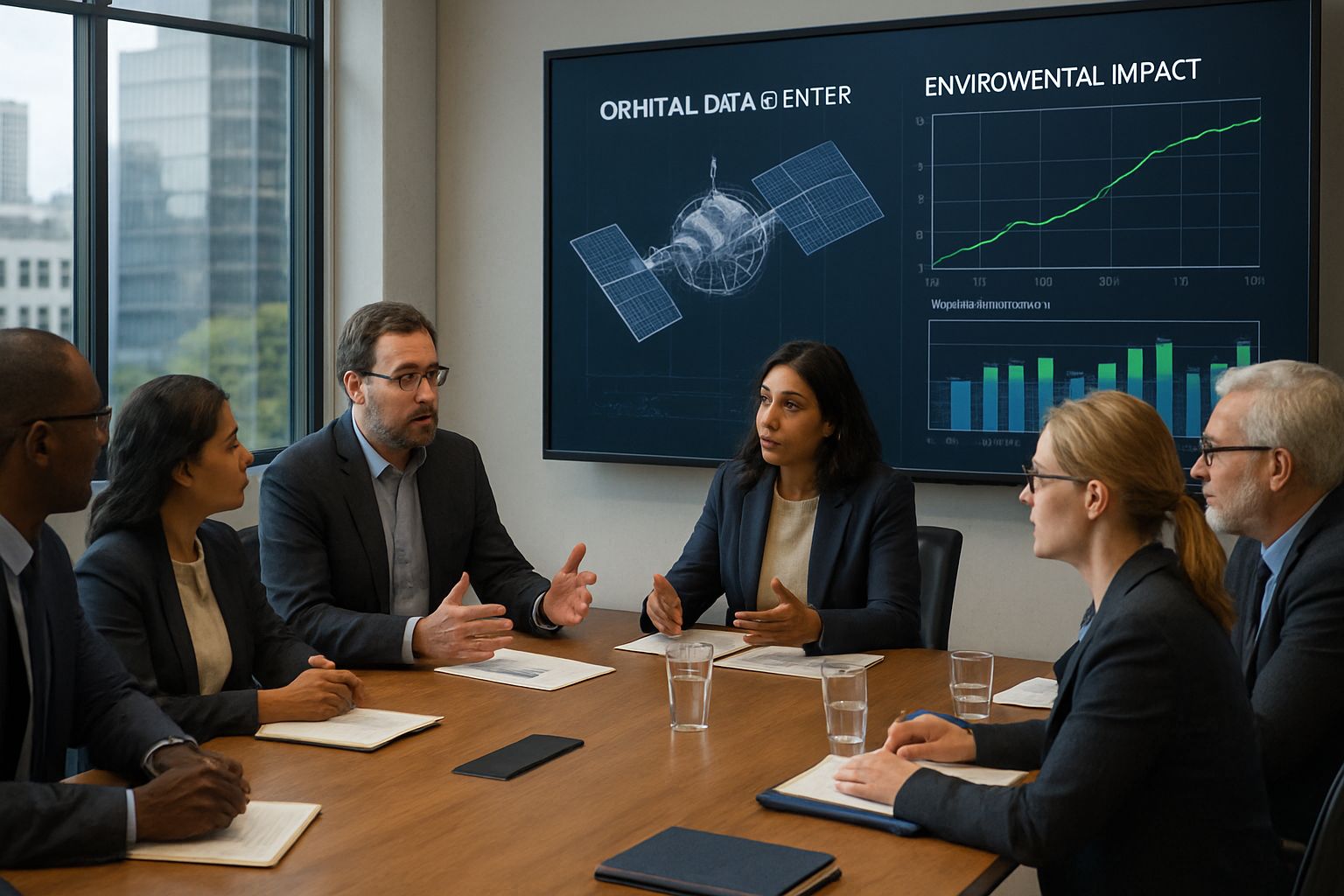
Pushback From Science Community
Astronomers formed the first major line of resistance. On 6 March, the American Astronomical Society filed a 64-page Petition to Deny. The document argues the planned constellation would saturate night images with tens of thousands of bright streaks. Moreover, sun-synchronous orbits keep panels illuminated during dusk, precisely when many telescopes observe faint phenomena. John Barentine stated the proposal feels like turning back hard-won dark-sky progress. Radio astronomers echo optical fears, warning that Ka-band energy could leak into protected research bands.
Consequently, the group asked the FCC to impose strict reflectivity, disposal, and collision-avoidance conditions. They also argued Orbital Data Centers threaten billions invested in national observatories. These scientific critiques gained sympathy across the docket, building momentum for further scrutiny. The objections spotlight major knowledge gaps. Moving forward, economic factors demand equal attention.
Economic Feasibility Questions Persist
Despite sky-high ambition, analysts remain divided on feasibility. ESPI models suggest unit economics demand launch prices below $400 per kilogram. Starship promises sub-$50 figures, yet consistent cadence remains unproven. Furthermore, radiation shielding, on-orbit servicing, and redundancy inflate capital outlays. Meanwhile, data egress poses limits because optical links still depend on ground gateways. In contrast, Microsoft Natick showed underwater modules can exploit natural water cooling and proximity to fiber backbones.
Those domestic prototypes house dozens, not millions, of servers, but provide a terrestrial benchmark. Consequently, Musk argues scale will invert costs once factories mass-produce Orbital Data Centers via Starship. Critical voices counter that economics crumble if launch tempo slips or demand lags. These open variables keep investors cautious, awaiting clearer milestones. Cost clarity will either unlock funding or freeze it. Environmental implications deserve similar rigor.
Environmental And Debris Risks
Large constellations carry cumulative environmental footprints rarely discussed in earnings calls. Peer-reviewed studies project thousands of tonnes of alumina and soot entering the stratosphere annually under high-launch scenarios. Moreover, re-entry ablation could slow ozone recovery, adding radiative forcing comparable to some regional emissions sectors. Climate scientists therefore want a NEPA-style review before any mass deployment. Space-traffic engineers also cite a higher probability of collision cascades, known as Kessler syndrome. Should even one percent of Orbital Data Centers fail, debris counts could spike dramatically.
Additionally, every dead satellite increases tracking load on ground radars already near capacity. These intertwined risks underscore calls for stricter disposal timelines and bonded deorbit funding. Consequently, regulators must balance innovation against planetary stewardship. Environmental math cannot wait until deployment. Competitive pressures, nonetheless, keep mounting.
Competitive And Policy Dynamics
Commercial rivals framed their objections in both technical and antitrust terms. Amazon’s Kuiper unit and Viasat warned the filing preempts scarce spectrum while hiding key engineering data. Nevertheless, FCC Chair Brendan Carr blasted Amazon’s petition, implying competitive sabotage. Meanwhile, Google and Blue Origin hint at separate orbital compute initiatives, seeking protective room to maneuver. Microsoft executives remain skeptical, noting customers still prefer ground colocation or regional projects like Microsoft Natick.
Consequently, policy deliberations now double as market positioning exercises for future space infrastructure. Orbital Data Centers therefore straddle telecom rules, trade policy, and industrial strategy. These political undercurrents complicate efforts to reach evidence-based conclusions. Policy jockeying may delay technical reviews. Technical barriers remain, as the next section shows.
Technical Barriers And Unknowns
Engineering realities still overshadow promotional rhetoric. Heat rejection demands radiator wings large enough to reflect significant sunlight and increase visible magnitude. Therefore, designs may clash with astronomers irrespective of coating technologies. Radiation hardening also reduces component density, cutting performance per kilogram. Furthermore, continuous power relies on flawless deployment of massive solar blankets susceptible to micrometeoroid damage. Subsequently, any tear could disable an entire computing module until costly servicing flights arrive. Cooling remains tricky because vacuum conduction is negligible, unlike water-based loops used on Earth.
SpaceX proposes passive radiative panels, yet on-orbit demonstrations at hyperscale are absent. Orbital Data Centers must also handle secure key management, firmware patches, and physical tamper resilience in uncrewed conditions. These factors add design unknowns, clouding schedule forecasts. Practical tests must validate each subsystem. Strategy now shifts toward coordinated milestone tracking.
Strategic Outlook And Steps
Investors, policymakers, and scientists now watch key milestones that could clarify viability. Consequently, several inflection points will likely unfold during 2026.
- FCC ruling on waiver requests, expected after March reply cycle, will determine immediate regulatory pathway.
- Starship demonstration flights must prove launch cost below $400/kg to support Orbital Data Centers economics.
- SpaceX promised brightness mitigation studies; publishing credible satellite models could calm astronomers.
- Independent audits comparing orbital power efficiency with Microsoft Natick prototypes will inform corporate purchasing decisions.
- Environmental modeling of launch emissions and debris will shape possible international standards.
Together, these checkpoints frame a roadmap for potential deployment. However, missed targets could stall momentum and send capital elsewhere. Consequently, stakeholders weighing Orbital Data Centers must track each milestone objectively. Outcome projections will shift weekly. The conclusion distills actionable insights.
The SpaceX proposal exposes profound tensions between ambition and stewardship. Astronomers fear losing dark skies, while Musk predicts orbital compute dominance. Regulators therefore face a precedent-setting decision with global ripple effects. Economic success hinges on Starship costs, reliable power generation, and resilient hardware. Meanwhile, ground innovations such as Microsoft Natick remind analysts that Earth still offers creative alternatives.
Nevertheless, many enterprises continue exploring Orbital Data Centers for specialized workloads requiring extreme scale. Professionals can enhance their expertise with the AI for Everyone™ certification. Act now to stay ahead as policies, markets, and orbits rapidly evolve.
Disclaimer: Some content may be AI-generated or assisted and is provided ‘as is’ for informational purposes only, without warranties of accuracy or completeness, and does not imply endorsement or affiliation.


