

AI CERTs
4 months ago
Regulatory Stagnation Warning as UK Delays AI Law
UK policymakers have triggered a fresh Regulatory Stagnation Warning by delaying the long-promised standalone AI Bill. Consequently, companies lack a single statutory framework just as frontier models race into production. Meanwhile, ministers promote sectoral regulatory sandboxes to sustain momentum and gather evidence for future lawmaking. Observers see opportunity in the experimental approach yet fear creeping uncertainty for investors and consumers. Moreover, delayed legislation may weaken global confidence in the United Kingdom’s governance leadership. This article unpacks the policy timeline, evaluates sandbox performance, and examines strategic implications for growth and innovation. Throughout, we track how businesses should prepare amid the continuing Regulatory Stagnation Warning. In contrast, the European Union and United States are pressing ahead with clearer statutory instruments and enforcement mandates. Therefore, executives must understand the divergence and adjust product roadmaps, compliance budgets, and hiring plans accordingly. The following sections provide a concise, evidence-based briefing designed for technical and commercial leaders.
UK Legislative Delay Context
June 2025 media reports confirmed ministers would push the standalone AI Bill beyond the next King’s Speech. Consequently, statutory powers for central oversight remain on hold until at least 2026. The Regulatory Stagnation Warning resurfaced each time leaders repeated their commitment without setting a firm date. Government officials argue the pause allows broader consultation on copyright and other contested issues. However, critics note that piecemeal guidance lacks teeth, leaving enforcement fragmented across sector regulators.
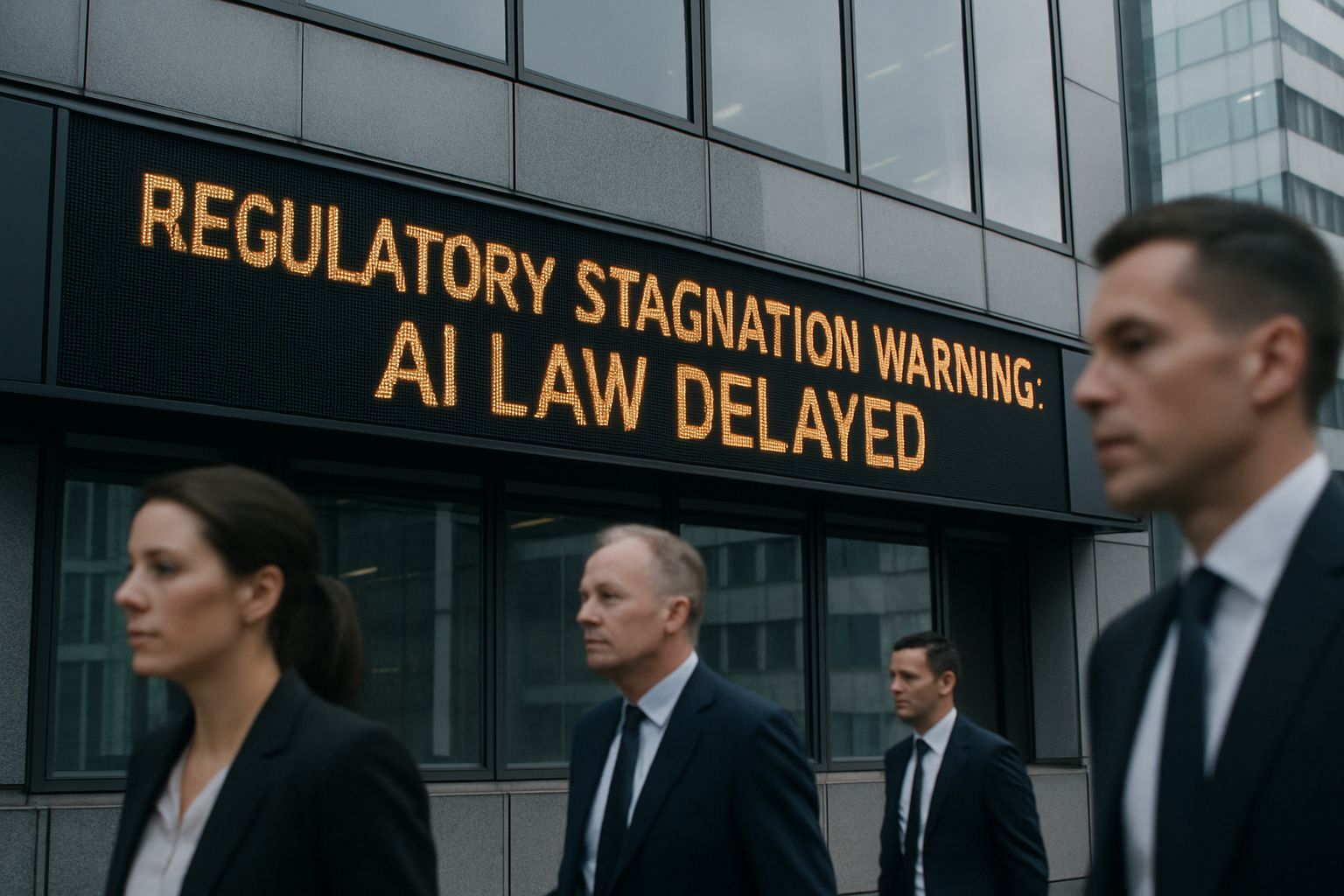
Current oversight relies on existing acts plus voluntary frameworks issued by bodies such as the ICO and FCA. In contrast, the planned comprehensive bill would embed binding risk classifications, reporting duties, and penalty mechanisms. Therefore, the delay creates parallel uncertainty for procurement teams evaluating high-risk deployments. Investors also flag valuation discounts where compliance costs are unknown.
Together, these factors sustain the present Regulatory Stagnation Warning for domestic and international capital. Nevertheless, policymakers hope targeted sandboxes will offset anxiety as we examine next.
Testbed Experiments Expand Rapidly
A regulatory sandbox grants controlled rule flexibilities so companies trial innovations under regulator supervision. DSIT describes the mechanism as a temporary switch-off for specific provisions, never for fundamental rights. Moreover, sandboxes promise faster evidence gathering, which officials claim accelerates policy refinement. This appeal explains why ministers doubled down on the model after shelving the bill. The Regulatory Stagnation Warning therefore coexists with an ambitious experimentation agenda.
- ~21% of UK firms currently deploy AI, according to government survey data.
- OECD modelling suggests productivity could rise 1.3 percentage points yearly, worth roughly £140 billion.
- MHRA Airlock Phase 2 runs until March 2026, covering additional clinical algorithms.
- DSIT consultation on the AI Growth Lab closes 2 January 2026.
Additionally, sector regulators continue operating their own pilots, from finance to communications. Consequently, corporate participants must navigate differing application forms and reporting standards.
Testbed breadth signals strong policy experimentation, yet governance fragmentation persists. Next, we drill into healthcare lessons that inform future designs.
AI Airlock Key Lessons
The MHRA launched the AI Airlock in Spring 2024 to evaluate AI as a Medical Device. Phase 1 involved twelve companies testing triage, imaging, and remote-monitoring tools. Subsequently, regulators published anonymised reports detailing performance metrics, bias checks, and post-market surveillance plans. Industry feedback praised rapid feedback loops and clear escalation channels. However, some startups found data-access negotiations with hospitals slow despite sandbox flexibility.
Phase 2, now underway, will produce guidance feeding directly into future medical device policy. Therefore, the Airlock illustrates how targeted pilots can de-risk clinical innovation while building public trust. The project also mitigates the broader Regulatory Stagnation Warning by showing tangible regulatory activity.
Healthcare testing proves sandbox value when governance is rigorous and transparent. Yet cross-sector scaling raises fresh challenges, as the following Growth Lab section shows.
Growth Lab Consultation Unfolds
DSIT’s blueprint, released 21 October 2025, outlines the cross-economy AI Growth Lab. The document seeks views on scope, governance, and immutable red lines. Moreover, it proposes either a single central unit or multiple regulator-led cells. Stakeholders must respond by 2 January 2026, influencing final design. Consequently, companies planning pilots should draft use-cases and resource forecasts now.
Several advantages motivate the proposal. First, a unified portal could simplify access, lowering entry barriers for small firms. Second, consolidated data flows would enhance comparative analysis across industries, driving evidence-based Policy refinement. Third, consistent terms may prevent forum shopping and reduce compliance friction. Nevertheless, critics warn that centralisation might slow decision cycles if bureaucracy swells.
Leo Ringer of Form Ventures called the plan “a strong signal of ambition to scale an AI business”. In contrast, civil society groups demand guarantees that consumer protections remain sacrosanct. Therefore, DSIT faces a delicate balancing act between Innovation velocity and societal safeguards.
The consultation phase offers a rare window to shape national strategy amid the continuing Regulatory Stagnation Warning. Next, we examine how industry and public stakeholders perceive that opportunity.
Industry And Public Reactions
Businesses mostly welcome sandbox expansion because predictable pathways accelerate product Growth and funding rounds. David Wakeling of A&O Shearman lauded the agile approach that removes “red tape where it serves no purpose”. Investors echo that sentiment, arguing the environment strengthens the UK’s competitive edge. However, union representatives highlight potential labour displacement without firm retraining programs. Consequently, pressure mounts for integrated skills Policy alongside technical standards.
Consumer advocates raise transparency concerns, especially for opaque algorithmic decision tools in welfare and credit scoring. Scott Singer at Carnegie Endowment observed that the UK positions itself “between the US and EU” on regulatory intensity. In contrast, some lawyers argue the Regulatory Stagnation Warning understates ongoing sector enforcement powers. Nevertheless, fragmented oversight complicates holistic risk assessments for multinational deployments.
Stakeholders agree experimentation adds value, yet demand clarity on final statutory direction. The next section explores how to balance opportunity with systemic safeguards.
Balancing Risk And Opportunity
Effective governance must weave together sandbox insights, existing statutes, and forthcoming legislation. Moreover, coordination between DSIT, MHRA, FCA, and Ofcom will prevent overlapping or contradictory guidance. Consequently, the Central AI Risk Function, once launched, could harmonise threat modelling across sectors. Professionals can enhance their expertise with the AI Security Level 1 certification. Such training builds internal capacity to navigate Innovation cycles while meeting evolving compliance duties.
- Create an inventory of AI systems and map associated regulations.
- Engage in the Growth Lab consultation with concrete sandbox proposals.
- Allocate budget for security certification and ethics training.
- Monitor legislative updates and adjust risk registers quarterly.
Additionally, boards should appoint cross-functional teams to oversee pilot participation and handle public communication. Therefore, proactive governance mitigates reputational shocks when the Regulatory Stagnation Warning materialises in headlines.
Combined technical and organisational measures let firms innovate responsibly despite shifting rules. The final section outlines immediate next steps for diverse stakeholder groups.
Next Steps For Stakeholders
Executives should finalise consultation submissions before the January deadline to influence sandbox design. Meanwhile, compliance leads must review existing legal obligations to avoid assuming leniency where none exists. Developers ought to embed privacy-by-design principles, reducing retrofit costs once the comprehensive bill arrives. Academics and NGOs can publish impact studies, enriching evidence for balanced Policy decisions.
Regulators themselves need robust data infrastructure to compare sandbox outcomes across industries. Moreover, they should publish evaluation metrics promptly, sustaining trust and accelerating Innovation diffusion. Consequently, transparent dashboards could transform the present Regulatory Stagnation Warning into a confidence signal. International partners will watch results closely, benchmarking their own frameworks.
Timely, coordinated action can convert legislative delay into a learning advantage. Ultimately, the nation’s digital competitiveness depends on moving from warning to resolution.
Conclusion And Forward Action
The UK’s AI governance journey now straddles prolonged legislative drafting and energetic testbed exploration. Consequently, organisations face a dual mandate: innovate quickly yet prepare for eventual statutory alignment. We highlighted the AI Airlock and proposed Growth Lab as pragmatic testing models. Moreover, actionable steps covered security, compliance, and strategic planning. Throughout, the Regulatory Stagnation Warning provided a lens for balancing risk and opportunity. Explore the linked AI Security Level 1 credential today and guide your team through the evolving landscape.
Disclaimer: Some content may be AI-generated or assisted and is provided ‘as is’ for informational purposes only, without warranties of accuracy or completeness, and does not imply endorsement or affiliation.


