

AI CERTS
11 hours ago
Matrix eVTOL sets 5-ton benchmark for flying taxis
Consequently, industry analysts view the sortie as proof heavy platforms can leave the test bench.
Moreover, the 10-passenger configuration expands potential revenue models beyond short urban routes.
However, certification hurdles and infrastructure gaps remain daunting.
This article dissects the aircraft's design, regulatory path, and commercial prospects.
Furthermore, it evaluates what the breakthrough means for global competitors and investors.
Professionals seeking deeper insight can also validate skills through the linked AI security certification.
Matrix eVTOL Size Leap
Firstly, scale defines the Matrix eVTOL narrative.
The aircraft weighs 5.7 tonnes at maximum takeoff, almost triple many Western prototypes.
In contrast, leading American designs target four to six seats and lighter footprints.
AutoFlight's triplane layout stretches 20 metres across the wings.
Meanwhile, length reaches 17.1 metres, with a height of 3.3 metres.
Developers believe bigger cabins drive lower per-seat costs by spreading energy and maintenance overhead.
Additionally, cargo variants can carry 1.5 tonnes or two standard containers, matching regional freighters.
These figures place the Chinese demonstrator in a new weight class.
The numbers underscore a decisive capacity leap over earlier multicopters.
Consequently, analysts foresee fresh mission profiles, leading naturally to cabin design considerations.
Design And Capacity
AutoFlight markets multiple cabin layouts to match diverse operator needs.
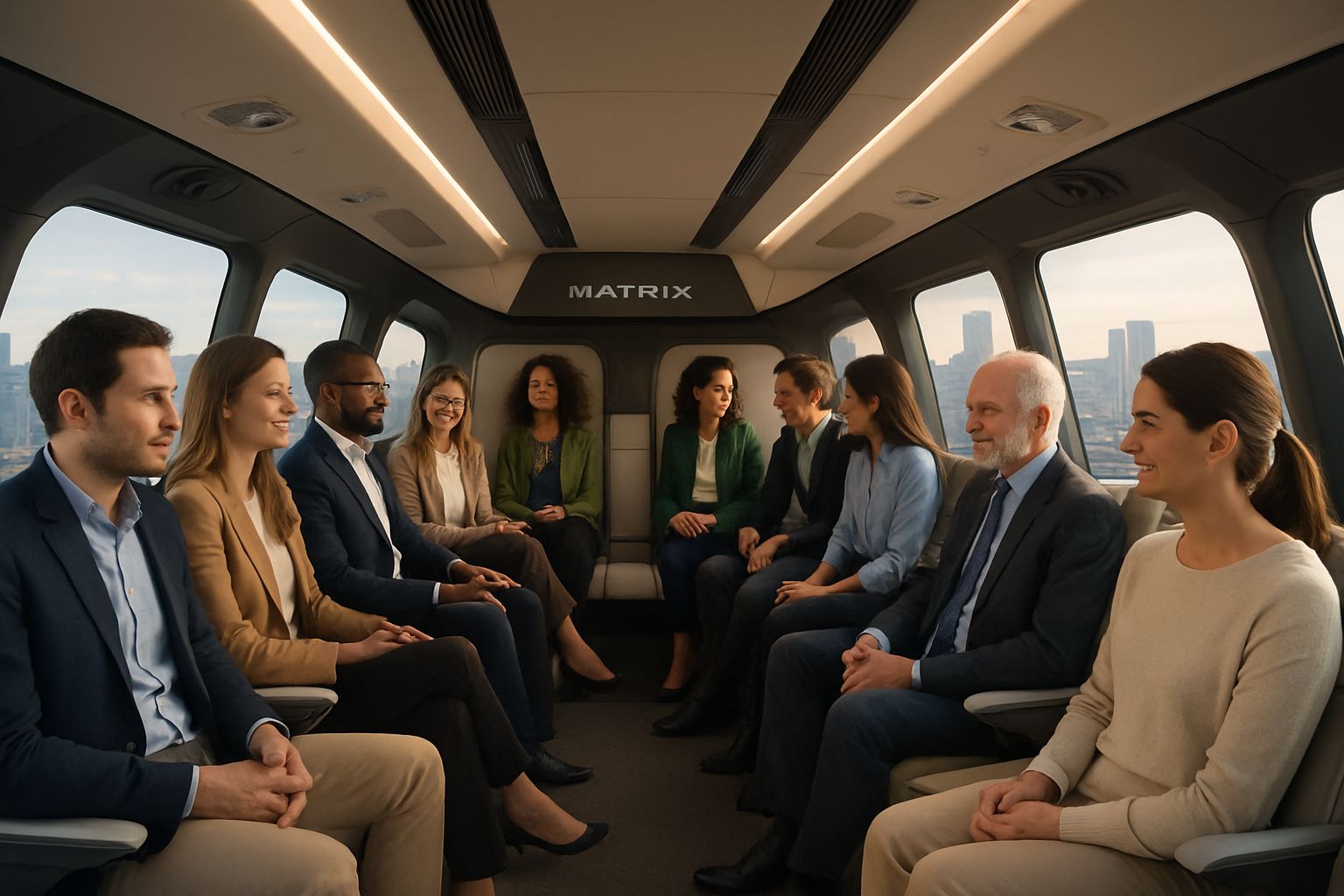
The baseline 10-passenger arrangement seats a pilot plus nine travelers in airline-style rows.
However, a six-seat VIP version sacrifices density for lounge comfort.
Moreover, business shuttle configurations promise quick swaps between cargo pallets and seats.
Lift comes from eight tilt propellers mounted on three wings, while two pusher propellers provide cruise thrust.
Consequently, transition happens within seconds, minimising energy burn during mode shift.
Matrix eVTOL flight control software coordinates propeller pitch, battery discharge, and aerodynamic surfaces.
Engineers claim redundancy across power channels equals or exceeds twin-engine helicopter standards.
Nevertheless, independent validation will determine whether promised safety margins hold under line operations.
Cabin flexibility and redundant systems strengthen the commercial pitch.
Subsequently, attention turns to how far the platform can travel per charge.
Range And Powertrain
AutoFlight quotes a 250-kilometre electric range for the current prototype.
Therefore, most metropolitan flights fall easily within that envelope.
In contrast, the proposed hybrid variant could reach 1,500 kilometres according to company slides.
That figure, if verified, would outstrip many turboprop commuter aircraft.
However, hybrid propulsion introduces fuel tanks, turbines, and extra certification complexity.
Battery partner CATL provides cells said to deliver high energy density and fast charging.
Meanwhile, analysts stress the need for cycle-life data under repeated rapid-charge schedules.
Matrix eVTOL engineers have not yet published peer-reviewed performance reports.
Consequently, regulators will demand exhaustive evidence before approving revenue flights.
- Electric range: 250 km
- Hybrid range: 1,500 km
- Demonstration flight: ~15 minutes
- Payload capacity: 1.5 tonnes
These statistics sound impressive at first glance.
Nevertheless, sustained performance under commercial duty cycles remains the definitive proof point.
Certification agencies will probe those metrics in the coming years.
Certification Road Ahead
The Civil Aviation Administration of China issued draft powered-lift rules in late 2025.
Consequently, AutoFlight hopes to gain a type certificate around 2027.
Nevertheless, that timeline excludes operator approvals, maintenance programs, and pilot training courses.
International validation with FAA or EASA could add several more years.
Furthermore, hybrid versions would trigger separate testing campaigns covering fuel systems and emissions.
Matrix eVTOL program managers must also demonstrate continued safe flight after component failures.
In contrast, smaller eVTOL rivals plan parallel certification paths but with lighter airframes.
Therefore, the heavy platform will likely face additional structural and loads analysis.
Professionals can deepen regulatory knowledge through the AI Security Level-1 certification.
These lessons highlight the importance of documented safety cases.
Consequently, regulators remain the ultimate gatekeepers for any China taxi ambitions.
Market forces, however, also shape deployment prospects.
Market And Investment
China's low-altitude economy policies strongly support domestic urban and regional air services.
Moreover, the government promotes pilot corridors linking Shanghai science zones with surrounding cities.
CATL's strategic investment, reportedly worth hundreds of millions, supplies batteries and financial stability.
Consequently, investors interpret the move as validation of long-term demand for heavy eVTOL logistics.
AutoFlight argues its 10-passenger model offers lower seat-kilometre costs than comparable helicopters.
Meanwhile, analysts warn that utilisation rates and energy prices ultimately dictate margins.
In contrast, foreign competitors like Joby and Archer focus on lighter urban shuttles.
Therefore, the Matrix eVTOL may complement, rather than replace, those services on regional corridors.
Cities marketing themselves as China taxi pioneers must invest in vertiports, charging hubs, and noise studies.
These capital requirements could delay profitable operations despite strong passenger curiosity.
Financial momentum appears solid but not unconditional.
Consequently, technical milestones must convert swiftly into scalable business models.
Operational hurdles present the final strategic question.
Challenges And Outlook
Noise, public acceptance, and airspace integration remain unresolved for every emerging platform.
However, reports suggest the demonstrator sounded quieter than conventional helicopters during the Shanghai event.
Nevertheless, communities will demand rigorous environmental assessments before approving frequent flights.
Battery supply chains also face geopolitical scrutiny, especially for aircraft exported beyond China.
Furthermore, bilateral certification agreements determine whether China taxi services can launch overseas.
Matrix eVTOL advocates argue scale unlocks new regional links for 10-passenger groups, medical teams, or cargo.
In contrast, sceptics predict slower adoption given infrastructure and cost uncertainties.
Consequently, the next 24 months will test which narrative prevails.
Technical progress alone will not guarantee market dominance.
Therefore, continuous stakeholder engagement becomes critical as the roadmap unfolds.
The February demonstration proved the Matrix eVTOL can manoeuvre smoothly from hover to cruise despite its mass.
Moreover, its 10-passenger layout hints at lucrative regional shuttles beyond city centres.
However, certification timelines, battery physics, and vertiport investments still dictate when travellers board for real.
Consequently, investors and regulators will scrutinise every data point gathered during upcoming flights.
Meanwhile, CATL's backing and supportive Shanghai policies keep momentum rolling.
Professionals tracking the China taxi market can strengthen technical acumen through the earlier linked certification.
Therefore, watch the Matrix eVTOL program as a barometer of heavy electric aviation's promise.
Explore the certification path and stay engaged with our future analyses.


