

AI CERTs
2 months ago
Neuralink Trial: UK Patient Calls Brain Chip ‘Magical’
Sebastian Gomez-Pena, a 22-year-old medical student, stunned viewers last week. He moved a computer cursor using only thought. The demonstration emerged from the Neuralink Trial at University College London Hospital. Consequently, headlines hailed the moment as historic for invasive brain technology. Meanwhile, researchers stressed that rigorous science must still follow the hype. This piece unpacks the study’s progress, surgical details, benefits, and unanswered questions. Furthermore, it places the UK experiment within Neuralink’s broader global program.
Study Breakthrough Moment Unveiled
Seven UK volunteers now hold the N1 implant, according to UCLH. Moreover, surgeries occurred between October and December 2025. The hospital calls the effort GB-PRIME, a feasibility arm of the worldwide Neuralink Trial. Reuters reported that 21 participants are enrolled across all sites. In contrast, earlier public numbers were far lower. Therefore, the pace of recruitment appears to be accelerating.
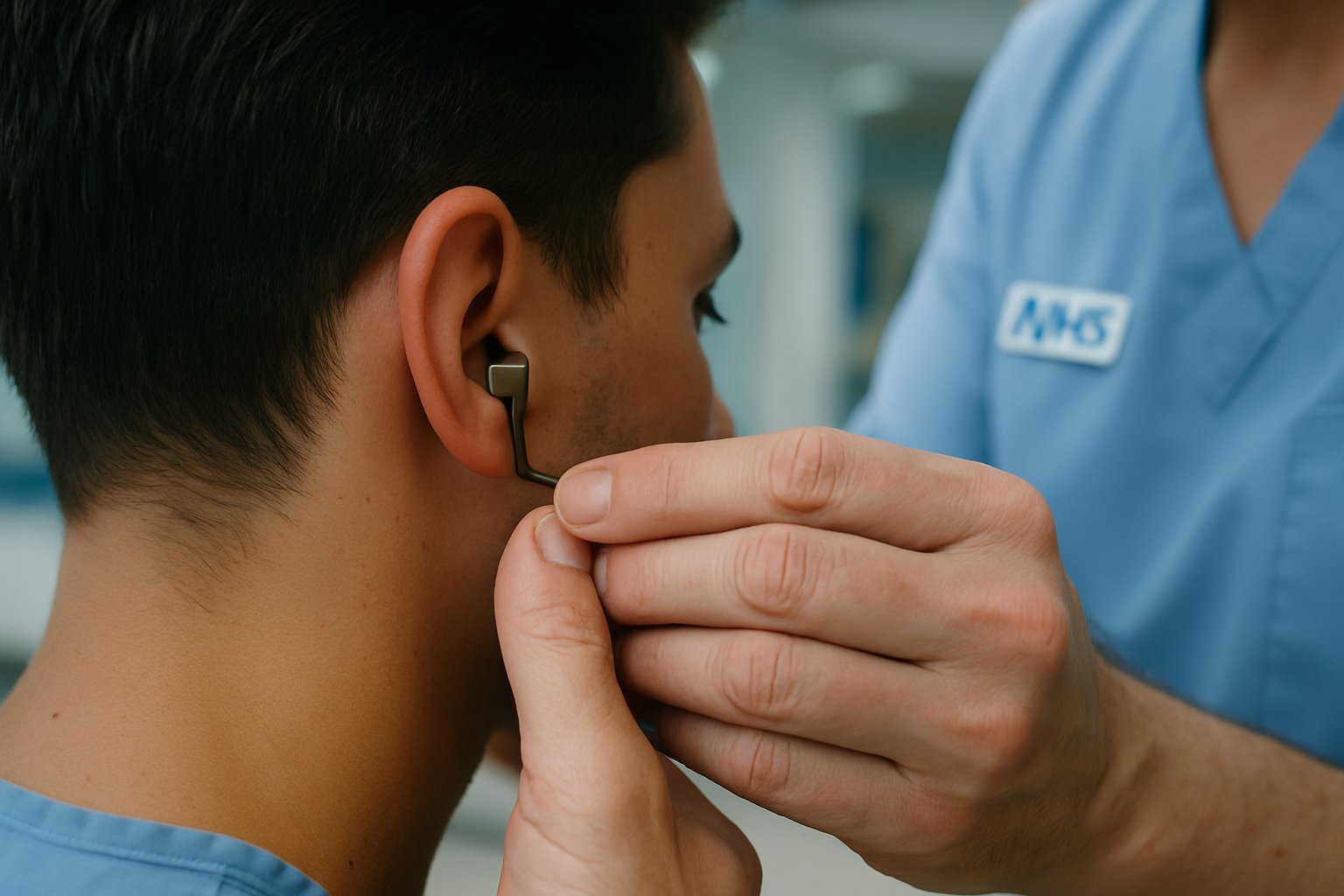
Engineers meet patients weekly to refine decoder software. Subsequently, each participant practices cursor control, typing, and phone navigation. Gomez-Pena described the experience as “magical.” Lead surgeon Harith Akram labeled the control “mindblowing,” underscoring professional excitement.
These milestones showcase functional success. However, long-term outcomes remain unpublished. Consequently, independent scientists still await peer-reviewed metrics.
Key Technical Specs
The N1 module sits flush within a skull recess. Additionally, over 1,000 electrodes on polymer threads record cortical signals roughly 4 mm deep. A dedicated R1 robot inserts each thread while dodging blood vessels. This precision reduces trauma and improves placement consistency.
The surgical robot’s five-hour procedure ends with a cosmetic closure. Eventually, wireless data reaches external decoders running adaptive machine-learning algorithms. As a result, imagined hand motions convert into cursor movements in real time.
Hardware sophistication fuels patient enthusiasm. Nevertheless, experts caution that signal longevity and immune responses still need hard data.
High Precision Surgery Explained
Neurosurgeons operate under MHRA, HRA, and NHS ethics approvals. Furthermore, strict screening ensures candidates withstand general anesthesia and cranial drilling. The Brain-Chip Interface threads penetrate soft cortex tissue at micron scales. Consequently, post-op imaging confirms accurate placement.
The table below summarizes core surgical parameters:
- Procedure time: approximately five hours
- Electrode count: about 1,024 channels
- Insertion tool: R1 stereotaxic robot
- Serious device adverse events: zero reported to date
UCLH staff report no deep infections so far. However, minor wound-care issues were noted, mirroring neurosurgical norms.
These data highlight surgical feasibility. Yet, durability across years must still be demonstrated. Therefore, extended follow-up is essential.
Surgical Workflow Overview
First, surgeons create a circular craniotomy. Subsequently, the robot aligns above exposed cortex. Each thread then enters tissue, avoiding surface vasculature. Finally, the titanium cap seals the recess, restoring skull integrity.
The streamlined workflow aims to standardize multicenter deployment. Nevertheless, only trained teams can replicate results safely.
Participant Experience And Impact
Gomez-Pena lost limb movement after a spinal injury. Additionally, he faced academic hurdles because typing required carers. After implantation, he now browses research articles solo. He said, “This technology gives you a new piece of hope.”
Other UK volunteers practice messaging friends and controlling smart-home devices. Meanwhile, UCLH therapists track independence gains with validated scales. Preliminary feedback indicates improved quality-of-life scores. Consequently, interest among spinal injury communities is rising.
These accounts personalize the Neuralink Trial. However, anecdotes cannot replace standardized outcome measures. Therefore, comprehensive metrics will be decisive for regulators.
Daily Training Sessions
Each morning, participants pair the implant with a tablet. Furthermore, a calibration game maps neural firing to on-screen targets. Iterative algorithms then fine-tune decoding curves. In contrast to external EEG systems, the intracortical approach offers higher signal-to-noise.
Training builds skill and software robustness simultaneously. Nevertheless, fatigue and motivation affect daily performance, requiring supportive coaching.
Global Enrollment Numbers Grow
Neuralink released an update on 28 January 2026. The company confirmed 21 subjects worldwide. Moreover, three continents now host implant centers. Consequently, data diversity should improve algorithm generalizability.
An expanded cohort also helps reveal rare complications. Additionally, statistical power increases for functional endpoints. The company stated, “Expansion helps us understand variations and improve hardware.”
Independent analysts welcome transparency about numbers. Nevertheless, they urge publication of adverse-event logs and performance distributions.
These developments evidence rapid scaling. However, structured reporting will determine scientific credibility going forward.
Recruitment Snapshot Today
• United Kingdom: 7 enrolled under GB-PRIME
• United States: 9 enrolled across two sites
• Canada and Spain: 5 combined, awaiting confirmation
Totals meet the 21-participant statement. Furthermore, additional sites plan applications with local regulators.
Potential Benefits Now Emerging
Early outcomes center on digital autonomy. Moreover, high channel counts promise finer motor decoding than legacy arrays. Possible future targets include speech restoration and robotic limb control. Consequently, investors view the platform as a versatile Brain-Chip Interface.
A recent survey of clinicians highlighted top anticipated gains:
- Independent computer use for paralysed individuals
- Hands-free smartphone access
- Adaptive wheelchairs with thought steering
- Robotic grasp devices for daily tasks
Professionals can enhance their expertise with the AI Robotics Certification. Additionally, structured learning helps teams translate lab breakthroughs into clinical workflows.
These benefits inspire optimism. Nevertheless, efficacy must persist as electrodes age. Therefore, implant longevity research remains vital.
Signal Fidelity Factors
Material biocompatibility reduces scar tissue formation. Meanwhile, machine-learning recalibration counters gradual signal drift. Furthermore, redundancy across 1,000 electrodes offers resilience if some channels fail.
Combined strategies aim to keep performance steady. Yet, peer-reviewed longitudinal data are still absent.
Risks Transparency Debates Persist
Nature and Guardian analysts cite limited peer-review output from the Neuralink Trial. Therefore, critics label the communications “science by press release.” Furthermore, chronic implant studies in primates showed thread retraction issues. Independent experts fear similar challenges in humans.
Ethicists highlight privacy concerns. Additionally, encrypted wireless links must resist hacking. In contrast, company statements emphasize security audits, yet technical details remain sparse.
Regulatory frameworks also lag. Consequently, lawyers debate data ownership of decoded brain activity. Meanwhile, patient advocates demand transparent governance structures.
These issues underscore non-technical hurdles. However, collaborative oversight could strengthen public trust.
Open Research Questions
1. Will electrode signals remain stable beyond five years?
2. How often will surgical revisions be required?
3. What standardized metrics best capture functional benefit?
4. How will insurers value invasive BCIs?
Addressing these queries will guide future adoption. Moreover, robust answers could influence reimbursement policies worldwide.
Future Outlook And Governance
UCLH plans quarterly follow-ups for every participant. Meanwhile, Neuralink engineers iterate hardware based on field data. Subsequently, the company may pursue CE and FDA approvals if endpoints are met.
Policymakers eye updated neurotechnology guidelines. Moreover, global standards could mandate independent data-safety boards. Developers would then share periodic summaries of adverse events and performance.
Industry watchers expect a peer-reviewed GB-PRIME paper within twelve months. Consequently, publication would either validate or temper current enthusiasm.
These steps mark the path toward mainstream use. However, careful governance must evolve in tandem with technical advances.
Stakeholder Action Items
• Researchers should preregister protocols and release anonymized datasets.
• Hospitals must train specialized surgical teams.
• Regulators could define clear implant explantation criteria.
• Investors need realistic timelines anchored in clinical data.
Coordinated action will decide the Neuralink Trial legacy. Additionally, transparent collaboration fosters sustainable innovation.
These challenges highlight critical gaps. However, emerging solutions are taking shape.
Conclusion
The Neuralink Trial delivers tangible wins, including thought-controlled computing and expanded enrollment. Moreover, high-precision robotics underpin impressive surgery outcomes. Nevertheless, transparency, safety, and long-term durability questions persist. Consequently, regulators and scientists press for peer-reviewed evidence. Meanwhile, professionals can prepare for neurotech integration through the linked certification. Explore advanced courses, contribute to ethical frameworks, and stay informed as the Brain-Chip Interface era evolves.


