

AI CERTS
2 months ago
HTC VIVE bets on open AI smartglasses
Moreover, the move follows the company's partial XR divestiture to Google earlier in 2025. Industry watchers see the announcement as a direct counter to Meta's closed strategy. In contrast, HTC promises users can switch between local VIVE AI and external GPT or Gemini models. This article unpacks the business rationale, technical architecture, and competitive stakes behind the initiative. It also examines privacy claims, market timing, and potential risks for enterprise buyers.
Global Market Surge Context
Global demand for smartglasses exploded during 2024 and 2025. Furthermore, Counterpoint logged a 110% shipment jump in the first half of 2025 alone. AI capable models represented nearly four fifths of that volume. Consequently, market value approached two billion dollars, according to several briefs. Meta held roughly seventy three percent share with its Ray-Ban line. Nevertheless, analysts predict room for challengers because compound annual growth could average sixty percent through 2029. Corporate IT teams are watching closely, expecting hands-free interfaces to augment field service and logistics workers. Meanwhile, regulators have started flagging data usage issues inside continuously recording wearables. These dynamics set the stage for alternative strategies. Therefore, HTC's forthcoming expansion beyond Asia must capitalize on momentum while easing compliance fears.
Shipments are rising fast yet privacy concerns remain unresolved. Consequently, differentiation now hinges on trust and flexible AI access, themes explored next.
HTC VIVE Strategy Explained
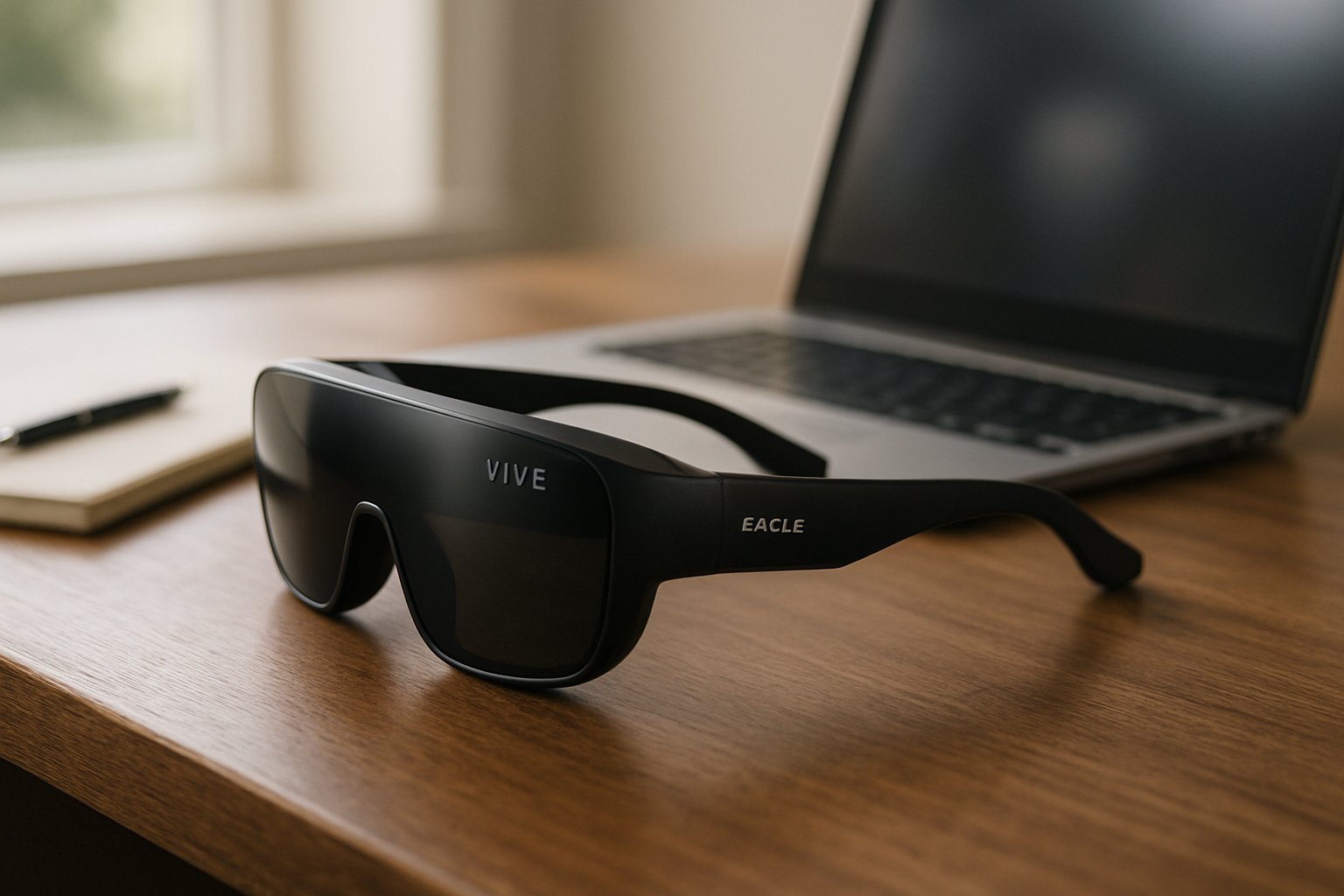
HTC frames Eagle as a gateway to multiple AI engines rather than a singular walled assistant. Additionally, the company labels the architecture an Open Platform, a term highlighting vendor neutrality. Under the hood, on-device VIVE AI handles simple commands for speed and battery efficiency. More complex prompts route anonymously to OpenAI GPT or Google Gemini, whichever the user selects. Consequently, buyers receive faster innovation without waiting for HTC to train massive language models. Charles Huang told Reuters, “We want to leverage different platforms instead of building a closed ecosystem.” In practice, provider choice appears inside the companion app as simple toggles and regional presets. HTC VIVE expects carriers to bundle preferred endpoints, especially where data governance rules vary.
The Open Platform pitch centers on freedom and future proofing. Therefore, early adoption will test whether choice outweighs the simplicity of closed rivals.
Hardware And Software Highlights
Beyond architecture, Eagle's hardware aims for everyday comfort. The frame weighs roughly forty nine grams and uses ZEISS optics. Moreover, a 12-megapixel ultra-wide camera captures HDR stills and 1512×2016 video at 30 frames. A 235 milliamp hour battery promises 4.5 hours of music or 36 hours standby. Fast charging magnets restore half capacity within ten minutes, keeping downtime minimal. Connectivity includes Wi-Fi 6E plus Bluetooth 5.3 for stable phone pairing. Onboard storage sits at 32 gigabytes, enough for 3,000 photos or fifty short clips. Meanwhile, VIVE AI models run locally, preserving response speed during network outages. HTC VIVE claims AES-256 encryption secures all local data.
- 49 g frame for all-day wear
- 12 MP camera with HDR capture
- 235 mAh battery, 10-minute 50% charge
- Wi-Fi 6E and Bluetooth 5.3 connectivity
- 32 GB local storage
These specifications match or exceed many current smartglasses alternatives. Consequently, hardware limitations are unlikely to undermine the broader Open Platform value proposition.
Privacy And Security Claims
Always-on cameras trigger scrutiny from regulators and consumers alike. HTC answers with local storage defaults, optional anonymization, and a visible capture LED. Additionally, requests moving to cloud models shed personal identifiers before leaving the device. The firm states that no data feeds any training pipeline.
Furthermore, VIVE AI is undergoing ISO 27001 and 27701 certification audits. Professionals can validate comparable knowledge. They may pursue the AI Security Level 1™ certification. Nevertheless, privacy advocates ask for external audits of anonymization algorithms and retention policies. Reuters also flagged jurisdictional complications where data localization laws restrict foreign model access. HTC VIVE needs transparent reports to convert skepticism into confidence. Therefore, successful audits could transform privacy into a decisive purchase factor.
Competitive Smartglasses Landscape Shifts
Meta's Ray-Ban lineup remains the shipment leader. However, the giant pursues a vertically integrated approach with proprietary Meta AI. In contrast, Xiaomi, TCL, and other Asian players chase budget niches. HTC VIVE positions itself between premium design and flexible AI routing. Consequently, telecom operators seeking white-label services may view the Open Platform favorably. Analysts from Counterpoint think regional alliances could carve share from Meta's dominance. Meanwhile, enterprise pilots in warehousing, healthcare, and manufacturing are testing multiple vendors concurrently. Success may hinge on app ecosystems, not only base hardware.
Competitors battle on integration depth and content partnerships. Subsequently, differentiation through openness will face pressure as incumbents evolve.
Risks And Future Outlook
Operating an Open Platform introduces complexity in user support and billing. Furthermore, inconsistent responses across GPT and Gemini could confuse mainstream buyers. Latency spikes from cloud routing may also affect real-time translation or navigation features. HTC reduced its XR headcount after the Google deal, raising execution concerns. Nevertheless, partnerships can ease staff constraints if integration frameworks stay robust. Regulatory headwinds remain, especially in markets with strict data residency mandates. Counterpoint still forecasts double-digit share for challengers by 2029, assuming timely global rollouts. HTC VIVE plans European and U.S. launches in 2026, though pricing is unconfirmed.
Growth opportunities exist but require flawless logistics and messaging. Consequently, the next 12 months will reveal whether openness converts curiosity into sales.
Key Takeaways And CTA
HTC VIVE has injected needed diversity into an increasingly crowded smartglasses arena. Moreover, the multi-model approach promises rapid feature evolution without locking buyers to one vendor. Analysts still caution that execution, privacy audits, and regional pricing will dictate long-term success. Consequently, early HTC VIVE deployments in Asia and follow-up launches in Europe and the U.S. warrant close observation. Enterprises evaluating hands-free AI should benchmark latency, encryption, and model switching ease. Professionals can deepen security expertise through the earlier linked AI Security Level 1™ program. Explore the certification today and stay ready for the smartglasses wave shaping 2026 workflows.


