

AI CERTS
1 hour ago
Yang AI Warning: Data, Risks, and Strategies for 2026
Such language once felt cinematic. However, recent layoff data and executive projections suggest the storyline may prove accurate. This report dissects Yang’s claims, balances them with counter evidence, and outlines response options. Consequently, leaders can separate durable signals from provocative headlines. Read on to gauge how generative AI could redefine the Economy and social fabric.
Moreover, discover certifications that prepare teams for the next wave. Start-ups tout speed gains while unions highlight algorithmic bias. Nevertheless, the debate now influences election platforms across several states.
Automation Pressure Mounts Fast
Corporate leaders raced to pilot generative tools during 2025 earnings downturns.
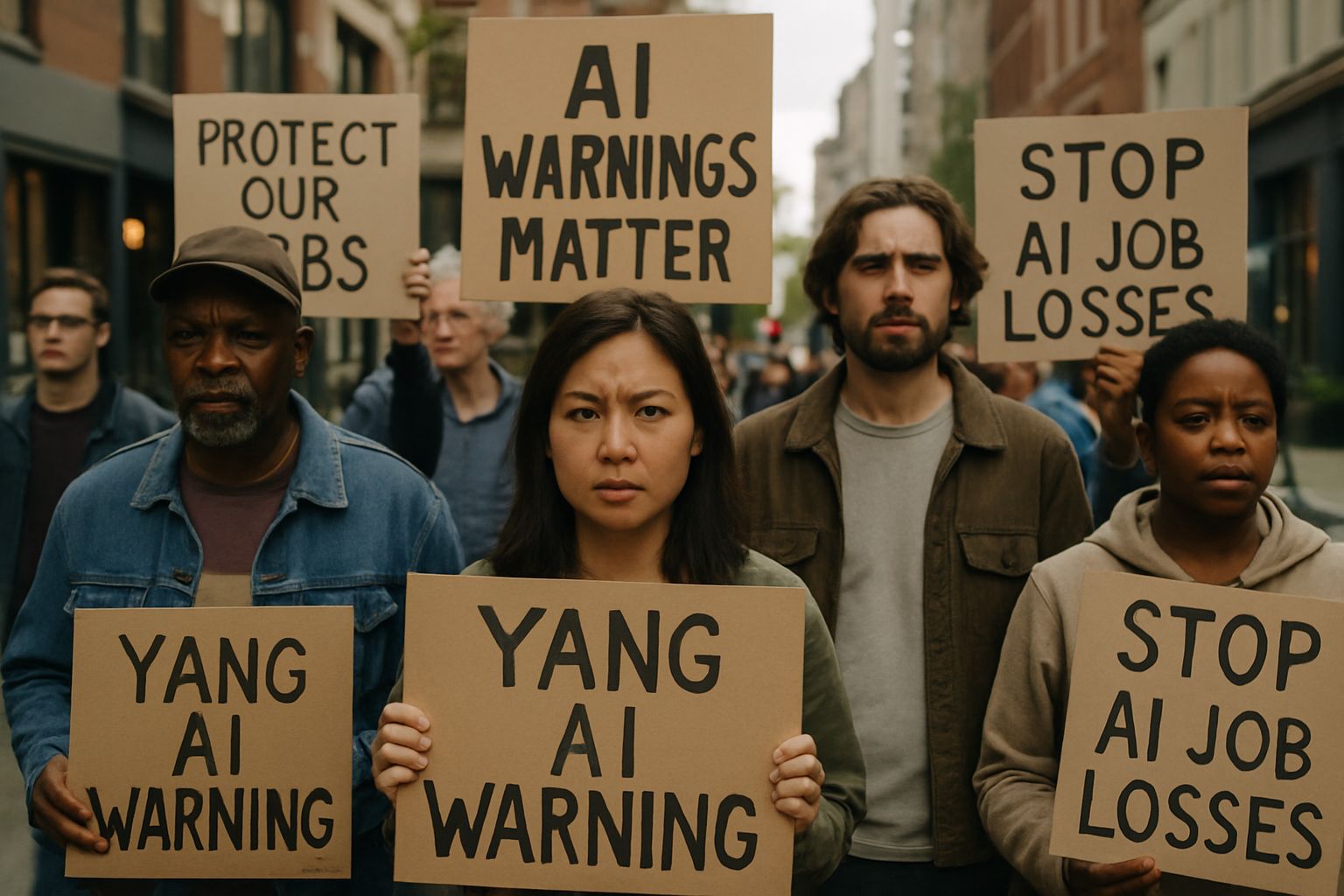
Consequently, many firms learned that drafting contracts, summarizing depositions, and producing marketing copy now requires fewer human hours.
Anthropic CEO Dario Amodei estimated that 50% of entry-level white-collar Jobs could vanish within five years.
Moreover, the IMF’s Kristalina Georgieva compared AI’s labour shock to a tsunami, warning of widespread Displacement across advanced economies.
The Yang AI Warning echoes that imagery, yet compresses the timeline to only 12–18 months.
In contrast, Forrester analysts argue adoption bottlenecks will slow that forecast, especially in regulated sectors.
Start-ups revealed pilot savings to investors, fueling stock surges that pressured slower incumbents.
Consequently, even risk-averse industries such as insurance accelerated internal chatbot deployments.
These projections reveal diverging speeds of change.
However, both sides accept that automation pressure is accelerating; the next section quantifies its scale.
AI Layoffs By Numbers
Challenger, Gray & Christmas counted roughly 1.2 million announced U.S. job cuts in 2025.
However, only about 54,000 cuts, or 4%, were explicitly attributed to AI technologies.
Skeptics cite that proportion when challenging the urgency inside each Yang AI Warning interview.
- AI-tagged cuts: 54,000 Jobs (4% of total)
- YouGov poll: 63% expect fewer Jobs ahead
- IMF estimate: 60% of roles affected across the global Economy
- Amodei forecast: 50% entry-level Displacement possible
Additionally, Tom’s Guide found media references to possible Riots tripled after Yang’s February article.
Consequently, investors monitor hiring disclosures for signs that the Yang AI Warning is converting into balance-sheet realities.
Numbers still tell a mixed story.
Nevertheless, perception often shapes policy; next we examine how Yang frames that risk.
Yang's Revolt Risk Context
Yang never typed “imminent AI riots” this year, yet his prose remains incendiary.
In 2019, he linked deep automation to “mass Riots,” recalling nineteenth-century labour flashpoints.
More recently, he warned of “ingredients for revolt” if soaring Displacement meets frayed safety nets.
Furthermore, the February Yang AI Warning predicted empty office towers spiralling into municipal budget crises.
He argued that collapsing downtown tax bases would ripple through the wider Economy, intensifying voter anger.
Subsequently, tech outlets adopted the catchphrase “imminent AI riots,” even without direct quotation.
Therefore, critics accuse journalists of exaggeration, yet the underlying anxiety mirrors previous industrial revolutions.
Nevertheless, repeated coverage has entrenched the Yang AI Warning inside public discourse.
Consequently, policymakers now reference the Yang AI Warning during committee hearings on unemployment insurance modernisation.
Meanwhile, labour organisers cite Yang’s rhetoric while demanding stronger collective bargaining rights for remote staff.
Additionally, several mayors floated pilot city dividends funded by local automation taxes.
The revolt narrative gained traction despite wording nuances.
Next, we contrast that narrative with measured economic models.
Competing Economic Impact Perspectives
Oxford Economics and Yale Budget Lab researchers track productivity metrics rather than headlines.
They note that AI-labelled layoffs still form a sliver of total Jobs churn.
However, they acknowledge that Displacement often accelerates after organisations complete pilot phases.
Moreover, historical data shows automation eventually spurs new industries, expanding the wider Economy.
Subsequently, Forrester introduced the term “AI-washing” to describe public relations spin surrounding routine restructurings.
Nevertheless, chief financial officers admit that branding a workforce shift as technological change calms shareholders.
In contrast, investors focusing only on the Yang AI Warning might overlook growth pockets like healthcare analytics.
Consequently, balanced planning demands stress tests for both contraction and expansion scenarios.
Economic models underline gradual transitions.
Yet corporate headlines remain powerful; the following section explores actionable safeguards.
Mitigation Strategies And Certifications
Companies cannot mute technological progress, but they can redirect talent quickly.
Additionally, continuous learning programs reduce skill gaps and lower riot risk drivers.
Professionals can enhance their expertise with the AI Cloud Strategist™ certification.
Moreover, local governments should pair reskilling grants with downtown revitalisation funds to protect the Economy.
Therefore, corporate planners referencing the Yang AI Warning should budget for redeployment pathways alongside automation budgets.
Meanwhile, transparent communication about forthcoming Displacement helps workers prepare rather than panic.
Consequently, early engagement may convert potential Riots into orderly negotiations.
In contrast, small businesses favour pooled talent exchanges rather than formal retraining pipelines.
Furthermore, civic groups experiment with portable benefit wallets that follow workers across gig platforms.
Proactive steps soften shocks.
Finally, we recap key insights and outline next moves.
Essential Takeaways Moving Forward
Generative AI is reshaping white-collar work faster than many expected.
However, the available data still paints an uneven picture.
Numbers confirm momentum, yet apocalyptic timelines remain contested.
The headline shorthand should not distract from tangible policy levers.
Consequently, leaders must track real layoff rates, fund reskilling, and test safety nets.
Moreover, professionals should pursue advanced certifications to stay relevant within evolving AI architectures.
Secure your competitive edge today; explore the certification link above and share these insights with your network.
Meanwhile, academic consortia will publish quarterly dashboards tracking actual automation outcomes.
Consequently, readers who monitor those dashboards will navigate uncertainty with clearer benchmarks.
Subsequently, government and industry collaboration will decide whether disruption becomes renewal.
Act early, learn continuously, and shape technology before technology reshapes you.


