

AI CERTS
3 hours ago
Workflow Orchestration Accelerates Agentic Support Automation
This article unpacks the 2025 surge, hard numbers, risks, and practical next steps. Moreover, it examines impacts on Customer Support and Back-office Finance teams. Readers will gain clear guidance for scaling agent fleets without losing governance. Finally, the piece links to a certification that elevates human oversight skills. However, adoption demands new metrics, security layers, and cultural change. In contrast, early adopters already report dramatic cycle-time gains. Therefore, understanding the landscape now pays future dividends.
Agentic Workflow Orchestration Rise
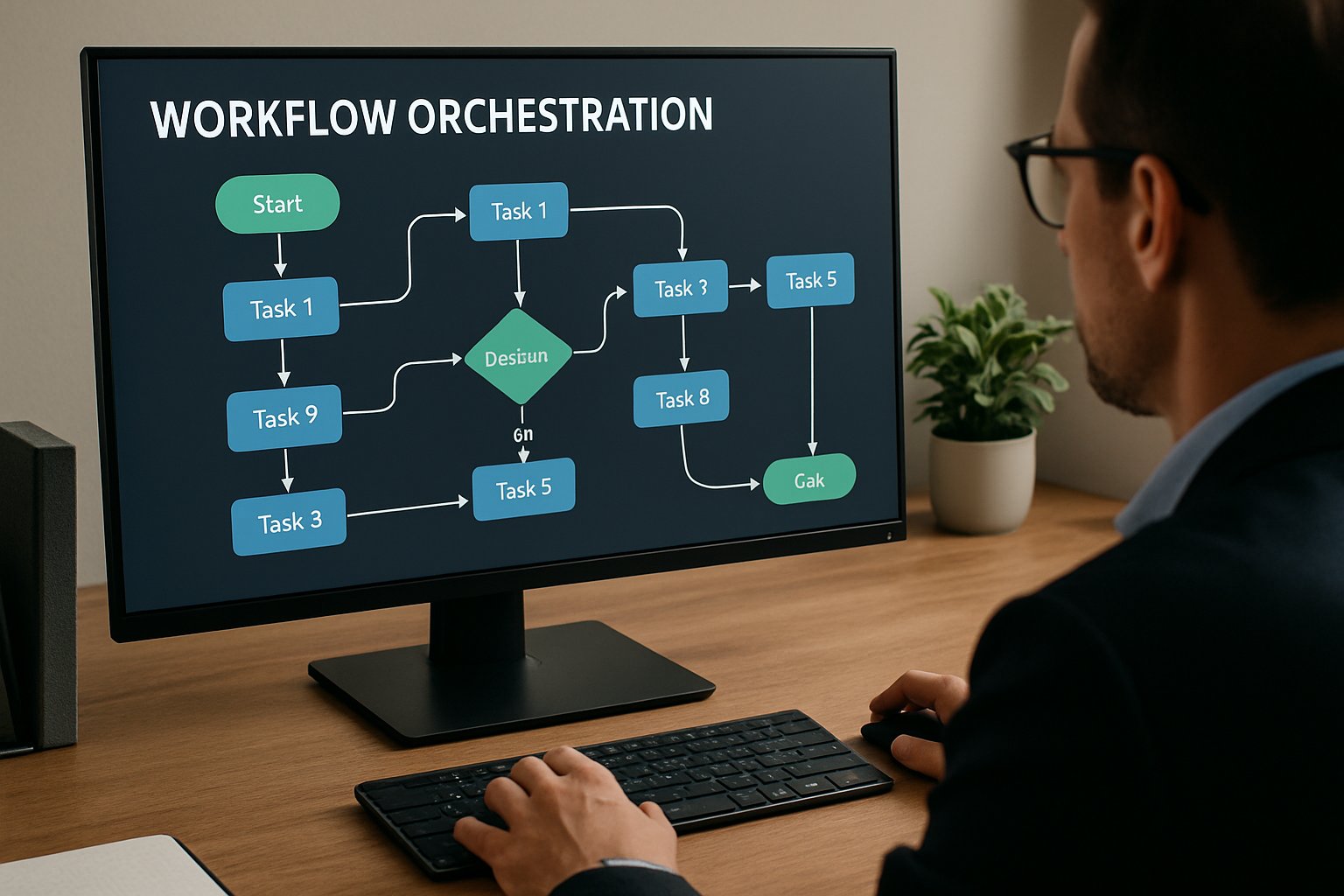
Enterprises moved from brittle RPA scripts toward goal-driven AI agents during 2024 and 2025. UiPath, ServiceNow, and Microsoft each launched control planes that supervise thousands of autonomous workers. Meanwhile, Gartner predicts 30% of network activities will be automated by 2026. Microsoft cites an IDC forecast of 1.3 billion agents by 2028. Such scale requires reliable Workflow Orchestration to avoid chaotic interactions.
Moreover, vendors highlight open APIs, observability, and rollback features that were absent in early RPA. Consequently, the conversation has shifted from "can we automate" to "how do we govern at scale". Agentic platforms now own the headlines, yet maturity varies widely. Nevertheless, market momentum appears irreversible; the next section quantifies demand drivers.
Market Forces And Data
Hard data backs the hype. Gartner sees half of day-2 network ops automated within twelve months. Furthermore, UiPath reported over 75,000 agent runs during its platform preview. McKinsey calculates multi-trillion-dollar productivity upside from agentic workflows across sectors. However, market sizing for agentic AI ranges wildly between research houses. Estimates for RPA alone stretch from $11 billion to $35 billion this year. Therefore, planners should benchmark definitions before locking budgets. Sound investment cases still center on disciplined Workflow Orchestration metrics like cycle time and exception rate.
- Gartner: 30% of enterprises will automate over half network tasks by 2026.
- IDC: 1.3 billion AI agents projected by 2028.
- UiPath: 75,000 agent runs recorded during preview.
- RPA market: $35 billion high forecast for 2026.
- McKinsey: Up to $4 trillion yearly productivity unlocked by agents.
- Fortune: RPA market CAGR remains above 30% through 2030.
These statistics prove accelerating demand yet reveal hazy valuation baselines. Next, we translate numbers into practical use cases.
Essential Enterprise Use Cases
Agentic systems already tackle three support domains at scale. First, AIOps agents triage incidents, restart services, and shorten downtime minutes. Secondly, Back-office Finance bots ingest invoices, match purchase orders, and reconcile ledgers continuously. Third, Customer Support chatbots escalate complex tickets and perform account updates across CRM stacks. Moreover, Oracle and SAP bake role-specific finance and HR agents directly into SaaS suites. ServiceNow pairs AI Agent Assist with Workflow Orchestration to route tasks across teams.
Consequently, case studies report double-digit percentage drops in handling time. Back-office Finance managers note fewer late-payment fees after agent ledgers flag anomalies instantly. Meanwhile, Customer Support centers show higher first-contact resolution. Use cases demonstrate clear wins when scope is well bounded. However, governance challenges remain, as the next section explains.
Governance And Security Pressures
Automation fails without trust. However, new attack surfaces threaten that trust daily. Researchers exposed prompt-injection exploits that turn agents into malicious insiders. Consequently, security teams now demand least-privilege identities, audit trails, and safe rollbacks. Microsoft positions Agent 365 as the single source of truth for agent fleets. Similarly, UiPath's Maestro oversees behavior, versioning, and Workflow Orchestration policies in one console. Nevertheless, analysts warn of a pilot-to-scale cliff when controls stay manual.
Effective Workflow Orchestration therefore links observability signals to automated kill-switches. Back-office Finance audits require immutable logs to satisfy regulators. Service interactions must mask sensitive data during agent steps. Governance gaps stall many projects before production cutover. Leading platform features now compete to address those gaps, as the comparison below shows.
Leading Platform Comparison Overview
Platforms differ along four vectors: model access, tooling depth, governance scope, and ecosystem reach. UiPath offers a low-code Agent Builder plus enterprise Maestro controls. ServiceNow embeds agents inside its Workflow Data Fabric, prioritizing ITSM and Customer Support scenarios. Microsoft integrates Copilot with Agent 365 for unified identity, telemetry, and policy. Moreover, Oracle and SAP push verticalized Back-office Finance templates and developer studios. In contrast, startups such as Fabrix focus strictly on observability and AgentOps.
Therefore, buyers must align platform strengths with their domain priorities and existing Workflow Orchestration layer. Feature matrices guide decisions, yet skill readiness ultimately determines success. The next section details talent and adoption pathways.
Skills And Adoption Pathways
Agent fleets need multidisciplinary teams, not only coders. Implementations demand prompt engineers, process analysts, security architects, and finance subject matter experts. Consequently, organizations create centralized automation centers for knowledge sharing and Workflow Orchestration standards. Reskilling remains urgent for contact-center supervisors transitioning to agent oversight roles. Finance leaders similarly learn to audit algorithmic decisions rather than post-hoc spreadsheets. Professionals can enhance their expertise with the AI+ Human Resources™ certification.
Moreover, such credentials signal governance literacy to compliance officers. Consequently, hiring managers increasingly screen resumes for accredited automation oversight credentials. In contrast, firms without training budgets face slower adoption curves. Skill programs close the talent gap and accelerate time-to-value. Finally, we summarize key insights and call readers to action.
Practical Enterprise Next Steps
Start small, then scale responsibly. First, map candidate workflows and quantify current cycle times. Secondly, instrument observability before deploying agents in Back-office Finance or Customer Support. Subsequently, define policy guardrails and automate enforcement using your chosen Workflow Orchestration layer. Finally, track agent ROI with standard KPIs such as time saved and error rate. These steps sustain momentum while containing risk. The conclusion recaps core messages and invites further learning.
Enterprises are rapidly moving beyond simple bots toward governed fleets of AI agents. Consequently, back-end and front-line teams already measure double-digit efficiency gains. Nevertheless, governance, security, and skills remain decisive success factors. Leaders should pilot safely, embed observability, and invest in continuous learning. Explore the linked certification to strengthen your oversight capabilities and keep your agents trustworthy. Moreover, early wins fuel executive sponsorship for expanding automation portfolios.


