

AI CERTs
5 months ago
Workflow Intent Recognition Engines Boost Enterprise Efficiency
Enterprise teams battle fragmented processes daily. Meanwhile, mounting customer expectations demand faster, error-free responses. Consequently, leaders look beyond conventional workflow tools for relief. Their attention now shifts to workflow intent recognition engines, an emerging AI layer. These engines translate natural language or events into orchestrated, cross-system actions. Furthermore, they promise smooth hand-offs between support, finance, IT, and network teams. Analysts foresee rapid adoption as vendors embed the capability across major platforms. However, confusion surrounds definitions, market size, and real-world maturity. This article clarifies the technology, market forces, benefits, and risk controls. Additionally, it offers a practical roadmap for enterprises ready to pilot intent-driven automation. Readers will also find links to recognized AI certifications for skills expansion. Consequently, understanding the ecosystem becomes a strategic imperative. The following analysis delivers that clarity in a concise, data-rich format. Prepare to explore technology foundations, market signals, and practical implementation guidance.
How Intent Engines Work
At the core sits an intent recognition layer built on NLU or LLM models. It classifies user input into a declarative goal plus required entities. Subsequently, a planning component decomposes the goal into discrete workflow steps. Therefore, orchestration services call APIs, RPA bots, or humans to complete each step.
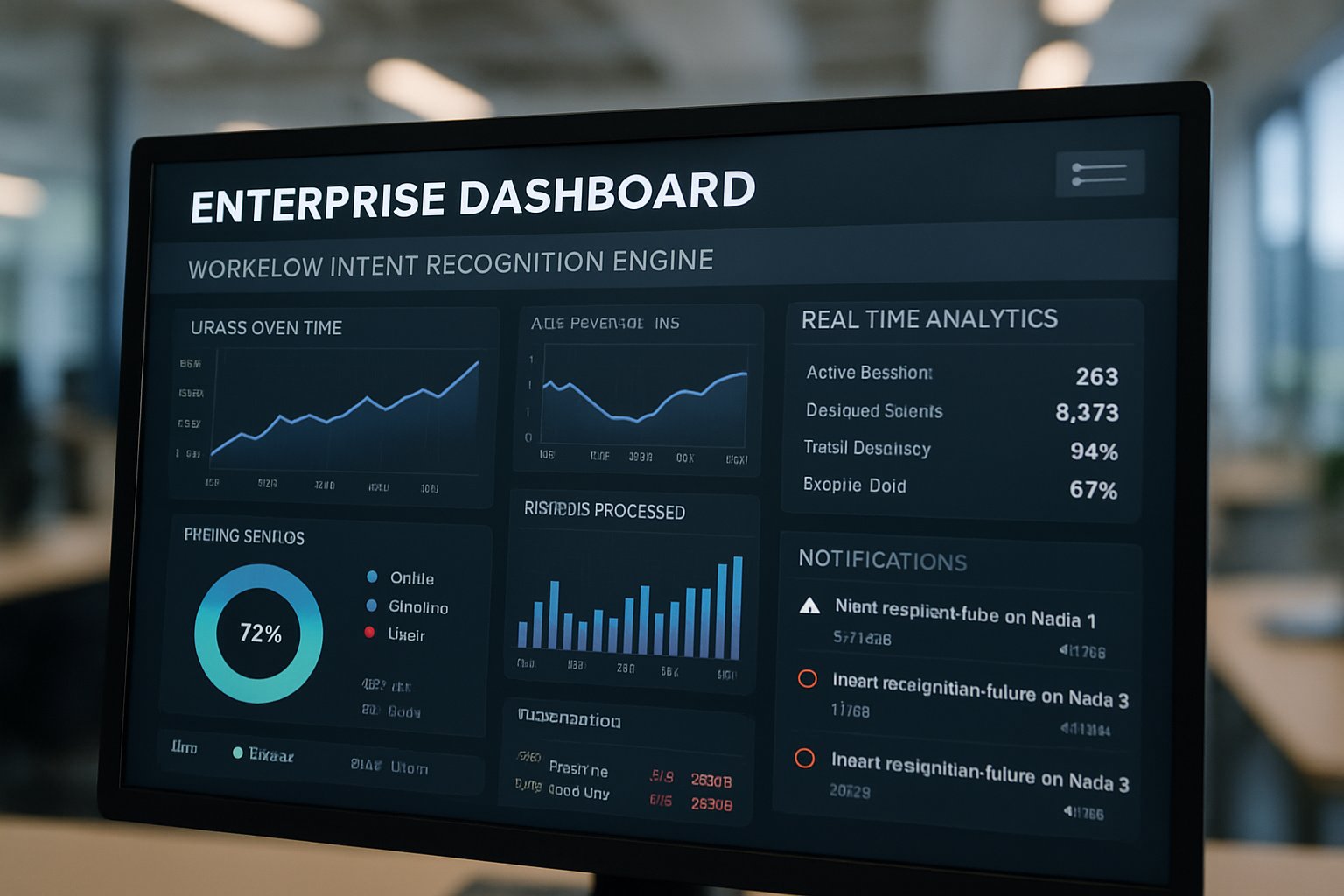
Microsoft, ServiceNow, and Salesforce have integrated similar pipelines into their platforms. Moreover, telecom vendors embed identical logic within autonomous network controllers. The combined stack now resembles workflow intent recognition engines rather than isolated bots. Consequently, organizations can trigger complex, multi-system flows from a single natural sentence.
For example, "refund order 1234" can launch CRM, finance, and logistics tasks automatically. This shift moves automation from task automation toward genuine goal fulfilment. Nevertheless, accurate intent detection remains essential to avoid costly misfires.
Additionally, human-in-the-loop checkpoints verify critical outcomes before irreversible actions proceed. This hybrid control model balances speed with compliance obligations in regulated sectors. Therefore, risk officers remain comfortable while teams accelerate delivery.
Intent engines connect language to action with remarkable speed. However, market momentum will determine their lasting impact.
Market Growth Outlook 2030
Market analysts see robust spending ahead. Mordor Intelligence sets the 2025 workflow automation market at $23.8 B. It projects growth to roughly $37.5 B by 2030, a 9.5% CAGR. Verified Market Research offers a similar trajectory, forecasting $45.5 B by 2032.
- 54% AI resolution at Zendesk enercity after agent deployment.
- 60% IT tools using AI agents by 2028, Gartner predicts.
- Process mining software seeing double-digit CAGR across vendors.
Collectively, these studies reveal strong confidence in intent-driven automation expenditure. In contrast, definitions vary, complicating a precise valuation of workflow intent recognition engines. Therefore, buyers should examine vendor scope before accepting headline numbers.
Process mining growth ties directly to rising intent initiatives because discovery illuminates automation candidates. Moreover, vendors bundle mining, mapping, and execution modules for end-to-end value. Customers favor suites that minimize integration overhead and license negotiations.
The market appears poised for sustained double-digit growth. Consequently, enterprise teams must plan budgets accordingly.
Cross Department Use Cases
Use cases now span customer support, IT, sales, and network operations. Zendesk detects refund intents and completes finance actions without human routing. Meanwhile, ServiceNow agents resolve access requests by integrating identity governance workflows.
Telecom operators declare latency objectives, and Ericsson controllers configure slices automatically. Additionally, Tray.ai links IT tickets with security approvals inside popular collaboration hubs. These scenarios show the shift from simple task automation to goal-based orchestration.
workflow intent recognition engines enable this breadth by abstracting business language from technical steps. Moreover, continuous monitoring feeds productivity intelligence dashboards, highlighting cycle-time savings.
Legal departments also benefit when discount approval intents auto-populate contract templates for review. Consequently, sales cycles shorten and revenue recognition accelerates. In contrast, manual routing previously introduced multi-day delays.
Real deployments already cut hand-off delays dramatically. However, benefits depend on disciplined governance, discussed next.
Benefits And Business Impact
Quantifiable gains emerge quickly when intents drive workflows. Enercity achieved 54% automated resolutions and 40% total automation within weeks. Consequently, support costs dropped while customer satisfaction improved.
workflow intent recognition engines accelerate cross-department throughput, shrinking cycle times by double digits. Furthermore, low-code interfaces broaden participation, reducing reliance on scarce developers. The engines also surface productivity intelligence, exposing hidden bottlenecks to managers.
Compared with isolated task automation, intent orchestration supports continuous optimization loops. Measurements feed dashboards, which drive iterative policy tuning and deeper automation. Therefore, organizations see compounding returns over time. Analysts expect workflow intent recognition engines to become core to digital operations suites.
Greater data consistency emerges because single sources of truth update in near real time. Moreover, routine metrics populate executive dashboards without additional extraction scripts. These secondary effects amplify the headline savings attributed to labor reduction.
The business case centers on faster service and richer insights. Nevertheless, unchecked agents can introduce new hazards.
Risks Require Strong Governance
Every autonomous system carries potential for error, bias, and abuse. Gartner warns that poorly governed agents may leak data or escalate privileges. In contrast, rigorous approval checkpoints reduce blast radius.
Security researchers demonstrate prompt injection attacks against workflow intent recognition engines. Moreover, ambiguous intents can misroute funds or expose sensitive records. Therefore, enterprises should restrict high-risk actions to supervised task automation components.
Adopting zero-trust policies and real-time auditing strengthens defenses. Additionally, continuous metrics feed productivity intelligence, enabling early anomaly detection.
Legacy approval chains often rely on email and spreadsheets that lack audit trails. Intent engines should instead log every action, parameter, and user decision centrally. Consequently, compliance teams can reconstruct events during investigations swiftly.
Governance turns potential liabilities into manageable risks. Subsequently, companies can scale adoption with confidence.
Enterprise Adoption Roadmap Guide
Successful programs begin with detailed process discovery. Process mining identifies high-volume intents and baseline performance. Consequently, teams prioritize automations with clear return.
Next, leaders craft an intent taxonomy and service-level objectives. Moreover, they embed guardrails such as least-privilege tokens and human approvals. Pilot projects often span two departments before full roll-out.
workflow intent recognition engines should integrate with existing orchestration and task automation layers. Professionals can enhance relevant skills through the AI Data Robotics™ certification. Finally, measure outcomes, refine models, and iterate quarterly.
Gradual scaling includes regional roll-outs, A/B controls, and controlled feature flags. Additionally, executive sponsors must communicate wins broadly to sustain momentum. Therefore, cultural adoption grows alongside technical deployment.
Disciplined roll-outs align technical ambition with business value. Meanwhile, maturity paves the way for future innovations.
workflow intent recognition engines are moving from hype to essential enterprise capability. They link natural language and analytics into cohesive, cross-department flow. Early adopters report dramatic efficiency gains alongside deeper operational insights. However, security and governance frameworks must mature in parallel.
Therefore, begin with measured pilots, clear guardrails, and ongoing process mining. Subsequently, scale once results validate investment and risk controls. workflow intent recognition engines will then underpin next-generation service delivery and customer experiences. Nevertheless, vigilant oversight ensures benefits outpace inevitable growing pains. Explore certifications, sharpen skills, and join the automation leaders shaping tomorrow.
Disclaimer: Some content may be AI-generated or assisted and is provided ‘as is’ for informational purposes only, without warranties of accuracy or completeness, and does not imply endorsement or affiliation.


