

AI CERTs
2 hours ago
Workers Protest over Military AI Contracts Intensifies
Tension between tech talent and the Pentagon reached a boiling point in late February 2026. Hundreds of engineers rallied behind Anthropic’s refusal to loosen guardrails on its Claude model. The latest Workers Protest signals a renewed determination to set ethical boundaries on military AI work. Consequently, leadership teams at Google, OpenAI, and other labs now face coordinated pressure from their own staff.
This article unpacks the standoff, the employees’ demands, and the potential industry fallout. Furthermore, we compare the present movement with earlier episodes such as Google’s 2018 Project Maven revolt. We also examine the government’s extraordinary threats, including Defense Production Act powers. Finally, readers gain actionable guidance and certification resources for navigating future AI ethics debates.
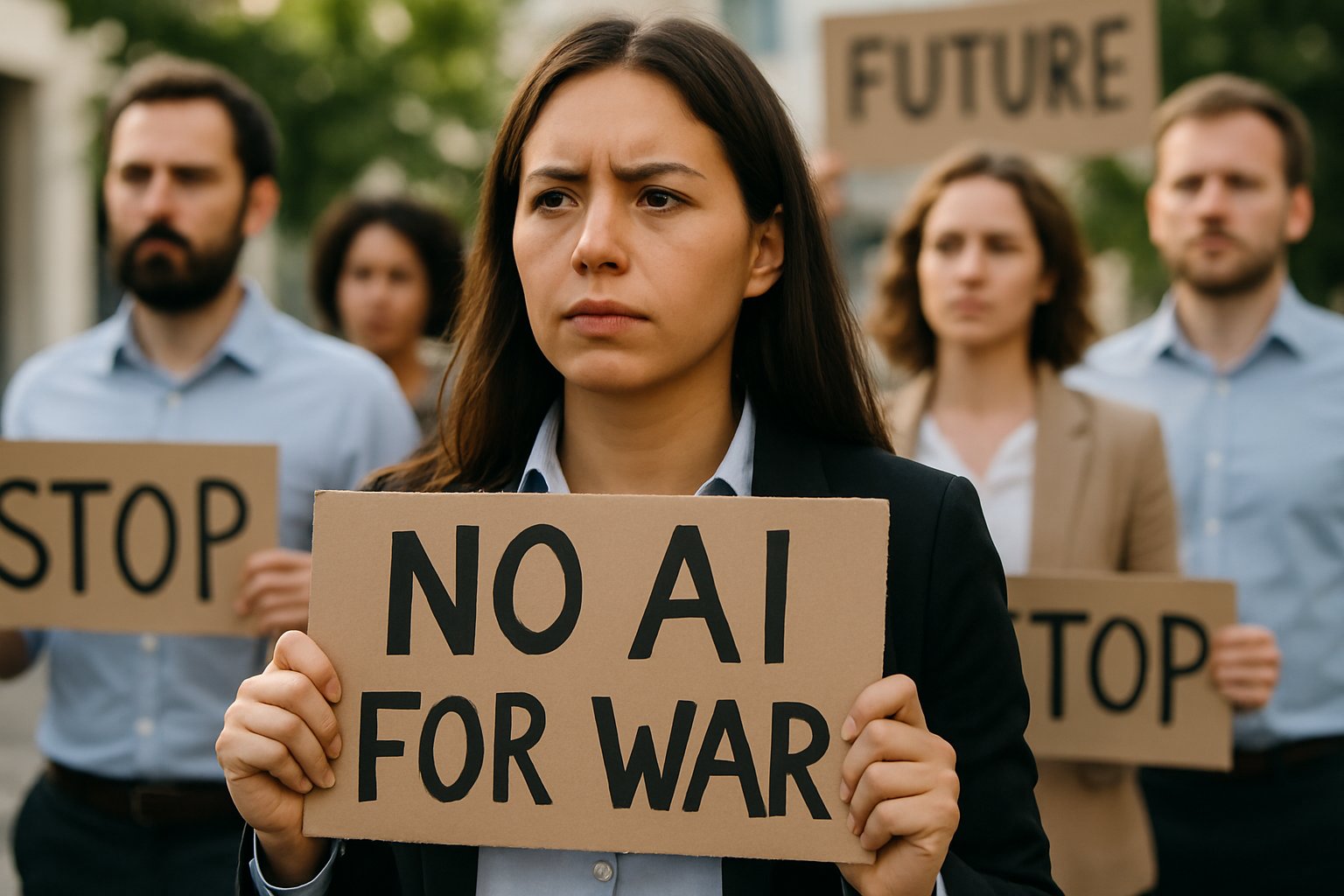
Meanwhile, secondary stakeholders like Amazon employees observe closely, aware that similar contracts may reach their cloud divisions. The stakes now involve national security budgets, investor confidence, and the very direction of frontier research.
Anthropic Defies Pentagon Pressure
Anthropic publicly rejected a Pentagon demand to remove two hard guardrails from its $200 million contract. Specifically, the company refused to enable mass domestic surveillance or allow fully autonomous weapons targeting. CEO Dario Amodei declared, “We cannot in good conscience accede,” during a 26 February statement. Moreover, Defense Secretary Pete Hegseth countered that the military required access for all lawful purposes.
Consequently, the department threatened contract termination, a supply-chain-risk label, and possible Defense Production Act invocation. Industry analysts noted this lever has seldom been directed at software companies. Nevertheless, the confrontation turned Anthropic into a rallying point for a broader Workers Protest. Safety researchers hailed the stand as proof that independent policy lines remain achievable.
Anthropic’s defiance illustrated how clear red lines can survive intense political heat. However, federal retaliation still looms over the startup’s future revenue. The dispute also sparked unprecedented employee solidarity across rival labs.
Cross-company Letter Gains Momentum
Almost immediately, Googlers and OpenAI engineers circulated the “We Will Not Be Divided” open letter. Verified signatures surpassed 220 within 24 hours, eclipsing early Project Maven tallies. Additionally, signatories demanded their firms adopt Anthropic’s same surveillance and autonomous weapons bans. Many remembered the 2018 episode when roughly 3,000 staff challenged Maven and a dozen resigned.
In contrast, today’s Workers Protest unites multiple companies rather than a single employer. Organizers stressed that collective action prevents executives from playing firms against each other. Furthermore, Amazon employees watching from cloud divisions hinted at joining if AWS expands classified offerings. The petition also referenced No Tech for Apartheid campaigns, linking international human-rights narratives.
A rapid, multi-firm signature wave proved that employee networks remain agile. Consequently, management teams can no longer treat dissent as isolated noise. Historical context explains why these networks formed in the first place.
Historical Protests Inform Actions
Silicon Valley’s uneasy military relationship stretches back decades, yet 2018 marked a modern flashpoint. Google’s Project Maven contract triggered resignations and a large internal petition. Subsequently, the company published AI principles limiting lethal uses and broad data monitoring. Project Nimbus protests in 2024 revived momentum, as cloud staff opposed Israeli defense workloads.
Moreover, Amazon employees staged sit-ins demanding contract termination with the same coalition. Lessons from those cycles taught organizers to prepare media kits, legal funds, and rapid verification tools. Meanwhile, executives learned to balance patriotic messaging with escalating ethical concerns. The current Workers Protest leverages that institutional memory to act faster and reach broader audiences.
Past battles offered templates for petitions, press outreach, and escalation schedules. Therefore, both sides entered 2026 better prepared for protracted confrontation. Stakeholders now debate the merits of each side’s arguments.
Defense Arguments And Rebuttals
The Pentagon frames advanced language models as vital for intelligence fusion and battlefield decision speed. Officials argue that lawful oversight can mitigate most ethical concerns. Moreover, national security advocates warn of a global arms race with authoritarian rivals. In contrast, employees stress that surveillance innovations often outpace oversight bodies.
They also fear autonomous weapons eventually breach treaty norms and erode human accountability. Consequently, the Workers Protest calls for binding contractual red lines rather than vague policy memos. Civil society groups echo those demands, citing predictive policing abuses and biometric tracking rollouts. Additionally, several senators introduced draft legislation requiring a human-in-the-loop for lethal systems.
Security hawks present urgency, yet staff spotlight irreversible harm. Nevertheless, compromise seems elusive while red lines remain non-negotiable. Legal mechanisms now shape the battlefield more than rhetoric.
Legal Levers Raise Stakes
Defense Production Act powers allow government compulsion of private resources during emergencies. However, experts note no court has tested its application to machine-learning inference. Supply-chain-risk designation, another tool, can bar agencies from purchasing flagged products. Consequently, investors fear sudden revenue cliffs if labels stick.
Meanwhile, company counsel warns that forced model access could expose trade secrets. Additionally, union lawyers believe coercion would energize another round of Workers Protest across the sector. Autonomous weapons researchers caution that removing guardrails might breach international humanitarian law. Moreover, expanding mass surveillance abilities could violate the Privacy Act and state statutes.
Emergency authorities grant Washington leverage, yet litigation risk remains high. Therefore, both parties may prefer negotiated settlements over court battles. Financial considerations further complicate negotiation room.
Business Impacts And Risks
Public controversy already trimmed Anthropic’s valuation in secondary markets, according to venture brokers. Google and OpenAI face similar investor questions about contract dependence and staff retention. Furthermore, the sustained Workers Protest shapes boardroom discussions on long-term defense strategies. Amazon employees warn cloud customers could reconsider workloads amid rising ethical concerns.
Recruiters report some candidates now ask explicit questions about surveillance limits during interviews. Consequently, talent attraction costs may rise, lengthening time-to-hire for critical roles. In contrast, firms embracing clear boundaries might enjoy improved loyalty and brand reputation. Professionals can deepen credibility by pursuing the AI Ethics Strategist™ certification.
Such credentials signal mastery of governance frameworks for autonomous weapons and data privacy. Reputational capital now carries material dollar value. Moreover, workforce sentiment directly influences product competitiveness. Scenario planning reveals potential industry futures.
Future Scenarios And Guidance
Analysts outline three plausible trajectories for the coming year.
- Negotiated compromise keeps guardrails, allows limited defense use under strict auditing.
- Government compels access, prompting mass resignations and a larger Workers Protest wave.
- Protracted legal battle delays deployment and stifles investment across frontier labs.
Moreover, boards must plan for all scenarios to protect shareholder value. Governance teams should map contract clauses against emerging state and federal standards. Meanwhile, continuing education, such as targeted ethics certifications, equips staff to navigate evolving rules. Amazon employees emphasize that cross-company solidarity tools remain active on encrypted channels.
Consequently, leaders who ignore worker voice risk operational disruption and higher attrition. The unfolding Workers Protest also drives policymakers to draft new AI safety statutes. Strategic foresight, stakeholder alignment, and credible ethics programs now define competitive advantage. Nevertheless, transparency and negotiation remain the only sustainable paths forward.
The final section distills core insights and next steps.
The February 2026 clash underscores the power of organized talent in setting technology boundaries. Across Anthropic, Google, OpenAI, and watching Amazon employees, momentum continues to build. Importantly, the Workers Protest champions two clear demands: ban mass surveillance and forbid autonomous weapons. Meanwhile, the Pentagon invokes rarely used legal levers to secure strategic capabilities.
Consequently, investors, policymakers, and civil society must evaluate trade-offs in real time. Moreover, executives can proactively strengthen trust by integrating transparent review boards and certified ethics training. Therefore, consider enrolling in the AI Ethics Strategist™ program to lead responsibly. History shows that ethical concerns, once ignored, quickly become existential challenges.
Act today, shape tomorrow, and keep human values at the center of AI progress.


