

AI CERTs
2 months ago
Why intelligent workflow co-pilots reshape U.S. knowledge work
U.S. enterprises face relentless pressure to deliver more with leaner teams. Consequently, many leaders now test intelligent workflow co-pilots to cut routine effort and accelerate decisions. These AI-driven aides extend well beyond chat replies. Instead, they draft documents, update systems, and trigger multi-step flows across applications. However, success depends on governance, integration, and cultural readiness as much as model accuracy.
Market Momentum Accelerates Rapidly
Major platforms intensified competition over the past 18 months. Microsoft embedded agents across 365, while Salesforce, Google, and ServiceNow followed suit. Moreover, RPA vendors rebranded assistants as co-pilots, adding natural-language “text to workflow” builders. Gartner now predicts 40 % of enterprise apps will feature task-specific agents by 2026. Therefore, buyers encounter an expanding menu of overlapping claims.
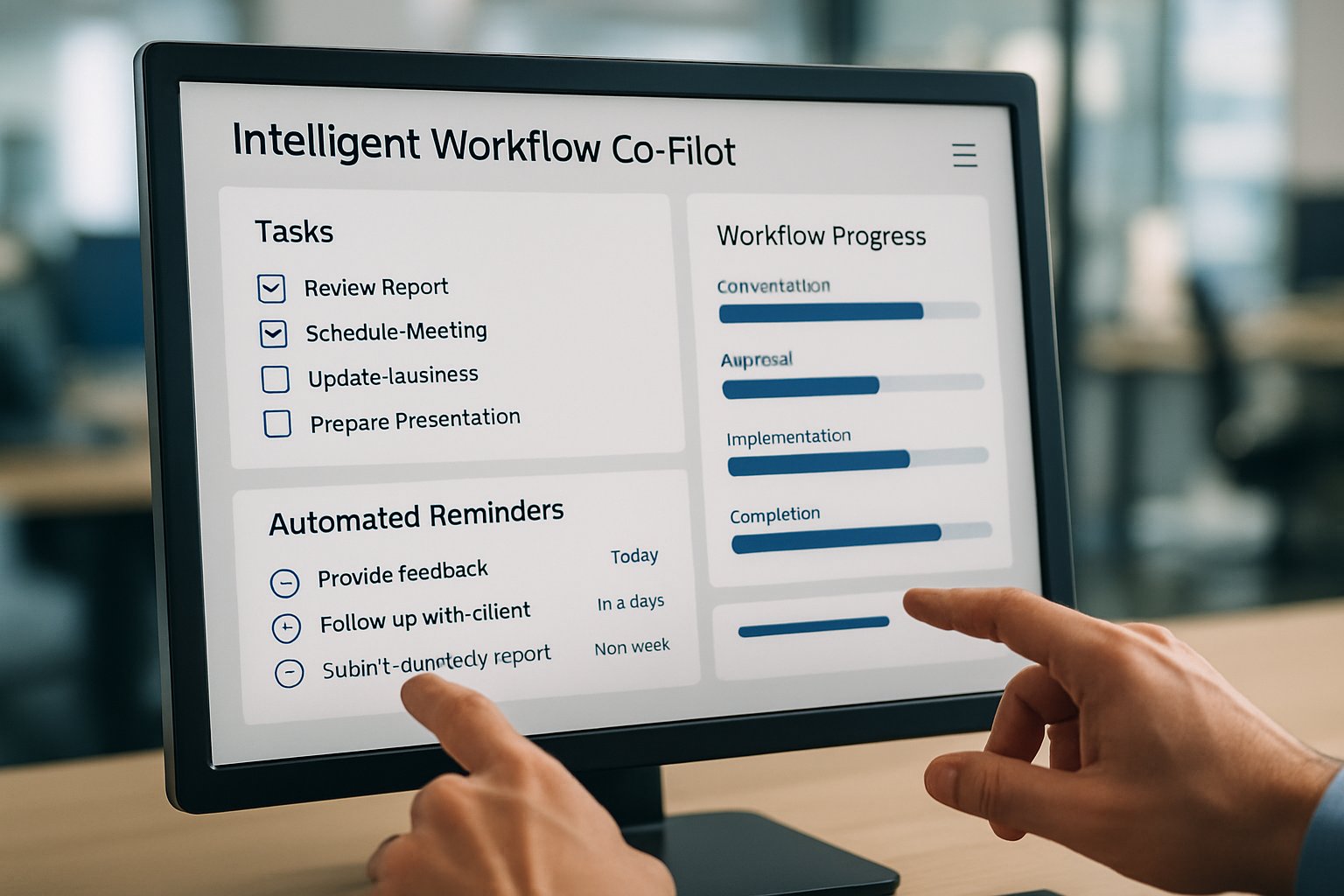
Despite hype fatigue, investment continues because intelligent workflow co-pilots promise tangible savings. Forrester’s vendor-commissioned studies forecast composite ROI of 116 % for Microsoft 365 Copilot. Nevertheless, analysts caution that benefits evaporate without clear metrics, robust connectors, and disciplined rollouts. These warnings underscore the importance of deliberate experimentation.
The surge of offerings shows no sign of slowing. McKinsey modeling suggests generative AI could automate 30 % of U.S. work hours by 2030. Consequently, leadership teams view co-pilots as a strategic hedge against talent shortages.
These signals confirm structural demand. However, real-world value hinges on verifiable performance metrics, discussed next.
Emerging Productivity Evidence Builds
Field experiments offer early proof points. GitHub Copilot studies show 12–26 % higher task throughput for developers, with junior engineers benefiting most. Furthermore, small trials inside marketing and finance teams report faster drafting and summarization, although rigorous controls remain scarce.
Independent researchers note mixed outcomes for senior specialists. In contrast, junior staff experience notable lift because suggestions handle boilerplate steps. Consequently, managers must tune deployment scopes by role to avoid productivity plateaus.
Key advantages often surface in three categories:
- Reduced context switching between applications
- Automated documentation and status updates
- Accelerated data synthesis for decisions
Additionally, the best gains arise when task orchestration spans several systems, eliminating manual handoffs. Yet empirical proof outside coding remains formative.
Evidence continues to accumulate. Nevertheless, sustained studies across diverse roles will be essential before company-wide rollouts.
Governance And Risk Controls
Accuracy concerns dominate board discussions. Hallucinated numbers in a legal brief can trigger liability. Therefore, grounding models on trusted repositories is mandatory. Microsoft, Google, and Salesforce now ship connectors, RBAC, and audit logs to address this need.
Gartner still warns that 40 % of agentic projects may fail without stringent oversight. Moreover, regulators scrutinize automated decision pathways, demanding transparent logs. Consequently, enterprises must enforce human-in-the-loop checkpoints, approval gates, and eDiscovery retention.
Security teams also monitor identity flows. OAuth scopes, token lifetimes, and data residency require careful design. Meanwhile, pricing models tied to usage create budget unpredictability unless throttles exist.
Robust controls build organizational trust. However, they introduce complexity that can slow pilot velocity if governance principles are unclear.
Integration And Task Orchestration
Seamless integration separates demos from durable productivity wins. Zapier, SnapLogic, and UiPath now embed task orchestration engines powered by natural language. Additionally, Microsoft’s Copilot Studio chains actions across Dataverse and Teams, while Salesforce Agentforce steers CRM-triggered steps.
Yet integration depth varies widely. Surface-level APIs may suffice for draft emails but fail during multi-system order processing. Therefore, architects should map end-to-end data flows before selecting a vendor.
Latency also matters. Sub-second responses preserve user focus during iterative work. Conversely, slow pipelines erode trust and adoption. Monitoring dashboards, retries, and exception routing keep flows resilient.
Integrated orchestration delivers compounding value. Nevertheless, every added connector multiplies maintenance overhead unless standard patterns exist.
Culture And Workforce Impact
Tangible gains emerge only when employees embrace new habits. Early pilots reveal two cultural frictions. First, forced adoption can spark backlash, especially when canned AI language flattens personal voice. Second, automatic meeting summarization raises surveillance anxieties.
Proactive communication mitigates concerns. Moreover, clear guidelines on acceptable AI usage prevent compliance missteps. Training must include prompt design, result verification, and escalation paths.
Talent dynamics shift as well. Junior employees gain speed yet still require mentorship on nuance. Meanwhile, senior experts may spend extra time validating AI output, offsetting some gains. Consequently, performance metrics should focus on outcome quality, not raw volume.
Cultural alignment unlocks sustainable benefits. However, neglecting workforce sentiment can stall even technically flawless deployments.
Procurement And ROI Reality
Licensing varies across seat, usage, and feature tiers. Google charges $30 per user monthly for Duet AI. Microsoft prices Copilot at similar levels but bundles features. Therefore, finance teams must model scenario costs under different adoption curves.
Vendor ROI calculators frequently assume full adoption within months. In contrast, many organizations stagger rollouts over quarters. Furthermore, integration work, change management, and legal reviews inflate total cost of ownership.
To quantify returns, teams should capture baseline task durations, then track deltas post-pilot. Examples include minutes saved on contract drafting or percentage lift in qualified leads. Additionally, external benchmarks from enterprise productivity AI studies provide context yet should not replace internal evidence.
Professionals can deepen relevant skills with the AI Sales™ certification, reinforcing disciplined measurement frameworks.
Financial rigor sustains executive support. Nevertheless, procurement must revisit contracts annually as usage patterns evolve.
Strategic Roadmap Recommendations Ahead
Several principles guide effective programs:
- Start with high-volume, low-risk tasks to generate quick wins.
- Prioritize platforms offering native governance and strong task orchestration capabilities.
- Prototype with mixed-seniority teams to validate differential impact.
- Embed clear KPIs and iterate based on measured outcomes.
- Invest in reskilling through enterprise productivity AI training and certifications.
Moreover, allocate budget for connector maintenance and policy reviews. Consequently, your roadmap remains resilient as regulations and vendor models change.
Strategic alignment secures competitive edge. However, complacency risks stranded investments while rivals accelerate automation.
These insights highlight emerging practices. Meanwhile, rapid platform evolution demands iterative evaluation and flexible governance.
Ultimately, intelligent workflow co-pilots will reshape knowledge work when deployed responsibly. Early movers already document measurable gains across coding, sales, and service flows. Furthermore, grounded data connections, transparent oversight, and human-centered change management convert potential into durable value.
Consequently, leadership teams that integrate enterprise productivity AI, robust task orchestration, and continuous learning will outpace hesitant peers. The next phase belongs to organizations willing to experiment, measure, and refine.
In conclusion, intelligent workflow co-pilots signal a decisive shift in how U.S. enterprises tackle routine knowledge work. Governance, integration, and culture determine success. Therefore, begin targeted pilots, track ROI diligently, and empower staff through certifications to stay ahead.


