

AI CERTs
2 months ago
Why AI literacy assessment tools dominate enterprise reskilling
Boardrooms are racing to quantify staff readiness for generative AI. Consequently, AI literacy assessment tools now headline corporate reskilling budgets. Gartner, LinkedIn and a Cisco-led consortium all released stark data during 2025. The message is clear: adoption is surging faster than workforce capability. Meanwhile, only 11 percent of learning leaders feel fully prepared for future skills demands. Such gaps threaten productivity, compliance and brand trust. Therefore, companies are embracing diagnostic instruments to target training, align budgets and boost confidence. This article explores why assessments matter, how the market is maturing, and what leaders must do next. Along the way, we examine best practices, potential risks, and emerging certifications supporting enterprise educators.
Market Drivers Surge Ahead
Global training spend reached $361.5 billion in 2023 and continues rising at seven percent annually. Moreover, LinkedIn reports that executive AI skill listings tripled within two years. Consequently, board expectations for measurable reskilling outcomes intensified. AI literacy assessment tools give chief learning officers a defensible baseline for planning. In contrast, blanket courses without diagnostics waste budget and erode learner trust. Gartner’s June 2025 framework formalized this urgency by ranking literacy diagnostics as an early transformation milestone. Additionally, the Cisco-led consortium pledged to reskill 95 million workers, further spotlighting assessment driven programs. Enterprises adopting AI literacy assessment tools report faster curriculum alignment and stronger executive sponsorship. Absorb Software found only 11 percent of L&D leaders feel highly confident about future readiness. Therefore, leaders now pair each upskilling strategy with data driven testing to justify investment.
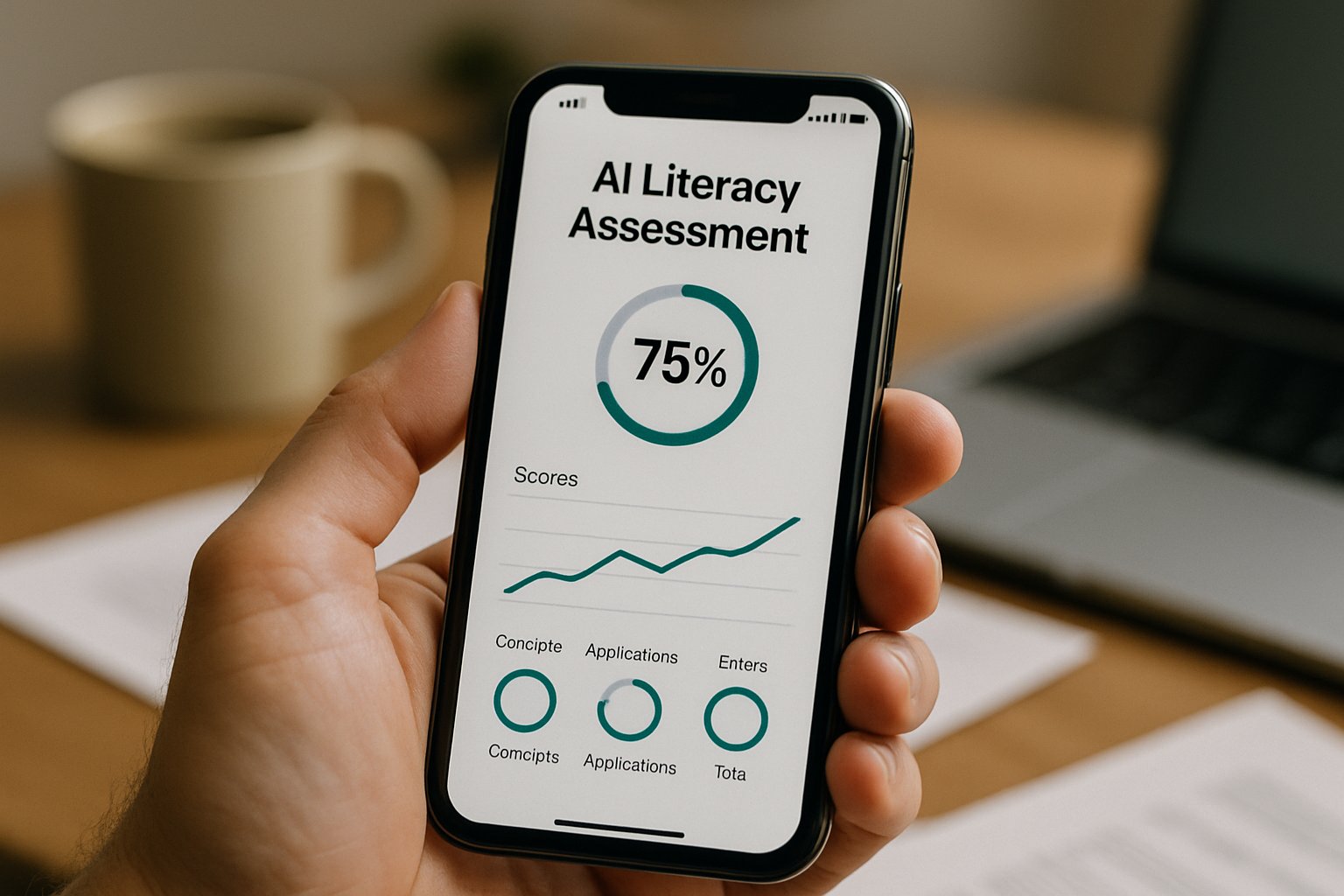
Assessments now direct spending and executive focus. However, their credibility depends on evolving measurement science, which we examine next.
Assessing AI Literacy Frameworks
Academic teams released several validated scales during 2025, including A-factor and AICOS. Furthermore, Gartner’s organizational approach links individual results to corporate data maturity. These designs treat literacy as four dimensions: concept knowledge, application, evaluation, and ethics. AI literacy assessment tools increasingly embed scenario simulations to mirror real tasks. Moreover, adaptive question banks adjust difficulty, yielding granular proficiency maps for each employee. Enterprises choose those AI literacy assessment tools that align with their compliance obligations. Psychometric validation matters because reskilling programs often influence promotion or staffing. Nevertheless, many instruments still rely on generic quizzes lacking role context. Researchers therefore recommend task aligned items that predict on-the-job performance. Such rigor supports any upskilling strategy by ensuring training aligns with measurable workplace needs.
Validated frameworks protect organizations from wasted effort. Consequently, attention shifts toward commercial vendors translating theory into scalable platforms.
Vendor Landscape Shifts Fast
Specialist vendors, including UMU and AILAT, launched enterprise offerings during late 2025. Additionally, legacy platforms such as LinkedIn Learning and Coursera now integrate external assessments via APIs. AI literacy assessment tools from these firms promise dashboards, LMS connections and automated learning paths. UMU markets a five-dimensional model and claims psychometric backing. In contrast, AILAT emphasizes industry scenario calibration and adaptive questioning. Both support multilingual delivery, essential for global deployments. Pricing typically follows a per-employee annual license paired with consulting services.
Case Study Snapshot Today
A European bank piloted UMU with 4,000 analysts during Q3 2025. Subsequently, average productivity scores rose six percent within three months, according to internal dashboards. Executives credited the assessment led curriculum for faster report turnaround and reduced compliance errors.
Vendor innovation continues at remarkable speed. Nevertheless, successful rollouts depend on disciplined implementation steps discussed below.
Implementation Best Practice Guide
Effective implementation begins with clear goals tied to business metrics. Firstly, combine organizational readiness assessments with individual diagnostics. Secondly, select AI literacy assessment tools that publish validation data and bias audits. Thirdly, map scores to role based learning pathways inside the LXP. Furthermore, communicate purpose, data usage, and privacy safeguards to earn employee trust. Many L&D teams embed the program inside a broader change management narrative to reduce resistance. Periodic re-assessment every six months measures learning transfer and informs promotion decisions.
- Define baseline metrics before rollout.
- Align assessments with existing upskilling strategy.
- Integrate results into performance dashboards.
- Audit fairness and data security periodically.
Professionals can enhance their expertise with the AI Educator™ certification to design evidence-based curricula.
Disciplined execution safeguards investment and trust. However, leaders must balance advantages against unresolved risks.
Benefits And Key Pitfalls
Benefits emerge quickly when diagnostics precede learning. Companies prioritize scarce budget, shorten course catalogs, and spotlight internal AI champions. Moreover, linking scores to business KPIs clarifies return on investment. Conversely, poorly designed tests invite legal scrutiny, bias claims, and morale issues. Change management missteps can amplify distrust, especially if transparency is lacking. AI literacy assessment tools also raise privacy questions because they collect sensitive cognitive data. Therefore, organizations should publish data retention policies and allow appeals.
Robust governance maximizes upside while limiting exposure. Consequently, forward-looking leaders track emerging trends to refine programs.
Future Outlook And Trends
Market analysts expect the corporate training sector to double by 2035. Furthermore, adaptive simulations and multimodal analytics will deepen personalization. Researchers predict convergence between maturity models and AI literacy assessment tools, enabling closed-loop skill orchestration. Blockchain credentials could store verifiable assessment outcomes for portable talent profiles. Moreover, regulators are drafting guidance on assessment fairness, especially within hiring contexts. Upgrading assessment platforms will therefore become a core upskilling strategy for digital transformation. Meanwhile, change management frameworks will incorporate continuous listening to monitor sentiment.
Technology and policy will reshape literacy measurement rapidly. Nevertheless, current best practices already deliver measurable value, as the concluding recap explains.
Enterprise reskilling budgets are under intense scrutiny. Fortunately, AI literacy assessment tools offer measurable insight, guiding investments toward high-impact roles. Moreover, validated frameworks and disciplined change management reduce legal and reputational risk. Linking results to an upskilling strategy accelerates adoption and proves ROI. Nevertheless, success demands transparent communication and continuous improvement. Professionals seeking to lead these programs should pursue the previously mentioned AI Educator™ certification for structured methodologies. Act now to benchmark your workforce, design targeted learning, and secure competitive advantage in the AI economy.


