

AI CERTs
2 hours ago
White House Faces AI Act Opposition Debate
The policy battle over advanced chips has entered a sharper phase. Consequently, White House special advisor David Sacks has become the loudest internal critic of sweeping export limits. However, the debate no longer stops at hardware. The broader AI Act Opposition now shapes how Washington, Brussels, and Beijing frame risk, growth, and control. Moreover, analysts warn that every month of delay shifts market power toward faster movers. In contrast, lawmakers like Senator Elizabeth Warren insist that reckless deregulation could expose consumers and soldiers alike. Meanwhile, global spending on generative systems races toward the trillion-dollar mark. Therefore, the next twelve months will determine whether American firms keep their strategic lead or watch rivals fill an artificial-intelligence vacuum.
Advisor Rebukes Export Policies
Sacks attacked the Biden-era AI Diffusion Rule immediately after its May 2025 rescission. Furthermore, he argued that broad regulation strangled allied demand and weakened U.S. leverage. “China is only months behind,” he warned during June interviews, framing curbs as self-inflicted damage. Nevertheless, critics note that his previous crypto holdings invite conflict-of-interest concerns. The AI Act Opposition narrative gained fresh oxygen when industry giants like Nvidia echoed similar points. Consequently, Congressional hearings now seek clarity on who truly benefits from looser controls.
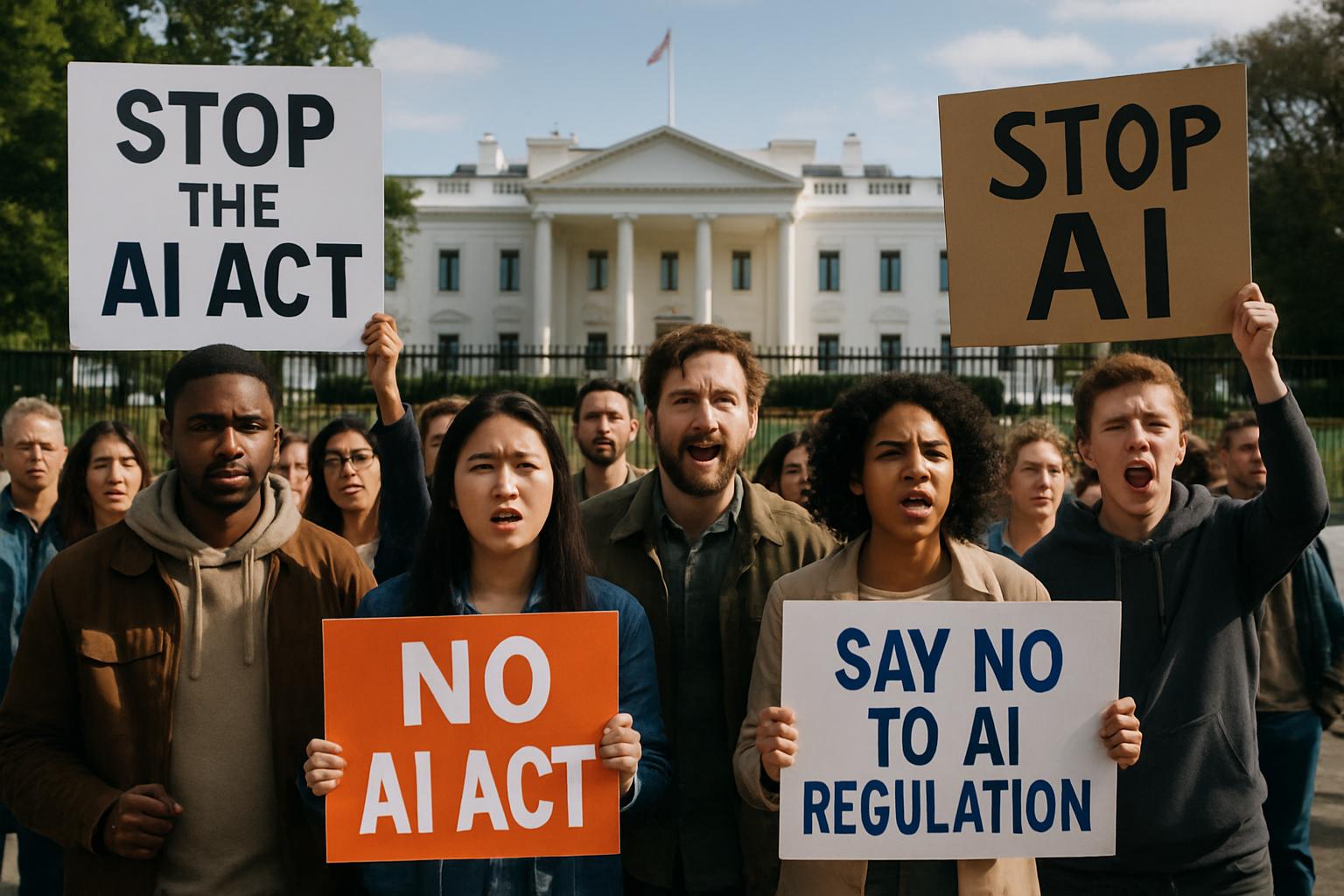
These arguments reveal deep philosophical splits. However, both sides accept that chip sales influence model performance worldwide. The section’s debate highlights growing uncertainty. Subsequently, attention shifts toward raw commercial stakes.
Market Stakes Keep Rising
Gartner projects artificial-intelligence spending will hit $1.5 trillion in 2025. Moreover, $209 billion targets processing semiconductors alone. In contrast, Chinese startups such as DeepSeek release strong models without top-tier fabrication plants. Consequently, investors fear that lost hardware markets soon become lost software ecosystems. The AI Act Opposition stresses this market reality while calling existing policy “outdated.”
- Global GenAI spending forecast: $644 billion (Gartner, March 2025)
- Nvidia data-center GPU share: 70-90% (analyst range, 2024-2025)
- DeepSeek benchmark gap: three percentage points on reasoning tasks (Forbes, June 2025)
These numbers illustrate why firms lobby hard. Therefore, policymakers must weigh profits against espionage threats. The commercial lens now yields to national-security concerns.
Security Fears Still Persist
National-security hawks dismiss market anxieties. Instead, they warn that relaxed controls ease military uptake abroad. Additionally, they question Microsoft’s claim that tighter rules push buyers toward Huawei. Senator Warren cites the same technology innovation curve when demanding stronger guardrails. Nevertheless, Sacks maintains that imprecise regulation drives friends into adversaries’ arms. The AI Act Opposition counters that selective licensing plus end-use monitoring can balance risk.
Security arguments remain unresolved. However, ethics debates are intensifying in parallel, leading to the next confrontation.
Ethics And Oversight Clash
Warren’s March 2025 letters accuse Sacks of favoring connected companies. Moreover, civil-society groups demand transparent disclosure rules. In contrast, the advisor claims existing government ethics reviews suffice. Consequently, Senate Banking Committee staff prepare subpoenas for internal emails. The AI Act Opposition frames oversight efforts as a measured check, not an absolute brake on innovation.
This ethical standoff highlights procedural fragility. Subsequently, global responses intensify the spotlight on Washington.
Global Reactions And EU
European regulators advance their landmark AI Act despite fierce lobbying. Meanwhile, Sacks’ remarks fuel transatlantic comparisons. EU officials view the American rollback as proof that voluntary schemes fail. Consequently, Brussels positions mandatory regulation as the safer bet. The AI Act Opposition counters that rigid rules slow innovation while handing markets to China. Furthermore, Chinese media portray U.S. divisions as tactical victory.
International posturing deepens policy complexity. However, future scenarios may offer compromise paths.
Future Scenarios And Policy
Think-tank reports outline three likely trajectories. Firstly, Washington could reinstate broad limits if security breaches surge. Secondly, targeted controls might prevail, pairing audits with controlled exports. Thirdly, Congress could codify preemption, blocking state-level AI laws entirely. Moreover, the second path aligns with Sacks’ stance and the AI Act Opposition coalition. Additionally, industry hopes that calibrated rules sustain innovation without eroding alliances.
Each scenario reshapes chip flows and data governance. Therefore, leaders must prepare strategic skill plans, discussed next.
Skills Path For Leaders
Policy turbulence increases the premium on commercial literacy. Professionals can enhance their expertise with the AI Sales™ certification. Moreover, firms want managers fluent in export compliance, government frameworks, and cross-border deal structures. Consequently, talent pipelines adjust training toward ethical AI sales and accelerated deployment. The AI Act Opposition underlines that educated executives reduce accidental breaches while sustaining growth.
Upskilling mitigates short-term uncertainty. Nevertheless, final outcomes depend on negotiated statutes, not just staff readiness.
These preparation steps close the discussion. However, a concise summary and next actions remain.
Conclusion
David Sacks’ critique has forced a wider conversation on export controls, security, and ethics. Consequently, markets, allies, and adversaries track every hearing. The AI Act Opposition keeps amplifying competitive anxieties while critics emphasize national-security exposure. Moreover, Gartner forecasts show enormous financial stakes, and EU regulators push stringent models. Therefore, businesses must monitor legislation, invest in compliance talent, and pursue strategic certifications. Nevertheless, balanced solutions appear achievable through targeted, transparent rules. Professionals should act now, gain updated knowledge, and navigate unfolding AI trade dynamics with confidence.


