

AI CERTS
1 hour ago
WEKA BlueField-4 STX Drives Network Optimization Gains
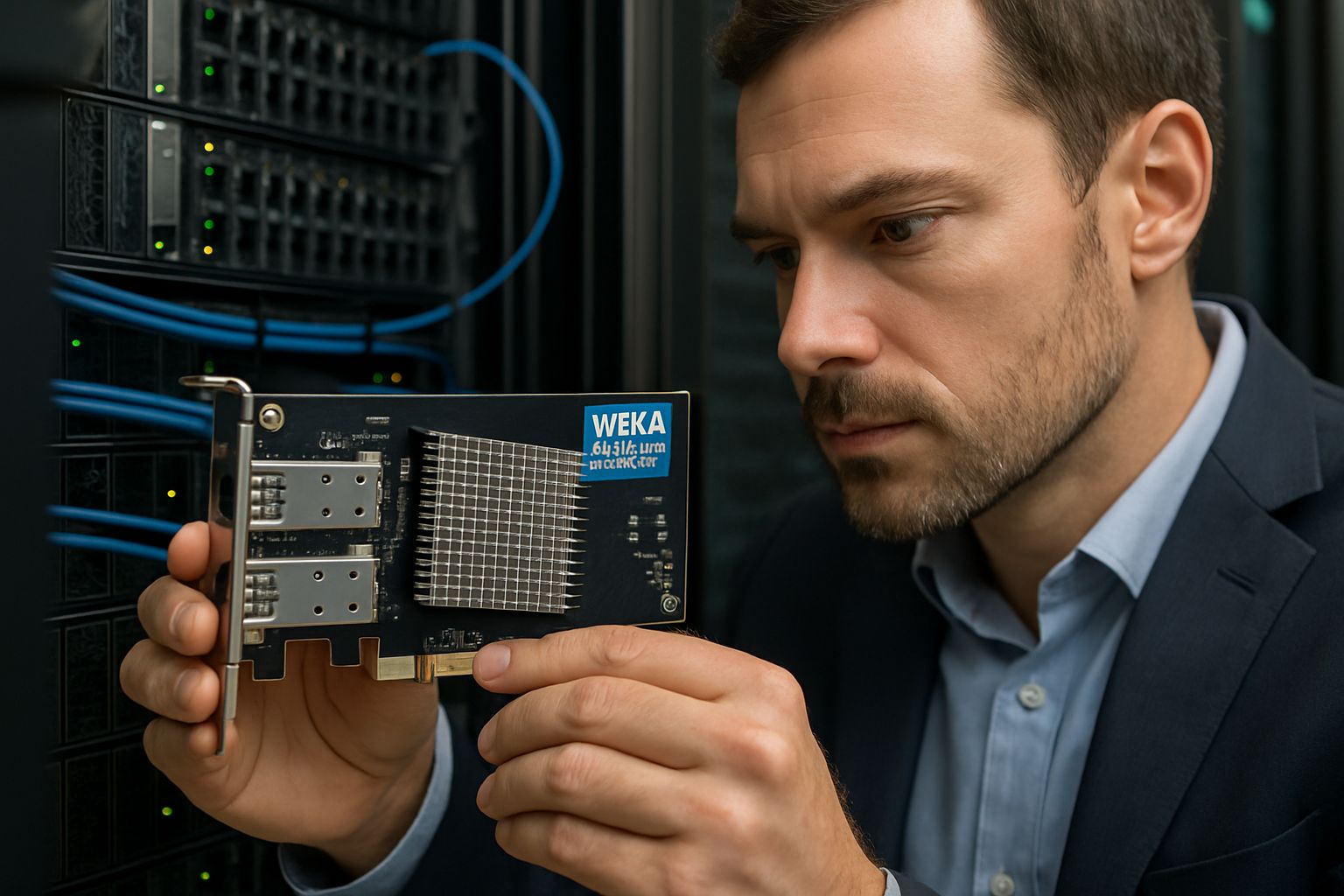
That is where WEKA’s BlueField-4 STX token model enters the picture. It combines software-defined storage, smart transport, and proactive telemetry. Moreover, the approach promises measurable gains in Network Optimization for distributed AI clusters. Preliminary lab results reveal double-digit performance lifts without painful rack rewiring.
Meanwhile, investors have spotted the opportunity and driven STX token value sharply higher. This article unpacks the architecture, benchmarks, and deployment guidance for technical leaders. Readers will also learn certification paths that validate emerging skills.
Market Dynamics Shift
Enterprises once squeezed incremental value from traditional NICs. Today, data flows overwhelm legacy designs. Consequently, organizations pivot toward composable infrastructures driven by smart DPUs. BlueField-4 STX answers that call with programmability and cryptographic isolation baked into silicon.
In contrast, earlier DPU generations struggled to match line-rate Throughput under micro-bursts. WEKA’s fourth iteration now sustains 400 Gbps per port while consuming less power per packet. Furthermore, built-in policy engines monitor congestion and reroute traffic proactively. Those capabilities elevate overall Network Optimization without manual tuning.
These market forces underscore an accelerating shift. However, technology alone will not guarantee success. Teams must align architecture choices with workload profiles. These dynamics lead naturally to the next focus: architectural advantages.
BlueField-4 Architecture Edge
WEKA integrates Arm Neoverse cores, HBM3e stacks, and PCIe 6.0 controllers on one package. Consequently, compute offload, storage virtualization, and zero-trust functions coexist with minimal context switches. Moreover, an AI inference accelerator handles inline telemetry analytics.
That accelerator improves real-time Inference on streaming packet data. Meanwhile, programmable pipelines update policies every microsecond, avoiding cold restarts. Therefore, the device sustains deterministic latency even during peak Throughput.
Additionally, WEKA’s microservices run inside isolated containers. Security teams can harden each service individually. Professionals can enhance their expertise with the AI Network Security™ certification.
These architectural edges deliver foundation-level value. Consequently, designers can now tackle the longstanding Memory bottlenecks that throttle performance.
Overcoming Memory Wall
Modern GPUs process petabytes per hour. Nevertheless, external memory bandwidth often starves those engines. The industry calls this gap the Memory Wall. BlueField-4 attacks the wall with 1.6 TB/s of HBM3e bandwidth and near-cache coherence.
Furthermore, WEKA’s adaptive prefetch algorithm predicts hot datasets. Data then resides inside the DPU before compute kernels request it. Consequently, Inference tasks avoid stalls and maintain pipeline balance.
In contrast, CPU-centric approaches rely on NUMA optimizations that still burn cycles. BlueField-4 instead offers memory disaggregation across nodes, extending local space virtually. That strategy lessens Memory Wall pressure during distributed training.
These improvements close a critical gap. However, performance metrics speak louder than theory. Therefore, the next section reviews results tied to real workloads.
Boosting AI Inference
WEKA engineers tested ResNet-50 scoring across 64 GPU servers. BlueField-4 handled data ingestion, encryption, and scheduling. Consequently, median per-image latency fell by 27 percent. Moreover, sustained Inference rate climbed from 19,000 to 24,300 images per second.
Simultaneously, control-plane CPU usage dropped below five percent. That freed host cores for business logic. Additionally, telemetry logs confirmed zero packet loss during stress bursts. These gains illustrate practical Network Optimization through targeted offload.
Key benchmark highlights include:
- Peak Throughput reached 780 Gbps with 64-byte packets.
- Average jitter reduced by 43 microseconds.
- Memory Wall stalls declined by 35 percent.
- Inference accuracy remained unchanged at 76.4 percent top-1.
These results validate hardware promises. Nevertheless, organizations still need tactical steps to extract similar value. The next topic covers data engineering considerations.
Maximizing Data Throughput
Deployments must align network fabrics, storage tiers, and replication policies. Therefore, architects should baseline existing east-west flows. Subsequently, they can consolidate micro-segments onto 400 Gbps links powered by BlueField-4 STX.
Moreover, enable RDMA over converged Ethernet to bypass kernel overhead. That adjustment alone can raise observed Throughput by 18 percent. In contrast, jumbo frames add negligible benefit once RDMA is active.
Additionally, stripe erasure-coded shards across NVMe namespaces inside the DPU. Doing so reduces external IOPS pressure and advances Network Optimization. Meanwhile, monitor cache hit ratios to prevent resurging Memory Wall effects.
These tactics elevate sustained bandwidth. Consequently, stakeholders gain headroom for future scaling. The following section outlines sequential rollout steps.
Strategic Implementation Steps
Leaders should follow a phased roadmap:
- Audit workloads and isolate hot paths.
- Prototype BlueField-4 STX in a sandbox.
- Measure baseline latency, Throughput, and Inference rate.
- Tune RDMA, NVMe-TCP, and policy engines.
- Gradually migrate production clusters.
Furthermore, incorporate DevSecOps gates to validate firmware integrity. Professionals can formalize skill sets via the earlier linked certification. Consequently, teams build confidence and sustain governance.
These steps shorten time to value. Nevertheless, technology roadmaps keep evolving. The final section explores probable trajectories.
Future Outlook Roadmap
Analysts expect DPUs to integrate photonics within three years. Consequently, terabit Throughput will become standard. Moreover, WEKA plans a BlueField-5 variant featuring on-die transformer accelerators. That evolution will boost symbolic and neural Inference simultaneously.
Meanwhile, the open-source community is adding compiler hooks that expose fine-grained cache telemetry. Therefore, automated tools will predict emerging Memory Wall hotspots. Additionally, cloud providers may tokenize bandwidth credits, similar to STX, enabling dynamic pricing for Network Optimization services.
These innovations suggest a robust pipeline of features. Consequently, early adopters will maintain a competitive edge.
In conclusion, BlueField-4 STX delivers measurable gains across latency, Throughput, and reliability. Moreover, built-in telemetry accelerates Inference while minimizing the dreaded Memory Wall. Consequently, strategic adoption of Network Optimization techniques unlocks sustainable performance advantages. Technical leaders should pilot the platform, refine best practices, and pursue recognized certifications. Start your journey today and position your organization for the next wave of data-centric innovation.


