

AI CERTS
3 months ago
Wearable AI Hardware: Decoding Android XR Glasses Rumors
Consequently, analysts are watching Android XR glasses as the next proving ground for Wearable AI Hardware. This article examines the platform shift, key partnerships, technical obstacles, market forecasts, privacy debates, and critical timelines. Each section distills verified data and expert opinions for consumer tech strategists and enterprise buyers. Meanwhile, readers seeking deeper compliance skills can explore the AI-Legal™ certification to navigate evolving regulations.
Broader Platform Strategy Shift
The Android XR announcement in 2024 repositioned Google as a software orchestrator rather than a lone hardware builder. Consequently, analysts compare the approach to Wear OS on watches. Meanwhile, Gemini AI sits at the core, delivering contextually aware assistance inside lightweight frames. Such positioning allows partners to iterate styles while Google secures developer loyalty. Moreover, the platform supports WebXR and OpenXR, easing porting from existing augmented reality projects. Sergey Brin admitted past missteps with Google Glass yet affirmed renewed belief in the vision form factor. Therefore, the shift places Wearable AI Hardware within a scalable ecosystem instead of a single flagship. These strategic decisions highlight flexibility and reduced risk. However, evaluating partner commitments requires deeper inspection.
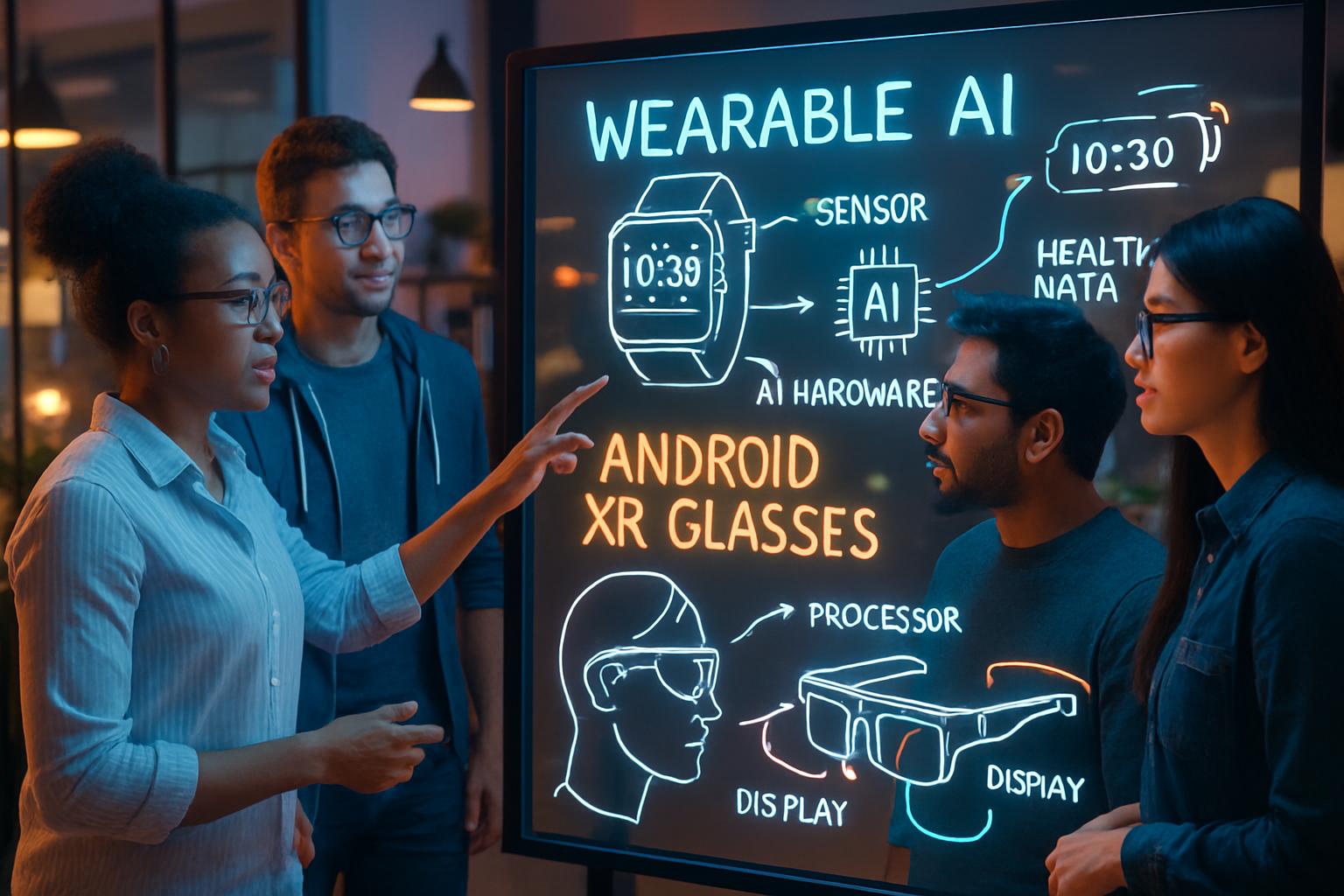
In short, Android XR blends open software with rich AI services. Consequently, partnership depth becomes the next metric to watch.
Key Hardware Partnerships Announced
The May 2025 showcase named several eyewear and silicon partners. Warby Parker secured up to $150 million for fashion-forward frames. Additionally, Gentle Monster targets luxury audiences wanting discreet displays. Qualcomm supplies optimized XR chipsets, while Samsung engineers reference devices under the Galaxy XR code name. In contrast, Xreal’s Project Aura may ship first, pairing optical see-through lenses with phone tethering.
Notable commitments include:
- Warby Parker: consumer launch planned after 2025, tethered compute.
- Gentle Monster: premium design emphasis, limited production volumes.
- Xreal Project Aura: optical see-through waveguide, Qualcomm silicon.
- Samsung and HTC assets: reference designs accelerating developer kits.
Moreover, these alliances distribute manufacturing risk across the supply chain. Wearable AI Hardware thus becomes a portfolio of branded offerings rather than one product. These collaborations underscore momentum. Nevertheless, technical hurdles still challenge execution.
Partnership diversity broadens style choices and distribution. However, unresolved engineering constraints could slow launches.
Technical Challenges Persist Today
Engineering elegant glasses remains difficult. Battery capacity must power cameras, microphones, and radio links without bulk. Furthermore, in-lens displays offer narrow fields of view, limiting immersive augmented reality scenes. Gemini processing partly shifts to paired phones, yet latency management still matters for real-time translation. In contrast, video see-through achieves richer overlays but increases thermal load. Consequently, early Wearable AI Hardware may favor notification utilities over full spatial mapping.
Privacy introduces additional complexity. Cameras facing bystanders revive the original Google Glass backlash. Therefore, hardware makers explore LED capture indicators and local processing to protect data. Shahram Izadi emphasized style and social acceptance as equal priorities alongside technology. These intertwined factors dictate final specifications.
Technical compromises will shape first-generation experiences. Moreover, overcoming them is essential for mainstream consumer tech traction.
Hardware limits remain stubborn barriers. Consequently, financial forecasts require cautious interpretation.
Market Forecasts And Reality
Market researchers paint optimistic revenue curves. Statista expects global AR and VR consumer revenue to hit $46.6 billion in 2025. Moreover, the AR headworn segment reached $6.3 billion in 2024 with double-digit CAGR projections. Nevertheless, previous cycles show premium devices, including Apple’s Vision Pro, shipping low volumes compared with inexpensive headsets. Therefore, price and comfort remain decisive variables.
Analysts track three baseline indicators:
- Average selling price under $500 for mass adoption.
- All-day battery life exceeding eight hours.
- Discreet frames that mimic everyday eyewear.
Consequently, investors evaluate whether Wearable AI Hardware can meet those benchmarks by 2026. Augmented reality excitement is high, yet supply constraints and subsidy models still apply. The platform strategy may reduce unit costs through shared components. However, skeptics caution against overly aggressive sales forecasts.
Forecast variance illustrates uncertainty. Meanwhile, privacy and regulation add further variables discussed next.
Privacy Policy Roadblocks Ahead
Smart glasses inevitably collect location, audio, and video data. Consequently, regulators scrutinize compliance with regional privacy laws. The European Union already debates visible camera labeling mandates. Additionally, U.S. states propose limitations on facial recognition during public recording. Professionals can enhance their expertise with the AI-Legal™ certification to navigate upcoming statutes.
Moreover, enterprise buyers demand transparent data retention policies before procuring Wearable AI Hardware. Google highlights on-device Gemini processing to minimize cloud uploads. Nevertheless, opponents argue that always-listening microphones threaten civil spaces. In contrast, defenders liken sensors to smartphones already present everywhere.
Regulatory clarity will heavily influence deployment speed. Therefore, compliance initiatives must progress in parallel with hardware engineering.
Privacy discussions set societal expectations. Subsequently, timelines and public events hold heightened importance.
Timelines And Upcoming Signals
Concrete launch dates remain elusive. Google scheduled an “Android Show: XR Edition” livestream for December 8, 2025. Furthermore, partner roadmaps position first consumer units after 2025, possibly aligning with holiday 2026. Warby Parker confirmed design validation during 2025 testing rounds. Meanwhile, Xreal hints at small-batch developer kits earlier.
Key milestones to monitor include:
- Qualcomm reference silicon availability in early 2026.
- FCC filings for Gemini-enabled glasses in mid-2026.
- Retail channel training material leaks before preorders.
Consequently, supply chain signals will emerge months before formal unveilings. Investors tracking Wearable AI Hardware should watch component orders and regulatory certifications. Additionally, enterprise pilot programs may reveal pricing tiers ahead of consumer tech launches.
Enterprises planning pilot deployments should assemble cross-functional teams now. Moreover, adopting Wearable AI Hardware could unlock productivity gains before broad consumer tech rollout.
Upcoming events provide visibility. Nevertheless, strategic implications require an executive lens.
Final Thoughts
Android XR glasses crystallize a pivotal moment for Wearable AI Hardware. Google’s platform-first move, combined with fashion partnerships, positions augmented reality for mainstream debates. However, technical, market, and policy uncertainties persist. Moreover, enterprises hold influence through early pilot feedback. Consequently, leaders should track component milestones, privacy legislation, and partner announcements. Nevertheless, first movers can still shape standards through pilot feedback.
Meanwhile, professionals can sharpen compliance skills through the linked AI-Legal certification. Adopting best practices today accelerates readiness for tomorrow’s Wearable AI Hardware. Therefore, stay informed, engage with upcoming livestreams, and prepare your organization for the next wave of spatial computing.


