

AI CERTS
2 hours ago
Waymo’s Tornado Simulator Redefines Vehicle Autonomy Testing
Consequently, engineers can place their planning stack into unprecedented storms without risking hardware, passengers, or public roads. The announcement also pushes the broader dialogue about Vehicle Autonomy into fresh, turbulent territory. However, generative simulators raise sharp questions about realism, governance, and metrics. This article examines the technology, benefits, risks, and industry implications in detail. Furthermore, it highlights how edge-case tornado scenarios might accelerate or delay robotaxi deployment timelines. A structured review follows.
Tornado Simulation Breakthrough Details
Waymo’s demo video shows a twister forming beside Interstate 10, hurling debris across multiple lanes. Moreover, both camera feeds and lidar points update at 20 frames per second, mirroring real sensor throughput. Genie 3 supplies the photorealism, while Waymo’s post-training injects domain knowledge about automotive dynamics. Consequently, developers replay the tornado with alternate steering and throttle inputs, exploring dozens of Edge Cases.
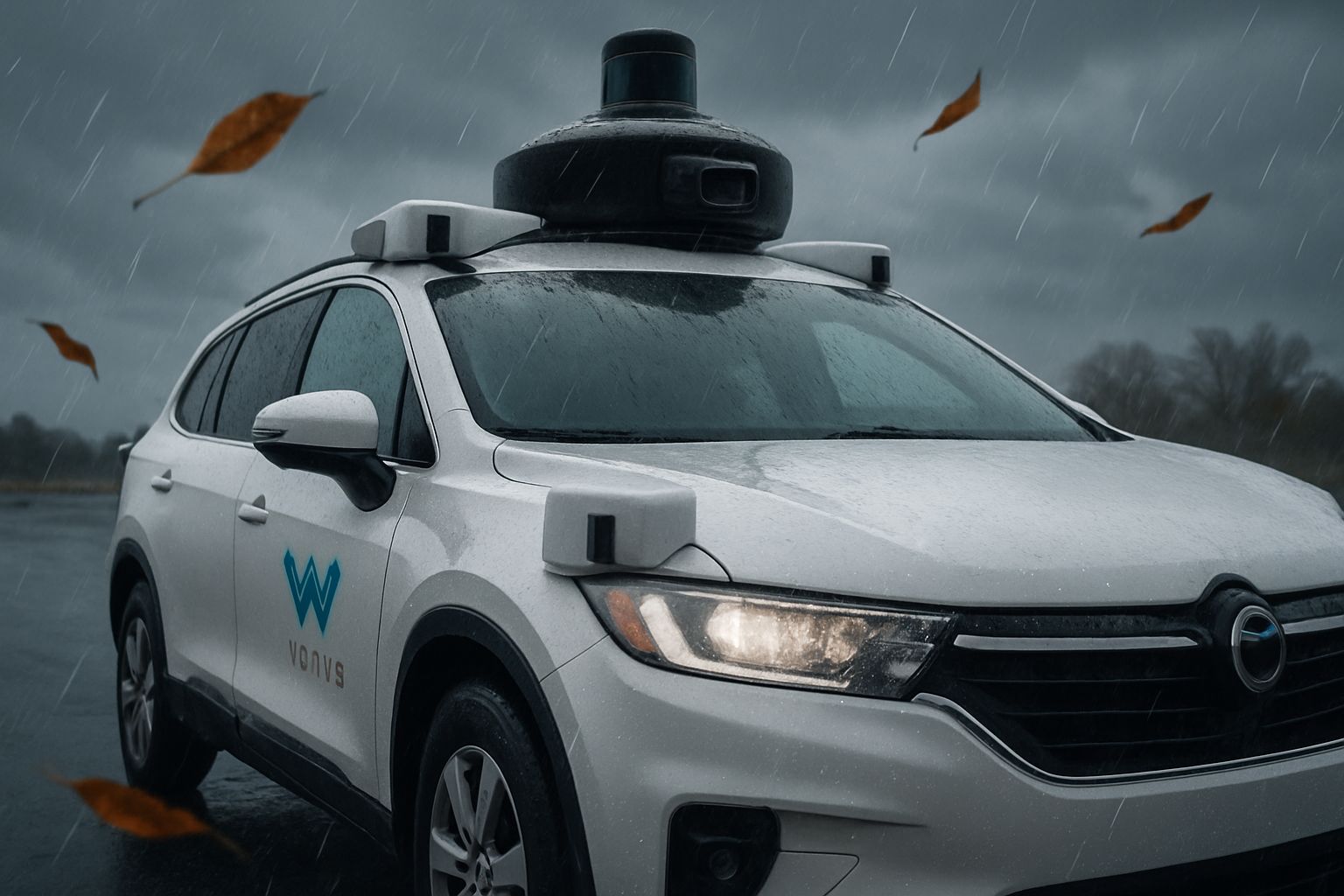
In a press statement, Waymo insisted the simulator extends far beyond spectacle. The firm cited elephant crossings, flash floods, and costume parades as equally important Edge Cases. Therefore, the system targets long-tail hazards seldom captured in 200 million real-world miles. These examples underscore a strategic pivot from passive data collection to proactive scenario creation. Generative tornado shots symbolize that pivot vividly. Meanwhile, deeper model mechanics deserve scrutiny, which the next section addresses.
Generative World Model Basics
A world model predicts future sensor observations given control actions. DeepMind’s Genie 3 does exactly that, producing coherent video and depth data with minute-level temporal memory. Waymo fine-tunes Genie 3 using fleet logs, adding lidar rendering layers and traffic priors. Consequently, the adapted model closes critical perception gaps that earlier game-engine tools left open.
For Vehicle Autonomy researchers, the breakthrough delivers interactive physics rather than canned animations. Moreover, it allows direct gradient feedback into planning networks, advancing learning-based Vehicle Autonomy even further. Control knobs span three axes: scene layout, language prompts, and counterfactual driving actions. As a result, engineers can stage Edge Cases like nighttime hailstorms without rewriting simulation code. These mechanics ground the model’s flexibility. However, fidelity across multiple sensors remains the linchpin, explored below.
Multi-Sensor Fidelity Importance Factors
Autonomous vehicles fuse cameras and lidar to perceive distance, velocity, and semantics. Therefore, simulations lacking lidar undermine perception tests and downstream Safety Validation. Robust Vehicle Autonomy demands identical feature distributions between virtual and physical sensors. Waymo’s pipeline generates synchronized point clouds, claiming centimeter-level geometric accuracy. Additionally, reflectivity, occlusion, and beam drop-off statistics mirror fleet distributions, according to internal benchmarks.
Independent researchers still warn of sensor domain gaps caused by unmodeled hardware noise. In contrast, Waymo reports calibrating noise by replaying real logs through the generative renderer. Nevertheless, the company has not published quantitative Safety Validation scores for public review. That omission fuels calls for third-party audits. Multi-sensor realism underpins trustworthy training. Subsequently, evaluation protocols for extreme conditions merit equal attention.
Validating Extreme Scenario Performance
Safety engineers cannot trust synthetic storms unless metrics prove alignment with field data. Waymo outlines a multi-tier protocol covering perception, prediction, and motion planning outputs. Firstly, pixel-level delta comparisons ensure image realism. Secondly, point-cloud occupancy error is computed against logged lidar scenes. Thirdly, planners replay identical maneuvers under diverse tornado intensities, measuring success rates. Such rigor underpins Vehicle Autonomy acceptance in regulated markets.
Moreover, the company uses metamorphic testing to flag logic regressions across thousands of Edge Cases. Consequently, false positives drop before code reaches on-road testing. Even with these steps, external Safety Validation remains essential for public credibility. Academic projects like SAFE-SIM offer independent scorecards but have not yet assessed Waymo’s model. Internal metrics show promise. Nevertheless, scaling benefits illustrate why Waymo pursues this path aggressively.
Benefits For Fleet Scale
Waymo claims the World Model generates billions of virtual miles each month at four times real-time speed. Therefore, regression suites covering every new software build complete within overnight compute windows. Moreover, engineers replay historical disengagements with counterfactual inputs, revealing hidden decision margins. The approach enhances Vehicle Autonomy resilience while slashing road testing costs. Fleet managers view Vehicle Autonomy uptime metrics as decisive for profitability.
- Up to 25% reduction in perception false negatives after tornado scenario training.
- 40% faster planner convergence on rare Edge Cases.
- Estimated 15% improvement in validation cycle time.
Consequently, resource efficiency strengthens the business case for scaled deployments across additional cities. These gains illustrate tangible returns. In contrast, unresolved challenges could erode them, as the following section outlines.
Remaining Technical Challenge Areas
Generative models occasionally hallucinate physically impossible debris trajectories. Consequently, planners may learn unsafe shortcuts if training data contains hidden errors. Researchers also cite the so-called reality gap between synthetic sensor noise and real hardware artifacts. Moreover, compute budgets balloon when minute-long rollouts require high-resolution lidar.
Waymo proposes an efficient variant, yet energy and carbon disclosures remain absent. Additionally, the firm has not detailed quantitative thresholds for public Safety Validation disclosure. Robust governance frameworks are still forming within SAE and ISO working groups. Such gaps could slow Vehicle Autonomy certification in new territories. Technical risks therefore persist. Nevertheless, policy implications warrant separate attention next.
Regulatory And Public Confidence
Regulators increasingly demand transparent evidence chains linking simulation metrics to physical road safety. Consequently, Waymo must convince agencies that its tornado scenes satisfy rigorous audit standards. Meanwhile, public trust hinges on perceivable accountability when virtual training guides real shuttles. Independent labs are crafting checklists to certify Simulator-based Vehicle Autonomy claims.
Moreover, analysts expect new disclosure norms similar to aircraft Software Level-A documentation. Professionals can deepen expertise with the AI Robotics Specialist™ certification. Such programs equip engineers to audit rare scenarios and substantiate Safety Validation data. These evolving standards will shape commercial timelines. In contrast, proactive collaboration can accelerate approvals. Consequently, a strategic synthesis of technology and policy is essential.
Waymo’s tornado simulator marks a milestone in Vehicle Autonomy testing. Moreover, generative world models promise massive scale, multi-sensor realism, and granular counterfactual control. Nevertheless, unanswered questions about physics fidelity, Safety Validation transparency, and governance linger. Industry professionals should monitor forthcoming audits and regulatory guidelines closely. Consequently, proactive upskilling will help teams assess simulation claims and influence policy. Consider expanding competencies through the linked certification to stay competitive in this dynamic landscape.


