

AI CERTS
2 months ago
Vivo Halts Wearable AI Hardware Drive Amid Market Saturation
Market watchers were surprised when Vivo chose to halt its six-month AI glasses initiative last week. The move echoes broader turbulence within Wearable AI Hardware demand and supplier dynamics. Consequently, industry insiders now debate whether similar devices can still carve distinct value propositions. Meanwhile, competitors race ahead, citing double-digit shipment growth through 2025.
For context, IDC estimated over four million smart eyewear units shipped in the first half of 2025. Nevertheless, many designs share components, features, and price points, fueling what analysts label homogenization. This analysis dissects the halt, examines market forces, and explores possible paths forward for Wearable AI Hardware innovators. Furthermore, readers will gain actionable insights and certification resources to strengthen personal positioning in spatial computing. In contrast, we balance reported facts with independent context to maintain a grounded outlook. Finally, every section closes with concise takeaways guiding you to the next critical point.
Smart Eyewear Market Shifts
Furthermore, IDC trackers show smart eyewear shipments climbed 82% year-over-year in Q1 2025. Analysts attribute demand to audio-first designs that trade displays for lighter frames and longer battery runtimes. However, this volume centers on similar bill-of-materials, making price differentiation difficult. Consequently, Wearable AI Hardware vendors face swelling competition as each seeks unique experiences beyond voice assistance.
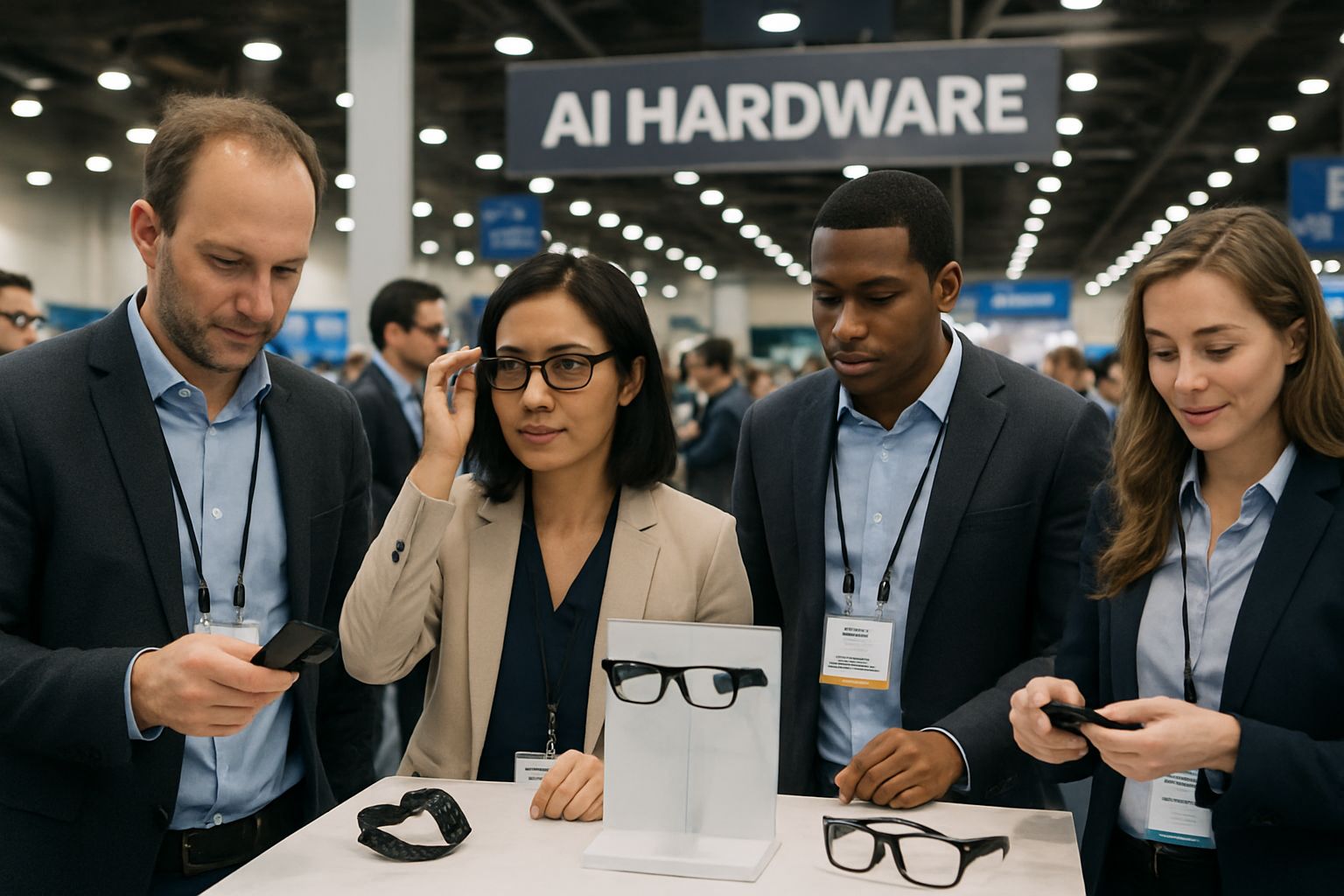
Growth Statistics Snapshot Now
The following metrics illustrate momentum and competitive intensity.
- Q1 2025: 1.487 million units, 82% YoY growth
- Q2 2025: 2.555 million units, 55% YoY growth
- China shipments: hundreds of thousands per quarter, accelerating
Industry CEOs warn that early adopters often return devices when practical value fails to materialize. Moreover, warranty costs rise because fragile frames endure tough outdoor environments. Analysts therefore believe sustainable differentiation must originate in software ecosystems rather than silicon tweaks. Meanwhile, component suppliers diversify client lists, reducing individual bargaining power for mid-tier brands. These statistics confirm breakneck adoption yet underscore uniform offerings. Nevertheless, differentiation remains elusive, preparing us for Vivo's timeline.
Vivo Decision Timeline Overview
On 23 January 2026, TechNode reported Vivo executives chose to halt the confidential AI eyewear project after six months. Goertek provided prototype assembly, while ThunderSoft delivered software stacks for demonstration units. Moreover, sources said leadership, including Executive VP Hu Baishan, saw no clear competitive edge. Therefore, the Wearable AI Hardware initiative was paused before any manufacturing commitment or marketing spend occurred.
The internal review reportedly considered marketing budgets, after-sales support, and regulatory certification timelines. Consequently, finance leadership advised reallocating funds toward computer vision research with longer payback windows. The timeline shows swift escalation and retreat. Consequently, we must examine internal hurdles driving this reversal.
Internal R&D Details Revealed
Interviews reveal parallel hardware routes, including single-green micro-OLED displays and audio-first concepts. In contrast, neither route matured enough to justify public disclosure. Additionally, heat dissipation and lens brightness reportedly limited outdoor usability. The project documentation indicated overlapping component suppliers already supported rival designs.
Consequently, cost targets crept upward, eroding margin projections for Wearable AI Hardware aspirations. Thermal throttling limited sustained processing, especially during simultaneous voice capture and camera streaming. Additionally, prototypes delivered under four hours of mixed usage, below internal benchmarks. Technical deadlocks compounded market sameness. Nevertheless, external forces amplified internal caution, which the next section explores.
Differentiation Challenges In Focus
Homogenization dominates the category because many firms license identical reference platforms from Qualcomm and Goertek. Moreover, shared supply chains compress feature variety, leaving software services as the prime battleground. However, Vivo lacks a robust global content ecosystem comparable to Meta's Ray-Ban line. Without exclusive applications, executives predicted the product would join a crowded, price-driven fight. Furthermore, marketing budgets required to educate consumers on advanced capabilities would dwarf likely first-year revenue.
Consequently, leadership concluded opportunity cost outweighed potential gains from continuing the glasses effort. Surveyed consumers indicated confusion between augmented reality, mixed reality, and simple audio wearables, complicating message clarity. This assessment highlights the brutal calculus encountered by aspiring Wearable AI Hardware players. Differentiation remains the crucial missing puzzle piece. Meanwhile, strategic alternatives could preserve institutional knowledge without shipping hardware immediately.
Strategic Alternatives Explored Today
One path directs resources toward Vivo Vision, the mixed-reality headset announced in 2025. Thereby, optical research and spatial computing algorithms stay relevant while commercial pressure eases. Another option involves licensing AI assistants to partner devices, expanding ecosystem reach without inventory risk. Additionally, executives may revisit consumer glasses once micro-LED costs decline and cloud offloading matures. Meanwhile, professionals seeking to align with these pivots can strengthen credentials through focused learning paths.
- Deepen prompt engineering via the AI Prompt Engineer™ certification.
- Master spatial UX principles for next-generation Wearable AI Hardware interfaces.
- Launch an enterprise pilot project to test value.
Outsourcing industrial design to boutique studios could inject fresh aesthetics without large capital expenditure. These strategic levers offer near-term flexibility. Consequently, they safeguard R&D momentum for eventual market re-entry.
MR Strategy Continuation Path
Unlike the shelved glasses, the mixed-reality headset targets developers and enterprise pilots first. Therefore, volume expectations remain modest, lowering immediate margin pressure. Moreover, the model accumulates spatial datasets valuable for future robotics programs. In contrast, consumer Wearable AI Hardware depends on mass appeal, making calculated sequencing essential. Subsequently, internal teams can transfer perception algorithms between products, preserving investment efficiency. Early partner demos include volumetric telepresence, industrial training overlays, and remote assistance for logistics staff. Leveraging MR sustains technical depth. Nevertheless, partner ecosystems must still blossom to unlock broader adoption.
The reported halt spotlights fierce competition and razor-thin margins in consumer glasses. Nevertheless, Vivo retains core talent and intellectual property for future Wearable AI Hardware breakthroughs. Consequently, the paused project may resurface once component costs and ecosystem maturity improve. Meanwhile, investors should watch supplier guidance for signals that the current halt is truly temporary. Additionally, professionals can future-proof careers by earning the AI Prompt Engineer™ certification and following spatial computing trends. Therefore, mastering prompt engineering positions you to create compelling interfaces across forthcoming Wearable AI Hardware platforms. Engage with our upcoming reports to stay ahead of every strategic pivot in this dynamic field.


