

AI CERTs
3 months ago
Virtual Styling Assistants Boost Conversion, Slash Returns
Ecommerce executives face tight margins and soaring return costs in 2026. Meanwhile, consumer expectations for frictionless shopping continue climbing. Consequently, brands are adopting Virtual Styling Assistants to replicate in-store guidance online. The technology pairs AI recommendations with interactive try-on experiences for apparel, beauty, and eyewear. Statista now counts more than one billion active mobile AR users, a vast potential audience. Furthermore, Shopify reports 94 percent higher conversion when products feature 3D or AR content. These figures suggest strong upside for retailers seeking new growth levers. In contrast, some merchants remain cautious about integration costs and measurement rigor. This article examines market momentum, technical foundations, business metrics, and practical steps for implementation. Readers will gain data-driven insight into where Virtual Styling Assistants deliver measurable value. Each section finishes with concise takeaways to support busy decision makers.
Market Momentum Accelerates Fast
Recent quarters show pilot projects becoming permanent site features across leading apparel groups. Moreover, L’Oréal logged over 100 million digital try-ons in 2023, up from 40 million. The beauty giant frames virtual try-on as habitual, not novelty.
Beauty Sector Leads Adoption
Other verticals, including footwear and eyewear, echo that acceleration. Meanwhile, market researchers value the virtual fitting sector near seven billion dollars this year. They forecast compound growth exceeding twenty percent through 2034.
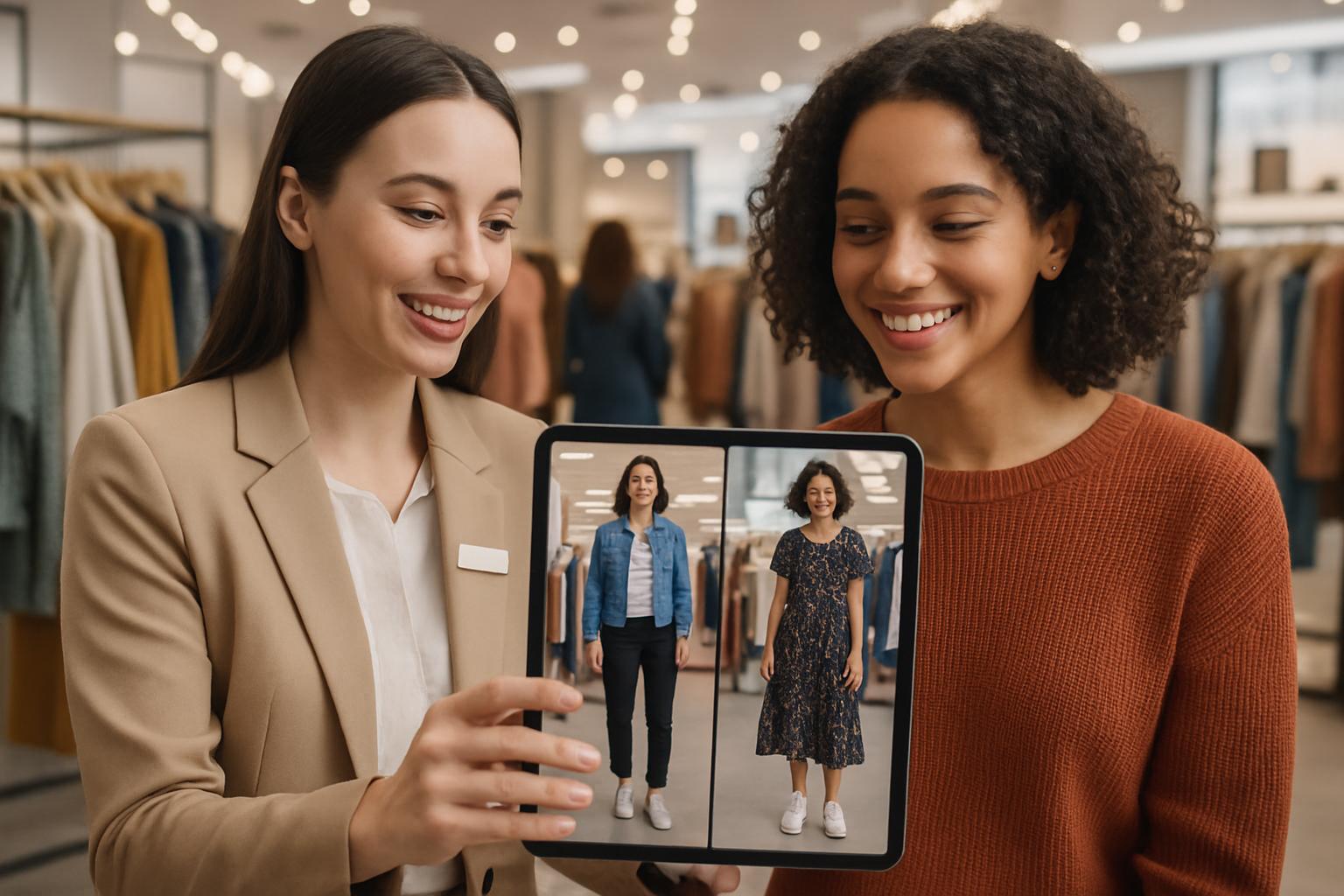
Retail analysts attribute part of the uptick to higher Fashion Sales conversion on mobile devices. Virtual Styling Assistants complement AR visuals by steering shoppers toward suitable items quickly. These trends underscore strong momentum.
Adoption now moves beyond experimentation and shows durable revenue impact. However, metrics still vary by category and tool design. The next section dissects those metrics in detail.
Conversion Metrics In Focus
Numbers speak loudest when budgets tighten. Shopify’s platform data shows products with 3D or AR convert ninety-four percent better. Moreover, vendor case studies report user-level conversion uplifts between twenty and eighty percent. However, sitewide improvements depend on adoption rates across visitors.
- Conversion uplift: Shopify cites 94% higher purchase rate with 3D/AR assets.
- Returns reduction: Vendors note 20–40% fewer returns when try-on or assistants are used.
- Average order value: Engaged shoppers spend 10–30% more, boosting Fashion Sales profitability.
Virtual Styling Assistants influence these metrics by offering data-driven Personalized Recommendations during browsing. Consequently, shoppers gain confidence and add complementary items, raising basket totals.
Robust metrics convince finance teams to fund further rollouts. Nevertheless, careful attribution remains essential for credibility. Technical capabilities determine whether proclaimed gains persist.
Technical Foundations Rapidly Mature
Underlying technology has improved markedly during the last 18 months. Additionally, research such as VTON 360 demonstrates multi-view garment consistency across poses. Language-guided styling now lets assistants adjust looks on the fly.
Computer vision captures body measurements while 3D engines render accurate fabric drape. Furthermore, large language models supply contextual style advice, generating Personalized Recommendations with conversational tone. These innovations cut key barriers around realism and latency.
Virtual Styling Assistants rely on four pillars: capture, modeling, rendering, and recommendation logic. Each layer must integrate seamlessly with commerce platforms for stable performance.
Technical maturity lowers risk and accelerates deployment timelines. Consequently, implementation best practices deserve detailed attention next. The following section provides that actionable guidance.
Implementation Best Practice Guide
E-commerce leaders should pilot Virtual Styling Assistants in high-return categories first. Next, define key KPIs like engagement rate, conversion delta, and return reduction. Moreover, run A/B tests to isolate impact from other merchandising changes.
Content creation matters because low-fidelity assets erode shopper trust instantly. Therefore, invest in high-resolution 3D garments and fast WebGL viewers. Teams lacking internal skill can partner with specialized vendors.
Data privacy remains crucial; obtain explicit consent before capturing images or measurements. Additionally, review regional regulations to avoid compliance gaps.
Professionals can enhance their expertise with the AI Customer Service Strategist™ certification. The program covers conversational AI design, measurement, and customer experience governance.
Executing these steps builds a solid foundation for scale. However, limitations and risks still require balanced assessment. The next section confronts those challenges.
Key Challenges And Caveats
Not every deployment hits headline numbers. Virtual Styling Assistants can backfire when performance lags or imagery disappoints. In contrast, some retailers report sluggish uptake when UI placement is poor. Slow mobile performance also depresses Fashion Sales uplift.
Attribution confusion remains another pitfall. Moreover, many vendor studies highlight per-user gains while ignoring sitewide dilution. Cost can escalate if 3D asset pipelines are not automated.
Privacy concerns may deter certain demographic groups, reducing Personalized Recommendations accuracy. Nevertheless, clear opt-ins and transparent storage policies mitigate fear.
Challenges emphasize the need for rigorous planning and measurement. Therefore, strategic alignment with business goals is non-negotiable. Leaders can now craft a forward roadmap integrating these insights.
Strategic Roadmap Moving Forward
Start by mapping shopper journeys and identifying decisive friction points. Subsequently, match each friction with a relevant Virtual Styling Assistants feature. Allocate budget for 3D asset creation and performance monitoring.
Furthermore, integrate analytics dashboards showing engagement, conversion, and returns versus baseline. Virtual Styling Assistants data should feed merchandising and supply chain planning loops. Additionally, link outputs to lifecycle marketing for Personalized Recommendations in emails and push messages.
Seasonally review tool accuracy, UX speed, and Fashion Sales correlations. Involve cross-functional teams, including legal, to update privacy disclosures.
A structured roadmap keeps initiatives funded and impactful. Consequently, organizations stay ahead of fast-moving competitors. The concluding section recaps key insights and suggests next steps.
Virtual Styling Assistants now stand at the intersection of technology, merchandising, and consumer expectation. Market data shows sizable conversion lifts, higher average orders, and lower returns across beauty, eyewear, and apparel. However, real gains require strong assets, clear KPIs, and respectful data practices. Technical progress and billion-user AR adoption lower historical barriers. Therefore, leaders should pilot, measure, and iterate toward enterprise scale. Professionals can pursue the AI Customer Service Strategist™ credential to guide such programs. Act now to convert curiosity into measurable Fashion Sales growth. The opportunity window remains open, yet fast movers will capture the largest advantage.


