

AI CERTS
4 hours ago
UMass Bacterial AI Neuron Breakthrough Shifts Bioelectronics
Such capability excites bioengineers designing wearables, implants, and ultra-low-power processors. Moreover, the material is biodegradable, offering sustainability benefits.
However, the breakthrough still faces scale-up and validation hurdles. Independent experts applaud the physics yet caution about manufacturing logistics. Nevertheless, the data, published in Nature Communications, reveal unrivaled voltage and energy alignment with biology. This article unpacks the science, performance numbers, challenges, and market context. Subsequently, we outline next steps for engineers and investors.
Trailblazing Scientific Milestone Unveiled
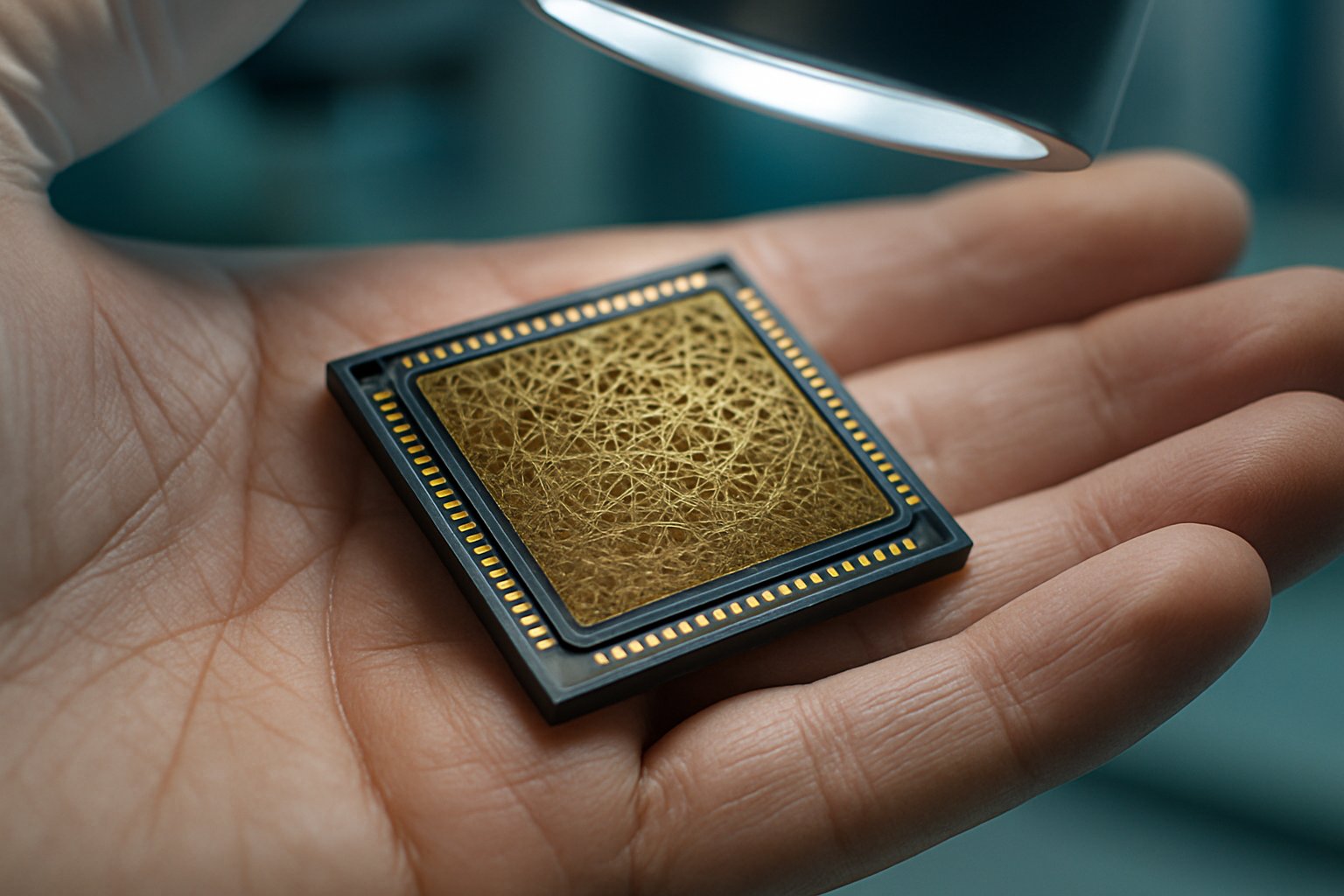
Geobacter sulfurreducens produces conductive filaments called protein nanowires. Yao and Lovley harvested these fibers and embedded them in nanoscale memristors. Previously, artificial neurons required hundreds of millivolts or even volts. In contrast, the new devices switch at roughly 60 millivolts, mirroring neuronal action potentials. The source Bacteria thrives in muddy sediments.
The milestone matters because energy efficiency now rivals biology. Each spike consumes as little as 0.2 picojoules under certain capacitances. Meanwhile, reproducibility tests showed stable switching across 1,000 sweeps. Industry analysts therefore view the Bacterial AI Neuron as a credible leap toward bio-compatible computing.
Those findings validate core claims. Consequently, stakeholders are rethinking interface design strategies. Such interest raises questions about device mechanics.
How The Device Works
At the heart sits a volatile memristor. The nanowire film forms a conductive filament only when voltage exceeds threshold. Charge then flows, quickly resetting after the spike. Consequently, the surrounding RC network mimics neuronal integrate-and-fire behavior.
Because switching begins near 60 millivolts, external cell signals need no amplification. Moreover, current peaks stay around 1.7 nanoamperes, matching membrane physiology. These aligned parameters let the Bacterial AI Neuron receive real cardiac waveforms directly. Researchers demonstrated this by feeding cultured heart recordings into the device.
Integration without amplifiers reduces noise and power. Nevertheless, performance depends on precise material properties, as the next metrics show.
Crucial Performance Metrics Unpacked
Nature Communications supplied hard numbers that resonate with engineers. The team measured the Bacterial AI Neuron under diverse loads to build the dataset.
- Switching voltage: 60 ± 3 mV
- Switching current: 1.76 ± 0.06 nA
- Off resistance: ≈ 200 MΩ
- Spiking energy: 0.2–37 pJ depending on capacitance
- Stable across 1,000 cycles
Collectively, these statistics place the prototype within biological ranges. Furthermore, they surpass previous silicon memristors by orders of magnitude in efficiency. This Discovery ranks among the year's most cited preprints.
Such alignment underpins the technology’s appeal. However, manufacturing realities could dampen momentum, as discussed next.
Production Scale Challenges Ahead
Laboratory protein filament yields remain tiny. Current bioreactors generate micrograms over several days. Consequently, producing wafer-scale films would demand many orders of magnitude more material. Uniform deposition across large substrates also lacks established protocols. Scaling the Bacterial AI Neuron to millions of units requires new bioreactors.
Moreover, memristor variability increases with area. Engineers must therefore refine fabrication chemistry to ensure consistent switching thresholds. In contrast, silicon fabs already deliver ppm-level uniformity. Achieving similar control with biological films will challenge existing toolsets.
These obstacles reflect early maturity. Subsequently, application prospects drive continued investment.
Potential Application Pathways Emerging
Ultra-efficient neural interfaces headline the roadmap. Arrays of the Bacterial AI Neuron could sense and stimulate tissue without power-hungry amplifiers. For example, wearable ECG patches might run multichannel analytics using ambient energy. Additionally, implantable prosthetics could translate neuronal firing into prosthetic movement in real time.
Beyond healthcare, developers envision broader impacts.
- Edge AI inference with microwatt budgets
- Environmental sensors fabricated from biodegradable Protein components
- Education kits demonstrating living electronics
Moreover, biodegradability appeals to regulators fighting e-waste. Consequently, policy momentum may accelerate pilot programs. Professionals can enhance their expertise with the AI Researcher™ certification. Deploying each Bacterial AI Neuron at the edge could cut carbon footprints.
These opportunities excite investors across sectors. Nevertheless, competition remains fierce. The next section surveys rival approaches.
Competitive Landscape Snapshot Today
Silicon neuromorphic chips like Intel Loihi and IBM TrueNorth dominate current deployments. They excel at large-scale inference yet require higher voltages. In contrast, organic electrochemical neurons offer softness but still draw more power. The Bacterial AI Neuron joins this field by targeting direct bio-signal processing.
Market researchers forecast double-digit growth for neuromorphic hardware. However, commercial success hinges on scalable, reliable production. Investors therefore watch material science milestones closely. Meanwhile, patent filings in protein electronics increased steadily over the last five years.
Competition will reward platforms achieving volume first. Subsequently, researchers must chart clear roadmaps.
Future Research Actions Required
Teams must boost Nanowire yield by at least six orders of magnitude. One path involves genetically engineering Bacteria to overproduce filaments. Additionally, roll-to-roll deposition techniques could spread films uniformly. Collaborative work with semiconductor foundries may accelerate process optimization.
Researchers also need long-term biocompatibility studies. Animal implantation trials will verify immune responses. Moreover, standardized reliability testing should benchmark filament stability under humidity and heat. These data will influence regulatory clearance for medical devices.
Addressing these gaps will convert promise into products. Consequently, the Bacterial AI Neuron roadmap depends on cross-disciplinary alliances.
UMass Amherst has shown that electronics can finally speak the language of living cells. The Bacterial AI Neuron operates at brain-level voltages, nanowatt power, and picosecond response. Moreover, Nanowire materials drawn from Bacteria may usher in greener device fabrication. Nevertheless, significant scaling, reliability, and regulatory hurdles remain. Engineers, investors, and policymakers should therefore monitor yield improvements and in-vivo data. Meanwhile, professionals can future-proof their skills by pursuing the AI Researcher™ certification. Consider joining interdisciplinary teams now and help translate this Discovery into practical systems.


