

AI CERTs
2 hours ago
Thomson Reuters Legal Assistant CoCounsel Transforms Research
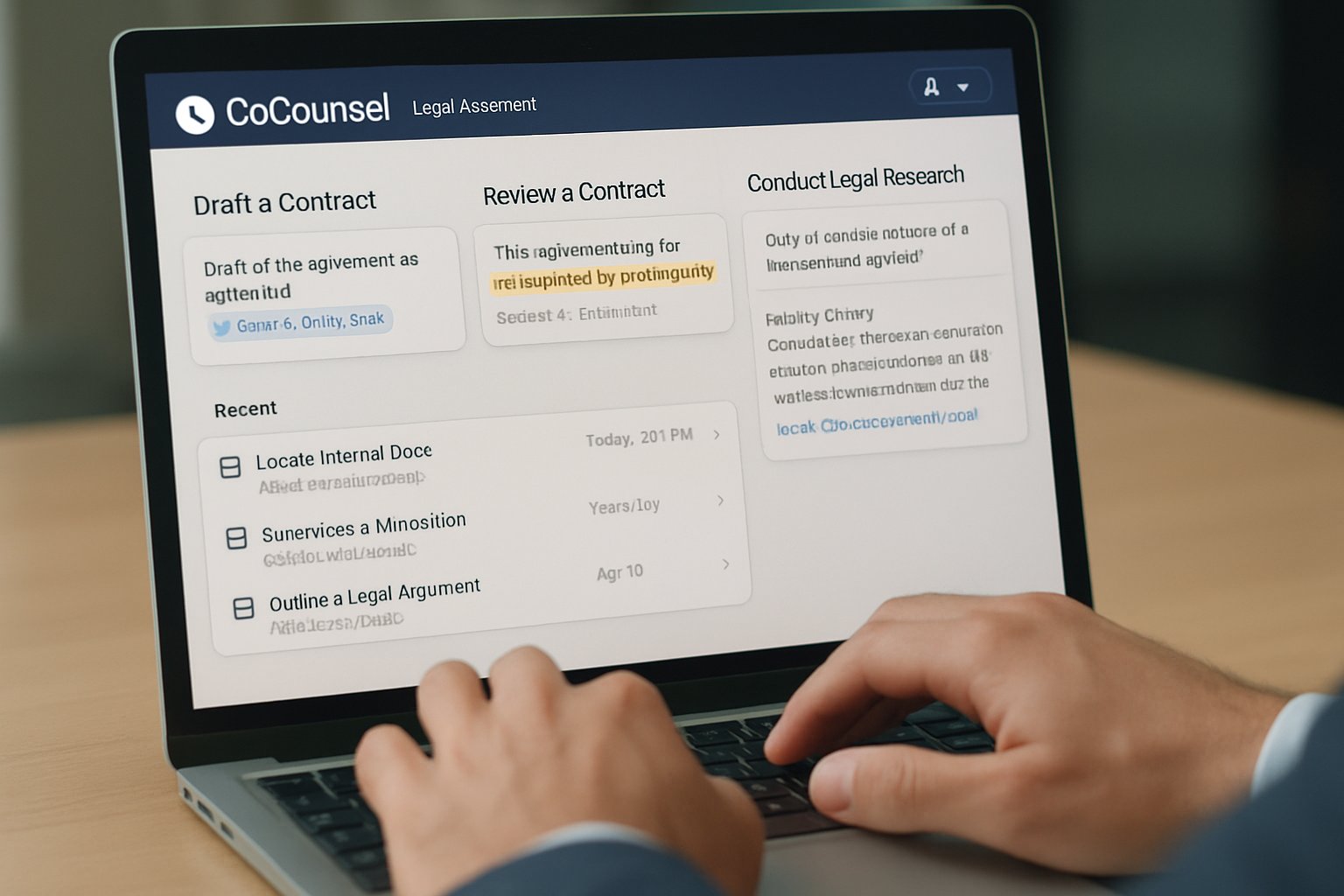
August 5, 2025 marked a pivotal milestone for legal technology. On that date, Thomson Reuters unveiled CoCounsel Legal, its generative AI Legal Assistant built for professionals. The launch blended Casetext heritage with Westlaw authority, promising agentic research and drafting support. Consequently, corporate counsel and law firms gained a new option for automating complex legal workflows. This article explores market context, technology foundations, competitive dynamics, and governance implications surrounding the debut.
Furthermore, independent analysts view the release as consolidation rather than novelty. Nevertheless, deep research capabilities reveal meaningful progress toward auditable generative outputs. Meanwhile, rising adoption rates and billion-dollar forecasts suggest strong demand for responsible AI tools. Readers will discover how agentic orchestration, citation grounding, and guided workflows may reshape daily practice. Key takeaways are anchored in verified sources and balanced perspectives.
Global Legal AI Context
Market estimates place AI in legal at roughly $4.59 billion during 2025, according to The Business Research Company. Moreover, multiple studies project annual growth exceeding 25 percent. Consequently, investment has surged as vendors race to reduce research hours and drafting costs. Thomson touts its acquisition of Casetext for $650 million as evidence of strategic commitment. In contrast, rivals such as LexisNexis and Bloomberg Law are accelerating their own generative offerings.
The Thomson Reuters Future of Professionals Report claims 55 percent of corporate legal departments adopted new AI during 2024-2025. Such data underscores widespread curiosity and mounting pressure to modernize workflows. Therefore, vendors emphasize productivity metrics and verifiable outputs when courting cautious buyers. These market signals contextualize the CoCounsel release discussed next.
Adoption statistics confirm a receptive but demanding audience. However, understanding the underlying technology proves essential before judging real value.
Agentic AI Workflows Explained
Agentic AI differs from simple chat interfaces. Instead of returning one answer, the system plans, executes, and tracks multi-step tasks. Subsequently, CoCounsel coordinates multiple models that retrieve sources, draft text, and validate citations. Moreover, Thomson highlights orchestration layers that pair general LLMs with domain-specific modules.
Deep Research exemplifies this architecture. It devises a structured research plan, calls Westlaw retrieval tools, then assembles a citation-backed memorandum. Consequently, attorneys can inspect reasoning paths, not merely final prose. Such transparency aligns with ethical duties of competence and diligence.
- Plan generation outlining legal issues and jurisdictions
- Source retrieval via Westlaw and Practical Law
- Draft synthesis with inline citations
- Validation pass eliminating hallucinations
These orchestrated steps aim to reduce manual toggling among research platforms. Consequently, time savings become quantifiable in subsequent efficiency studies. The next section examines Deep Research in greater detail.
Deep Research Capability Breakthrough
Deep Research, branded an industry first, grounds every answer in proprietary content. Furthermore, outputs embed live Westlaw links, KeyCite signals, and pinpoint citations. Colleen Nihill of Morgan Lewis observed that the tool "reasons through legal questions rather than simply return search results." Such endorsement illustrates perceived qualitative improvement over keyword search.
Guided reports also support downstream tasks like drafting a responsive contract clause. Consequently, users pivot from research to drafting without switching interfaces. One early adopter framed the system as an always-on Legal Assistant accelerating opinion memos. Nevertheless, independent benchmarks remain limited, leaving empirical accuracy rates partly opaque.
Deep Research promises auditability and speed. However, competitive response shapes perceptions of uniqueness, addressed in the next section.
Competitive Legaltech Landscape Shifts
Competitors like LexisNexis, Harvey, and Bloomberg Law intensify the race. Meanwhile, startups market lightweight plugins that generate contract language from prompts. Thomson seeks differentiation through trusted content and enterprise scale. Moreover, the Westlaw Advantage rollout bundles CoCounsel features into existing subscriptions.
Analyst Bob Ambrogi described the launch as "consolidation plus incremental innovation." In contrast, Artificial Lawyer highlighted agentic planning as a meaningful leap. Consequently, pricing, user experience, and validation depth may influence buying decisions more than pure model size.
Third-party surveys suggest lawyers favor integrations over standalone chatbots. Therefore, ecosystem breadth could steer market share toward platforms like CoCounsel that span research, drafting, and contract analysis.
Competitive pressure guarantees rapid capability cycles. However, risk management considerations still dominate procurement conversations, discussed next.
Risk And Governance Considerations
Legal work demands near-zero tolerance for hallucinations. Consequently, Thomson invested in multi-model validation and citation exposure. Nevertheless, scholars report that even advanced systems occasionally invent precedent. Bar associations thus remind attorneys to supervise every Legal Assistant output. Furthermore, confidentiality obligations raise questions about cloud processing of sensitive contract documents.
Thomson advertises SOC 2 compliance and future FedRAMP aspirations, yet buyers will request audits. In contrast, some startups rely on upstream providers lacking comparable attestations. Copyright litigation also influences governance, as Reuters recently defended Westlaw data against unauthorized training use. Therefore, provenance and licensing remain strategic differentiators.
Governance challenges will not vanish overnight. However, structured adoption frameworks can mitigate many concerns, enabling focus on strategic outcomes. Those strategic outcomes come into view now.
Strategic Impact For Firms
Productivity metrics headline most business cases. TR case studies show research tasks that once took hours now finish in minutes. Moreover, time saved can be redirected toward advisory work commanding premium fees. Consequently, partner utilization rates may improve without increasing billable pressure on associates.
Smaller practices also benefit, yet pricing could challenge solo adoption. Professionals can enhance their expertise with the AI Customer Service™ certification. Such training builds internal capability to evaluate each Legal Assistant suggestion critically.
Firms piloting CoCounsel report faster contract review cycles and streamlined diligence. Additionally, integrated Westlaw citations help persuade skeptical partners who demand source transparency. Therefore, early results hint at sustainable competitive advantage.
Operational gains appear tangible across organization sizes. However, disciplined change management determines whether benefits scale. The concluding section synthesizes lessons and next steps.
Conclusion And Next Steps
Thomson Reuters has fused Casetext intelligence with Westlaw depth to release a formidable Legal Assistant platform. Furthermore, agentic research, guided drafting, and transparent citations set this Legal Assistant apart from generic chatbots. Nevertheless, any Legal Assistant demands rigorous human review, especially when precedent stakes run high. Consequently, firms should pilot the Legal Assistant within defined matters, measure accuracy, and refine prompts. Professionals who master both domain knowledge and Legal Assistant oversight will capture the greatest value. Explore certifications, run controlled trials, and share insights to shape the next generation Legal Assistant responsibly.


