

AI CERTs
3 weeks ago
Thinktank Pushes AI Labels to Protect Information Integrity
AI chatbots have become quiet gatekeepers between audiences and original journalism. However, very few readers know which outlets those systems prioritise or ignore. Consequently, concerns about Information Integrity now dominate policy conversations in Westminster and newsrooms alike. On 30 January 2026, progressive thinktank IPPR published fresh evidence underscoring that problem. The group analysed thousands of AI answers and mapped which publishers appeared. Moreover, the results showed striking gaps, including BBC absence and Guardian dominance. The organisation therefore calls for nutrition-style labels, collective licensing, and public support for local outlets. Those measures, they argue, would rebuild trust and diversify revenue. Meanwhile, policymakers weigh technical standards that might accompany any future regulation. This article unpacks IPPR’s evidence, reactions, and the road ahead. Additionally, we explore how transparency tools could mesh with emerging C2PA provenance frameworks. Finally, we assess implications for advertisers and broadband regulators.
AI Labels Debate Today
IPPR’s analysis probed ChatGPT, Google Gemini overviews, and Perplexity across 100 user queries. In total, researchers logged more than 2,500 links. Furthermore, they recorded each citation to gauge source concentration. ChatGPT cited The Guardian in 58% of answers, dwarfing every rival outlet. Consequently, BBC links almost vanished because the broadcaster restricts crawler access. Similar skews appeared within Google’s AI Overviews. Such distortions raise acute Information Integrity concerns for democratic societies. Therefore, IPPR advocates standardized Nutrition Labels so users can quickly inspect provenance. The thinktank also proposes collective licensing to share economic returns. Without Nutrition Labels, opaque rankings could silently shape public debate.
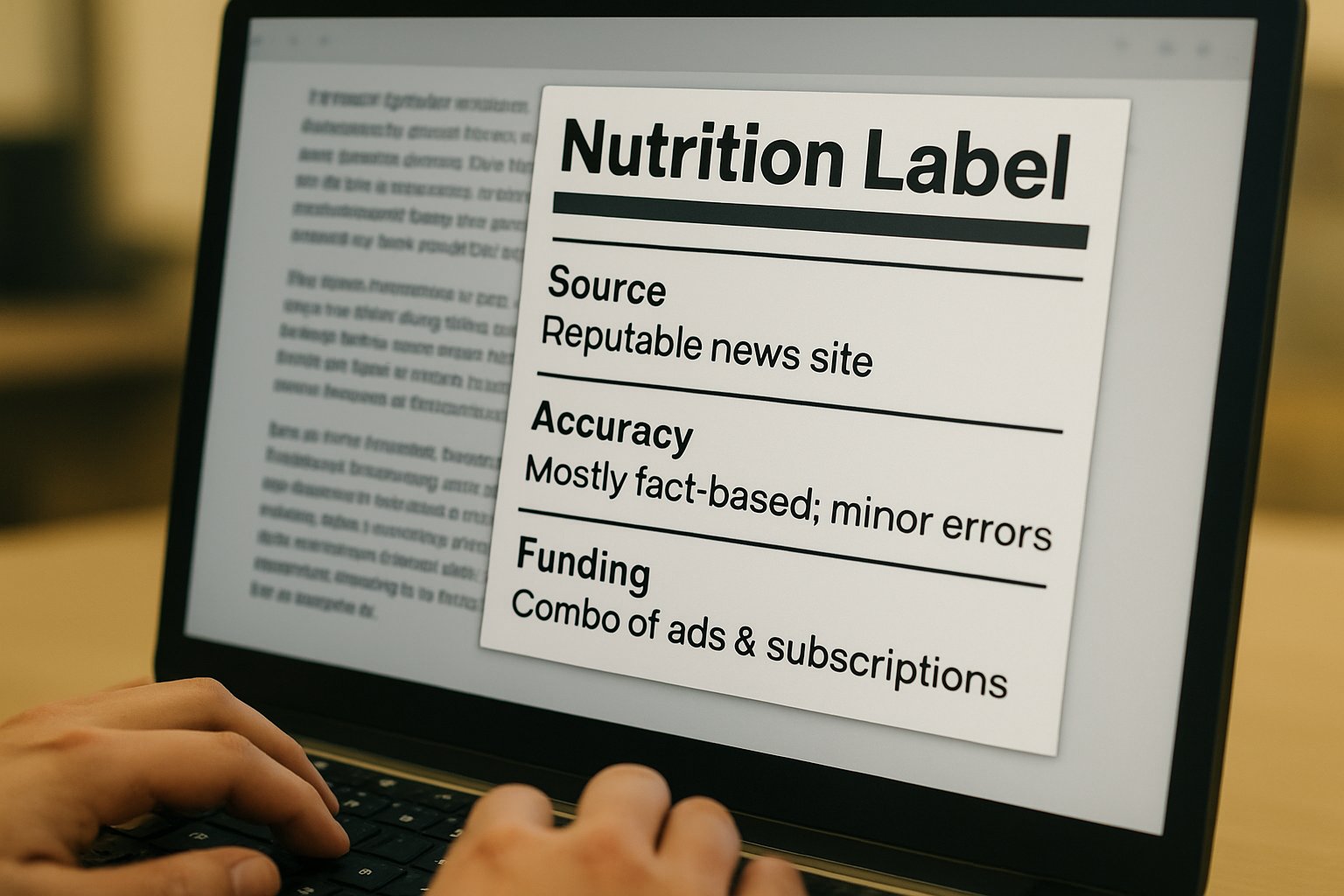
These findings show concentrated sourcing and missing transparency. However, the proposed framework offers a practical diagnostic step toward balance. Subsequently, attention turns to the economic rationale behind those policy levers.
Uneven Source Visibility Issues
Media economists warn that traffic shifts follow source visibility inside AI assistants. Moreover, early evidence suggests referral losses already hurt local publishers. Reuters Institute surveys found 7% of global adults now get weekly News headlines from chatbots. In contrast, usage rises above 20% among under-25s in several markets. Consequently, ad revenue and subscription funnels risk further erosion. The institute therefore insists that any licensing regime prioritises plural payment distribution. Carsten Jung frames this as a safeguard against platform winner-takes-all dynamics. Information Integrity again sits at the centre of that argument.
The economic stakes extend beyond journalism revenues. Moreover, civic pluralism depends on diverse visibility signals. Therefore, we must examine the policy toolkit now on the table.
Proposed Policy Framework Explained
IPPR outlines three complementary levers for regulators. First, mandatory Nutrition Labels attached to every AI answer summarising journalistic content. Second, collective licensing covering text, audio, and video archives. Third, targeted public funds supporting local investigations and innovation experiments.
- ChatGPT cited The Guardian in 58% of sampled responses.
- BBC links appeared in fewer than 1% of answers across tested tools.
- Google AI Overviews reaches roughly two billion monthly users worldwide.
- Weekly AI chatbot headline consumption sits at 7% globally, 20% among under-25s.
Additionally, IPPR asks the UK Competition and Markets Authority to oversee any pricing disputes. Owen Meredith from the News Media Association supports that approach. Nevertheless, he cautions against dilution of copyright protections. Information Integrity among smaller outlets, he argues, depends on enforceable rights.
The framework blends transparency, payment, and public interest media support. Consequently, implementation details demand careful technical planning. Meanwhile, independent researchers evaluate whether labels will truly help audiences.
Industry And Academic Perspectives
Academic experiments complicate the label narrative. Altay et al. found that AI-generated tags decrease perceived accuracy and sharing. In contrast, detailed provenance cues can repair some trust losses. Furthermore, standards like C2PA embed tamper-evident metadata in files. Adobe, Microsoft, and BBC champion that approach across creative sectors. However, adversaries can still strip or spoof markers. IPPR recognises this limitation yet views labels as a near-term bridge. Industry voices echo the balance message. Google notes improving disclosure design while resisting blanket fees. OpenAI argues that broad fair-use exceptions already cover training and News snippets. Nevertheless, legislative momentum appears to favour remuneration schemes.
Diverse stakeholders accept that Information Integrity requires multilayer solutions. Consequently, technical, legal, and behavioural tools must align. Implementation challenges now take centre stage.
Implementation Hurdles Ahead Now
Rolling out Nutrition Labels poses engineering, design, and governance hurdles. Firstly, AI vendors need reliable source-tracking pipelines across multimodal corpora. Secondly, publishers must adopt consistent metadata templates and APIs. Moreover, small outlets lack funds for advanced tooling. Public grants could fill that capacity gap. Additionally, dispute resolution processes must remain swift. Regulators fear platform delays might blunt the entire scheme. Information Integrity could suffer if rollout becomes patchy.
Technical debt and resource inequality threaten schedule credibility. However, prototype pilots could surface practical fixes early. Strategic guidance for publishers therefore deserves examination next.
Strategic Steps For Publishers
Publishers should audit crawler permissions and update robots.txt entries. Moreover, aligning metadata fields with C2PA early reduces future friction. Consequently, internal product teams need cross-functional representation from editorial, legal, and commercial units. Leaders could also explore collective bargaining alliances coordinated through industry associations. Professionals can enhance their expertise with the AI Ethics Certification™. Such training embeds Information Integrity principles into daily workflows. In contrast, reactive compliance often raises costs and tensions. Publishers further benefit by experimenting with transparent attribution widgets on their own sites.
Early action secures technical readiness and negotiation leverage. Therefore, publisher strategies directly influence broader ecosystem health. Finally, we look toward future legislative timelines.
Outlook For Information Integrity
Parliamentary committees expect draft AI News legislation within twelve months. Meanwhile, the European Union advances similar disclosure requirements in its Digital Services Act updates. Additionally, the United States debates fair use exemptions and compulsory licensing. Global alignment would improve Information Integrity across borders, yet national interests differ. Moreover, platform lobbying resources remain formidable. Nevertheless, public concern about deepfakes and algorithmic bias sustains Information Integrity policy urgency. IPPR plans to publish progress scorecards every quarter. These reports will monitor label adoption, licensing deals, and plural funding.
Momentum appears steady yet incomplete. Consequently, continued stakeholder collaboration remains critical for lasting results.
The thinktank’s call for Nutrition Labels and licensing has surfaced a crucial policy inflection point. Moreover, the data underline why Information Integrity cannot be an afterthought during rapid AI deployment. Academia, industry, and regulators increasingly agree that transparency, payment, and provenance must coexist. Nevertheless, practical engineering and business hurdles remain significant. Consequently, proactive planning offers firms the best defence against future shocks. Therefore, readers should examine internal workflows and pursue specialized learning. Start today by exploring the linked AI Ethics Certification™ and other provenance resources.


