

AI CERTS
2 months ago
Tesla AI Shift: Pivot From Q4 Deliveries To Robotaxi Bets
In contrast, analysts say volume metrics now matter less than strategic progress in autonomy and robotics. Therefore, questions center on whether software margins can replace shrinking hardware growth. This report unpacks the numbers, the narrative, and the road ahead for investors. It also explains how Q4 deliveries interact with ambitions spanning car to code.
Delivery Miss Context Shift
Firstly, Tesla produced 434,358 vehicles during the quarter but delivered fewer than forecast. Visible Alpha consensus had pointed to about 434,000 units. Therefore, the 418,227 figure marked a 15.6 percent yearly decline. Q4 deliveries also confirmed Tesla ceded the annual EV crown to BYD, which sold roughly 2.26 million cars. Nevertheless, the Tesla AI shift narrative muted any material sell-off.
Moreover, energy storage deployments hit a quarterly record of 14.2 GWh. Consequently, bulls highlighted diversification beyond automobiles. Nevertheless, gross margin details will not appear until the 28 January earnings call. Until then, traders lean on headline indicators.
The delivery shortfall underscored softer end-market demand and rising competition. Yet headline weakness alone failed to dictate valuation moves. Next, we examine why the market narrative rapidly changed.
Market Narrative Rapid Changes
Gene Munster wrote that investors have embraced the physical AI storyline. Similarly, Morgan Stanley called robotaxi milestones the primary catalyst for 2026. Therefore, focus jumped from quarterly math to decade-long platform bets. The Tesla AI shift appeared in every major commentary summary.
Reuters quoted trader Dennis Dick, who said deliveries are being ignored because of Optimus and robotaxi dreams. In contrast, the Financial Times urged caution, citing regulatory and execution risks. Consequently, the debate now contrasts long-duration optionality with nearer term softness.
Opinions diverge, yet most agree narrative gravity has migrated toward autonomy and robotics. Valuation swings reflect that shift more than unit output. To understand the technical foundation, we must explore Tesla's compute overhaul.
AI Hardware Overhaul Details
During 2025, Musk shelved the in-house Dojo supercomputer program. Subsequently, he announced AI5 and AI6 chips to be fabricated by TSMC and Samsung. Moreover, Tesla is expanding external GPU clusters in Austin to accelerate training throughput. The change exemplifies a car to code mindset inside engineering ranks.
However, winding down Dojo also meant reallocating specialized staff. Talent churn worries some analysts who track semiconductor execution. Nevertheless, proponents argue partner fabs reduce capital intensity and schedule risk. The Tesla AI shift thus relies on outsourced manufacturing coupled with in-house software.
Chip strategy clarity reassured many but left open performance unknowns. Compute capacity remains pivotal for autonomous driving breakthroughs. We now turn to the products that would consume that compute.
Robotaxi And Optimus Outlook
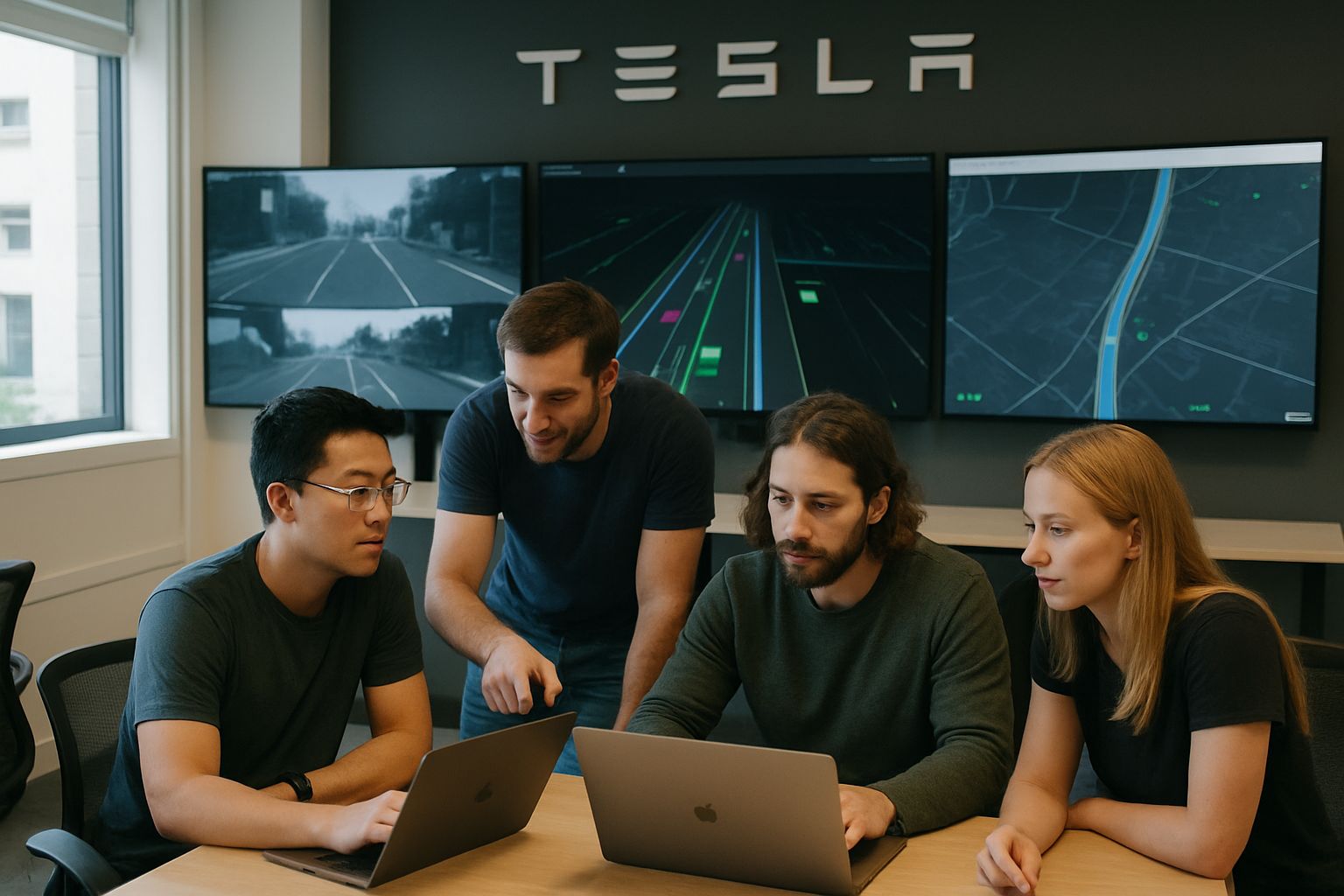
Tesla plans an unsupervised robotaxi launch, dubbed Cybercab, in limited pilots during 2026. Meanwhile, Optimus humanoid units are testing basic factory tasks. Additionally, unsupervised autonomous driving hinges on regulatory approvals across numerous jurisdictions. Morgan Stanley expects early service revenue only after fleet miles prove safer than humans.
FSD software remains the enabling stack for both vehicles and robots. Tesla now prices the package at fifteen thousand dollars, yet uptake slowed during 2025. Therefore, management hopes a subscription model accelerates adoption ahead of robotaxi rollouts. Success could transform revenue from episodic hardware sales to recurring code streams.
Professionals can enhance their expertise with the AI+ Human Resources™ certification. Such programs illustrate how skill development mirrors Tesla's car to code philosophy. Consequently, workforce readiness becomes critical for scaling physical AI operations.
Robotaxi and Optimus timelines still face technical and legal hurdles. However, their potential service margins remain the heart of the bull thesis. Ultimately, market faith in the Tesla AI shift depends on flawless execution.
Investor Debate Intensifies Rapidly
As of early January, Tesla traded near a one point four trillion dollar market cap. That valuation implies lofty forward price-earnings multiples above one hundred according to several datasets. Nevertheless, some analysts argue shares look inexpensive against robotaxi total addressable markets. Critics counter that the Tesla AI shift already bakes near perfect execution into price.
Additionally, short sellers point to falling automotive gross margins and rising inventory. In contrast, bulls highlight record energy storage growth and accelerating FSD software take rates. Moreover, they consider autonomous driving data advantages defensible against rivals. Both camps watch Q4 deliveries for clues about cost absorption and demand elasticity.
- Large potential robotaxi service margins over sixty percent, per Deepwater estimates.
- Execution risk from unfinished safety validation and complex legislation.
- BYD competition intensifies pricing pressure in core vehicle segment.
Valuation therefore rests on software leverage rather than near-term shipments. Consequently, every autonomy milestone could swing billions in market value. Finally, we outline the roadmap Tesla must navigate.
Strategic Roadmap Ahead Now
Tesla will report full financials on 28 January, providing margin and cash flow details. Furthermore, management may reveal updated guidance on AI5 tape-outs and GPU procurement. Regulators will review expanded autonomous driving pilots in California and Texas during the spring. Therefore, investors will monitor incident data and legislative hearings closely.
FSD software version thirteen is scheduled for a wider push, targeting zero disengagement in suburban routes. Meanwhile, production engineers plan Optimus trial deployment at the Fremont plant. Q4 deliveries trend will inform whether Fremont needs capacity tweaks or price adjustments. The Tesla AI shift will only be validated when revenue diversification actually accelerates.
Key events therefore converge within the next twelve months. Successful milestones could inspire another re-rating, while stumbles may re-center emphasis on manufacturing. We conclude with practical considerations for stakeholders.
Ultimately, Tesla stands at a crossroads where execution must justify ambition. Consequently, the Tesla AI shift will face its real test in regulatory halls and customer garages. Investors should remember that dazzling demos cannot replace audited results. Therefore, monitoring FSD software deployment metrics remains essential for clarity. In contrast, engineers must keep translating car to code innovations into stable revenue streams. Moreover, each robotaxi mile logged safely will strengthen confidence in the Tesla AI shift story. Nevertheless, setbacks could spark swift multiple compression if optimism fades. Professionals evaluating exposure should diversify, stay alert to filings, and pursue continuous education. Finally, the Tesla AI shift invites bold vision, yet disciplined analysis will separate hype from value.


