

AI CERTs
13 hours ago
Synthetic Content Liability Exposure Escalates Indian Ad Risk
As India’s digital ad spend surges, a new threat shadows campaign ROI.
Draft IT Rules targeting deepfakes could redefine synthetic content liability exposure for every market participant.
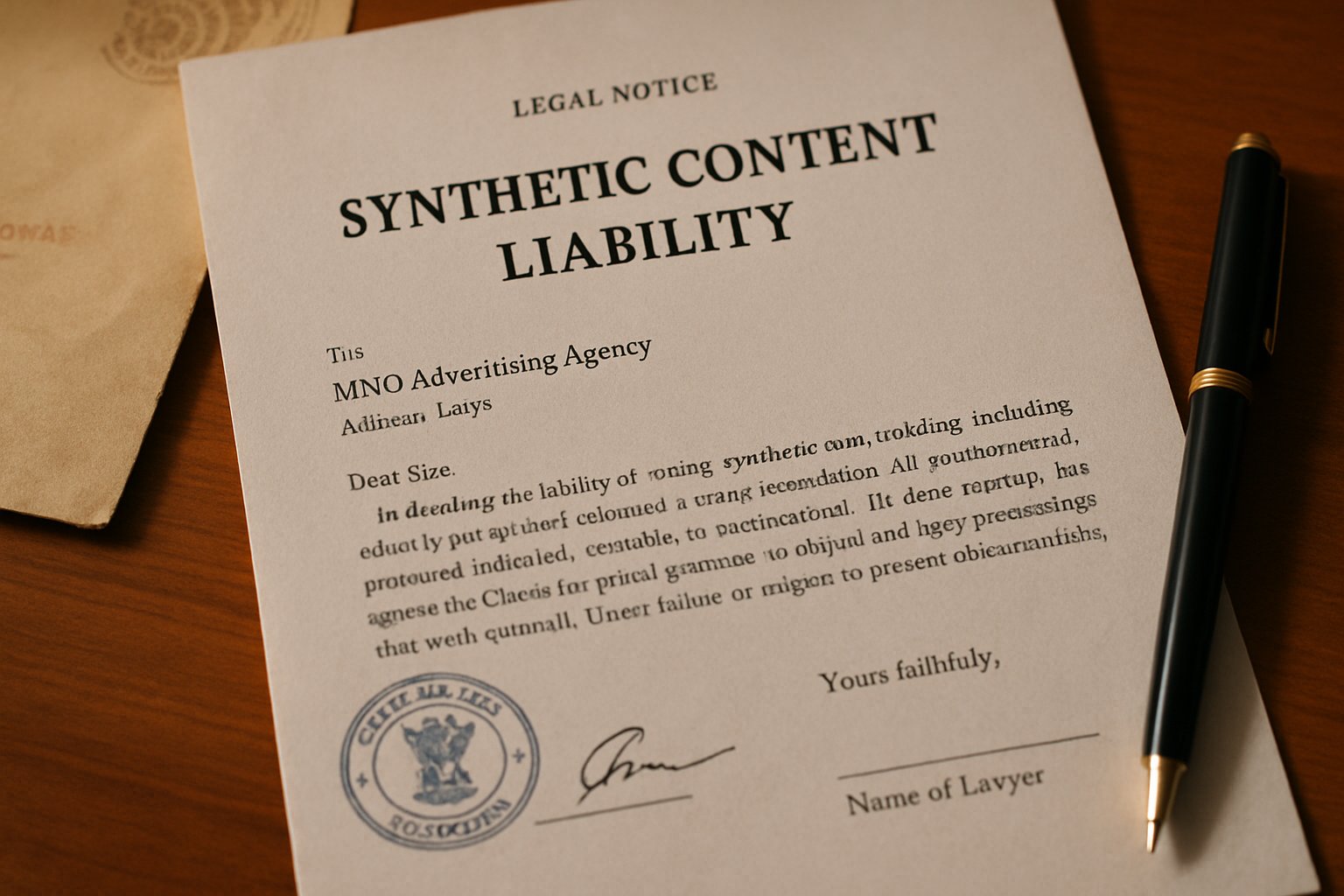
Meanwhile, courts issue urgent takedown orders against AI impersonations of Bollywood giants.
Consequently, advertisers must navigate overlapping technical, legal, and reputational hazards while scaling generative campaigns.
GroupM and Dentsu estimate digital advertising now commands up to 57% of India’s ₹1.3-lakh-crore market.
However, Sumsub detected a 245% yearly rise in deepfakes, signalling escalating fraud pressure.
Therefore, understanding the coming rules, court trends, and mitigation tactics is mission-critical.
This article unpacks the stakes, offers practical guidance, and links certification resources to boost readiness.
Readers will grasp how synthetic content liability exposure intersects AI legal compliance and adtech governance imperatives.
Moreover, actionable checklists will help teams protect budgets and brand equity.
Stakeholders cannot delay preparation because enforcement timelines may accelerate after consultations conclude.
Draft Rules Transform Liability
MeitY’s October 2025 draft amendments formally define synthetically generated information and impose strict labelling duties.
Platforms must display visual markers covering at least 10% of assets or audible cues during the first 10%.
Additionally, Significant Social Media Intermediaries must collect user declarations and apply reasonable verification technology.
Non-compliance jeopardises safe harbour protections, thereby expanding synthetic content liability exposure across the value chain.
In contrast, industry bodies argue the approach overreaches and could sweep benign filters into enforcement.
They instead request risk-based tiers and staggered obligations.
The draft rules place heavy technical and documentary burdens on platforms and advertisers.
However, policymakers insist clear labels are vital for user trust.
These divergent views set the stage for heightened courtroom attention.
Judicial Signals Intensify Risk
Bombay High Court recently called deepfake impersonations of Akshay Kumar “truly alarming” while ordering immediate removal.
Similarly, Suniel Shetty secured interim relief against unauthorised likeness use.
Consequently, courts are expanding personality rights and signalling readiness to penalise brands appearing in synthetic ads.
Legal scholars warn that litigants may soon target advertisers for synthetic content liability exposure when endorsements lack consent.
Moreover, safe harbour loss under the draft could complicate defence strategies previously relying on intermediary immunity.
Indian courts now treat persona misuse via AI as a public-order threat.
Therefore, advertisers must monitor proceedings and update risk matrices urgently.
The market implications of these legal signals are already visible in budget planning.
Market Impact For Advertisers
Digital spending growth continues at high-teens CAGR, yet fraud and brand-safety costs climb in parallel.
Integral Ad Science notes higher fraud rates for unoptimized placements during 2025 Indian campaigns.
Meanwhile, deepfake detection vendors expect millions of synthetic files circulating by next year.
Therefore, media planners confront synthetic content liability exposure alongside traditional viewability metrics.
- Digital ad share: 40–57% of ₹1.3-lakh-crore market (GroupM, Dentsu).
- Deepfake detections: 245% YoY increase, Sumsub Q1 2024.
- Label requirement: 10% visual coverage, MeitY draft.
Consequently, procurement teams are revising contract clauses to demand provenance evidence and indemnities.
Rising fraud statistics underscore direct financial threats for campaign performance.
In contrast, proactive planning can convert compliance into a competitive advantage.
Those preparations begin with assessing operational feasibility of the draft rules.
Implementation Hurdles Loom Large
Platforms host billions of uploads daily, making universal watermarking technically arduous.
Furthermore, verifying user declarations at upload demands robust identity proof and secure storage.
Adtech stacks must also propagate labels across programmatic pipes without degrading creative fidelity.
Advertisers fear engagement drops when overlays consume 10% of screen real estate.
Nevertheless, failure to comply could escalate synthetic content liability exposure and invite injunctions.
Advertisers therefore evaluate detection partners, cryptographic provenance tools, and updated asset pipelines.
Technical friction remains high, especially for user-generated environments.
However, scalable solutions are emerging through collaborative standards work.
Those brand-safety solutions intersect broader content adjacency concerns.
Brand Safety Complications Emerge
Brands already police hateful or violent content adjacency; synthetic media multiplies that complexity.
Moreover, deceptive AI endorsements can falsely imply sponsorship, triggering swift legal notices.
Integral Ad Science and DoubleVerify offer pre-bid filters, yet settings must align with evolving jurisprudence.
Consequently, risk officers elevate synthetic content liability exposure to board-level dashboards.
Stakeholders also refine crisis communication playbooks to address viral deepfakes within the first hour.
Synthetic adjacency risk demands integrated brand-safety, legal, and PR coordination.
Therefore, companies require structured compliance frameworks.
Building those frameworks starts with a detailed playbook.
Compliance Playbook For Teams
First, map content workflows and flag AI-assisted stages.
Subsequently, mandate creator attestations confirming consent for likeness and absence of unlabelled manipulation.
Furthermore, negotiate service contracts adding warranties, indemnities, and real-time takedown cooperation.
An internal review board should score assets against AI legal compliance and adtech governance benchmarks.
Consequently, incident response accelerates and liability risk declines.
Below is a quick checklist.
- Audit AI tool inventory quarterly.
- Enforce watermark verification before publication.
- Integrate third-party fraud detection APIs.
- Train staff on court trends and IT Rules.
- Store consent records for six years.
Together, these measures shrink synthetic content liability exposure during campaign lifecycles.
Structured governance embeds accountability at creative, contractual, and operational layers.
However, ongoing education remains essential.
Certification programs can fill that knowledge gap.
Certification Pathways Forward Now
Professionals can enhance expertise with the AI Policy Maker certification.
The syllabus covers AI legal compliance, content provenance, and risk communication.
Moreover, participants learn adtech governance frameworks aligning with emerging Indian standards.
Certification holders signal readiness to mitigate synthetic content liability exposure during regulatory audits.
Consequently, brands view certified staff as strategic assets while selecting agency partners.
Specialised training accelerates enterprise adaptation to shifting policy.
Therefore, upskilling complements technical safeguards.
A holistic outlook now brings us to final considerations.
India’s advertising surge will continue, yet the compliance landscape grows sharper each quarter.
Draft rules, assertive judges, and soaring deepfake volumes converge to magnify synthetic content liability exposure across campaigns.
However, brands that embed AI legal compliance and adtech governance into workflows can protect revenue and reputation.
Consequently, teams should adopt playbooks, partner with verification vendors, and pursue recognised certifications.
Act now to future-proof creative pipelines and secure customer trust before enforcement tightens.
Moreover, prompt action positions your brand as a responsible innovator in a crowded marketplace.
Visit the certification portal today and start building resilient, trustworthy campaigns.
Your future market share could hinge on decisions made before the rules crystallise.


