

AI CERTS
2 hours ago
Surrey’s AI Knee X-ray Signals Predictive Health Revolution
Global Osteoarthritis burden already tops 600 million sufferers. Consequently, any tool that guides earlier intervention could reduce pain and surgical costs. Speed matters too. The Surrey network predicts in under three seconds, nearly nine times quicker than a 2022 benchmark. Nevertheless, excitement must balance caution because generative models can hallucinate misleading details. Regulators and hospitals therefore watch the project carefully.
Surrey scientists shared results at MICCAI 2025 and on arXiv, inviting collaboration. Industry professionals now ask whether such prognostic images will reshape orthopaedic workflows. The following analysis explores technical choices, performance figures, clinical impact, and governance pathways.
AI Transforms Predictive Health
Surrey’s approach exemplifies how Predictive Health shifts from spreadsheet statistics to vivid imaging. Furthermore, diffusion models now rival human radiographers at generating plausible anatomy in seconds. The team first compresses each Knee X-ray using a VQ-VAE. Subsequently, a latent diffusion process denoises the compact code until a future image appears. In contrast, earlier GAN models required heavier compute and produced artifacts. The new method offers clarity that clinicians trust more easily.
Researchers then feed the same latent features into a classifier estimating progression Risk. Consequently, outputs remain consistent because both tasks share information. Osteoarthritis severity often advances silently, yet visual forecasts can motivate patient lifestyle changes. David Butler emphasized this motivational power during the MICCAI presentation. Moreover, presenting both current and projected images side by side supports shared decision making.
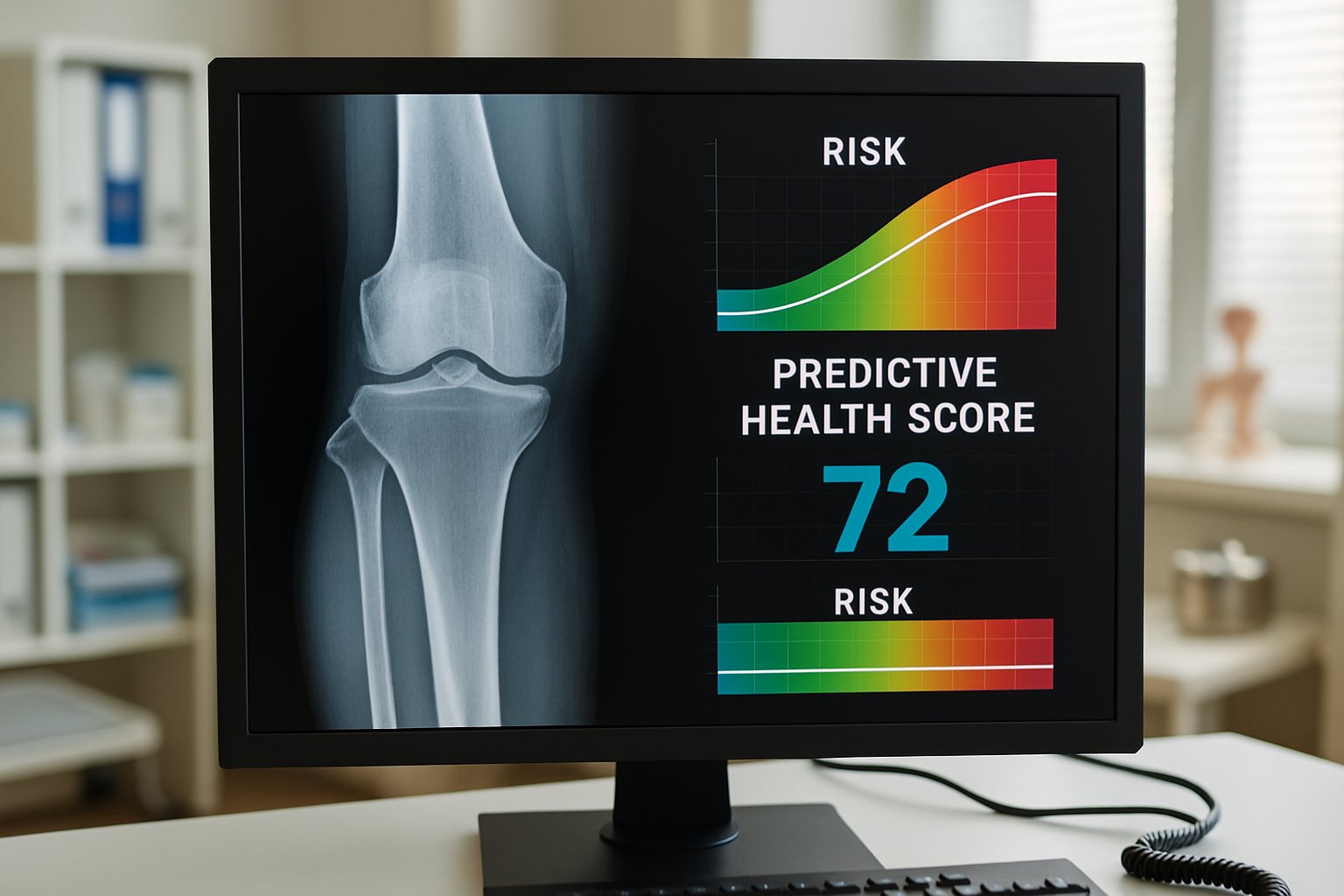
These advances demonstrate AI’s growing maturity. However, real-world adoption hinges on reproducibility, governance, and stakeholder confidence. The next section explains how the study validated accuracy and speed.
Knee Forecasting Breakthrough Study
The research drew on the Osteoarthritis Initiative, a respected longitudinal dataset. Investigators accessed 47,027 Knee radiographs from 4,796 participants imaged at multiple visits. Consequently, split design avoided patient leakage between training and testing. The model attained an AUC of 0.71 for twelve-month progression Risk. Moreover, this edged past a 2022 StyleGAN baseline that reached 0.69. While the margin seems small, small gains still matter when millions face potential surgery. Additionally, Surrey’s network predicted sixteen anatomical landmarks, boosting interpretability. Prof. Gustavo Carneiro noted that landmark overlays highlight areas likely to deteriorate. Consequently, this incremental improvement still strengthens Predictive Health modeling claims.
Performance numbers impress, yet context matters. Therefore, the following statistics illustrate gains in speed, size, and cost.
Key Performance Statistics Overview
Technical reviewers often ask for concrete figures. Surrey supplies several headline metrics:
- AUC 0.71 for KL progression, state-of-the-art on the OAI dataset.
- Inference time 2.70 seconds per X-ray, 8.7× faster than the comparator.
- Model size around 35 million parameters versus 215 million previously.
- Training completed in 12.6 hours on one A6000 GPU; baseline needed 114.88 hours.
- Synthetic image plus landmark outputs improve Osteoarthritis interpretability.
These data highlight efficiency critical for clinic integration. Nevertheless, accuracy remains moderate, underscoring the need for cautious deployment. The architectural details driving these numbers appear next.
Model Architecture And Efficiency
Surrey engineers combined a VQ-VAE encoder with a conditional latent diffusion backbone. Additionally, multi-task heads predict landmarks and progression simultaneously. Designers selected a compact U-Net that balances speed with fidelity, an approach aligned with Predictive Health priorities for point-of-care tools. Meanwhile, knowledge distillation kept parameter count low without losing accuracy. The network accepts a single Knee X-ray and outputs a denoised latent representing the future scan. Subsequently, the decoder reconstructs a full-resolution radiograph.
Compute savings translate to deployment flexibility. Therefore, hospitals lacking high-end clusters can still run predictions on standard workstations. Professionals aiming to replicate similar pipelines can enhance their expertise with the AI Data Robotics™ certification. Moreover, modular design means other joints or organs could be substituted with minimal retraining. Such extensibility supports a broader Predictive Health ecosystem.
The technical gains are significant. However, real clinical value depends on measurable patient outcomes, addressed in the next section.
Clinical Impact And Limitations
Visual forecasts promise stronger patient engagement. Consequently, clinicians can show side-by-side X-ray pairs and discuss dietary or exercise options before irreversible cartilage loss. Nevertheless, an AUC of 0.71 means false positives and negatives remain. In contrast, gold-standard prognostic workflows rely on multi-modal data like MRI and blood biomarkers. Therefore, combining modalities could lift predictive ceilings.
Safety remains an urgent concern. Generative models may hallucinate structures, inadvertently altering perceived joint spaces. Moreover, miscalibrated Risk probabilities could trigger unnecessary anxiety or delayed treatments. External validation across devices, ethnicities, and care settings is still pending. Furthermore, ethical debates consider how insurers might misuse forecast images to deny coverage for advanced Osteoarthritis therapies.
Such uncertainties underline ongoing Predictive Health evaluation needs. Clinical promise exists alongside gaps. Therefore, researchers must pursue prospective trials and transparent reporting, as the roadmap below outlines.
Future Research Roadmap Ahead
Surrey’s team plans multi-center studies that test generalizability across imaging vendors. Moreover, calibration curves will assess how well Risk estimates match observed outcomes. Developers also intend to extend the pipeline to hip joints and lung nodules, broadening Predictive Health coverage. Additionally, federated learning could preserve privacy while incorporating diverse cohorts.
Independent evaluators request open-source code and detailed failure mode analyses. Consequently, collaborative benchmarking events at MICCAI and RSNA may accelerate refinement. These planned actions will inform regulators and shape clinical trust.
Research momentum is building. However, oversight frameworks must evolve in parallel, as the next discussion explains.
Regulatory And Ethical Considerations
Generative imaging sits in a grey regulatory zone. The American College of Radiology, Pew, and the FDA therefore examine new accreditation pathways. Moreover, proposed ARCH-AI frameworks demand continuous post-market monitoring. Hospitals must log every prediction, track errors, and update models when drift emerges. Consequently, Predictive Health vendors will need strong governance teams.
Ethical obligations extend beyond compliance. Visual forecasts might influence workplace or insurance decisions, raising fairness issues. Additionally, clinicians remain accountable for final diagnoses, so user interfaces should foreground uncertainty and baseline images. In contrast, fully autonomous decisions would breach current medical norms.
Clear rules encourage innovation. Nevertheless, enforcement mechanisms must protect patients without stifling useful Knee insights. Coordinated dialogue among data scientists, radiologists, lawyers, and patients will define acceptable boundaries.
Regulatory clarity will reinforce public trust. Therefore, a balanced path can unlock the full Predictive Health potential outlined throughout this article.
Conclusion And Next Steps
Surrey’s diffusion pipeline offers a vivid glimpse of future-focused prognosis. Moreover, fast inference and clear visuals promise stronger conversations between patients and clinicians. Nevertheless, moderate accuracy, potential hallucinations, and regulatory ambiguity temper enthusiasm. Consequently, the community must pursue external validation, continuous monitoring, and transparent reporting. Independent audits will verify that Osteoarthritis and other conditions benefit without hidden harms.
Professionals interested in shaping this future should master generative imaging principles and ethical frameworks. Therefore, explore the linked certification and follow upcoming multi-center trials. Predictive Health will mature only through rigorous science and responsible deployment.


