

AI CERTS
3 months ago
Surgical Robotics Claims: Reality, Evidence, and Future
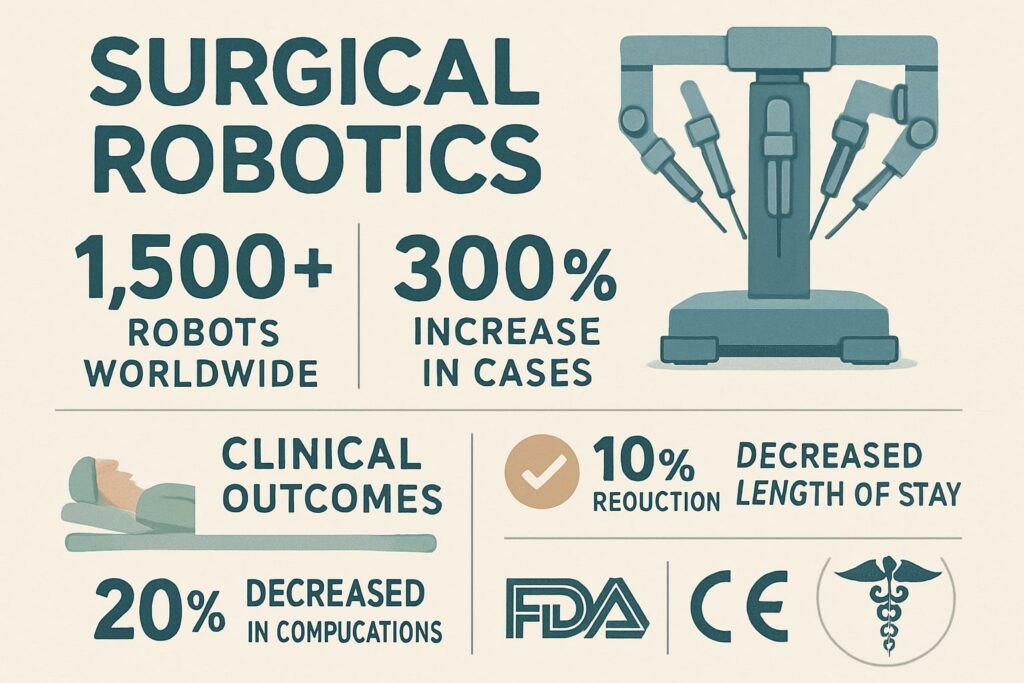
This article examines evidence, regulatory context, and market realities surrounding Surgical Robotics today.
Furthermore, we debunk the 10,000-procedure myth while outlining legitimate progress in Healthcare Automation.
Readers will gain data-driven clarity, actionable insights, and certification resources for Precision Surgery careers.
Moreover, every sentence remains concise, ensuring efficient comprehension for busy professionals.
Consequently, you can separate scientific fact from optimistic spin.
Let's begin by contrasting hype with documented outcomes.
Autonomy Hype Versus Reality
Many press releases blur distinctions between robot-assisted and autonomous systems.
Nevertheless, most commercial platforms operate at Level 1 autonomy, meaning surgeons control every instrument movement.
Therefore, most Surgical Robotics deployments still require constant human oversight.
In contrast, fully autonomous demonstrations remain confined to animal or ex-vivo models, with Johns Hopkins reporting eight gallbladder removals.
Therefore, no peer-reviewed study validates 10,000 human procedures without complications under autonomous control.
Levels Of Surgical Autonomy
Researchers classify autonomy from Level 1 assistance to Level 5 full independence.
Task automation, labeled Level 2, includes automated suturing or stapling under supervision.
Conditional autonomy, or Level 3, allows the robot to suggest maneuvers that surgeons approve in real time.
Moreover, no clinical system has advanced beyond Level 3 to date.
These facts dismantle exaggerated numbers. However, understanding market scale provides further context.
Current Global Market Scale
Robot-assisted surgery volumes already dwarf experimental autonomy figures.
Intuitive Surgical reported 2.68 million da Vinci cases in 2024, reflecting massive adoption of Surgical Robotics worldwide.
Meanwhile, Medtronic's Hugo trials involved 193 patients, showing safe hernia repair yet highlighting smaller scale.
- da Vinci installed base: 10,189 systems (Q1 2025)
- SS Innovations claims over 5,000 telesurgeries
- Global Surgical Robotics market estimates range USD 4–12 billion
Analysts divide the market into orthopedic, soft-tissue, and neurosurgical segments, each with distinct reimbursement frameworks.
Orthopedic robots dominate capital spending because implant procedures often generate predictable revenue streams.
Additionally, payers increasingly reimburse Healthcare Automation technologies that demonstrate measurable outcomes.
Consequently, the market is booming, though autonomous volumes lag behind assistive counterparts.
Next, we examine breakthrough research driving that potential.
Recent Key Research Breakthroughs
Academic labs push boundaries through controlled experiments.
Johns Hopkins' SRT-H autonomously completed eight cholecystectomies on porcine tissue using language-conditioned imitation learning.
Moreover, the STAR platform previously outperformed surgeons in suturing tasks, demonstrating submillimeter precision.
Additionally, intercontinental telesurgery trials by SS Innovations showcased robust connectivity across 10,000 kilometers.
Yet, each study involved limited cohorts and lacked longitudinal follow-up.
Deep learning models powering autonomy rely on meticulously labeled video frames captured during thousands of laparoscopic cases.
However, acquiring high-quality annotations demands significant surgeon time and still suffers from inter-observer variability.
Nevertheless, these achievements sustain investor interest in next-generation Surgical Robotics platforms.
Breakthroughs prove technical feasibility. Nevertheless, benefits and constraints deserve balanced analysis.
Accordingly, we now explore advantages and drawbacks.
Core Benefits And Limitations
Precision Surgery promises reduced variability through consistent instrument trajectories.
Furthermore, Healthcare Automation could extend specialty care into underserved regions via telesurgery and tele-mentoring.
- Submillimeter repeatability on predefined tasks
- Reduced surgeon fatigue during lengthy procedures
- Potential 24/7 coverage in emergency settings
Nevertheless, device malfunctions remain a risk, as FDA MAUDE reports document past injuries.
In contrast, high system costs and training demands slow hospital adoption.
Therefore, cost-benefit analyses must accompany every procurement decision.
Automated camera control already reduces scrub-nurse workload, freeing staff for higher value tasks.
Nursing unions, however, caution that efficiency gains should not translate into staffing reductions without careful study.
Consequently, hospitals exploring Surgical Robotics must balance advantages against technical debt.
Advantages excite stakeholders; however, unresolved challenges temper expectations.
Regulatory frameworks illustrate those challenges more clearly.
Regulatory And Liability Landscape
Regulators classify autonomy using Levels 1 through 5.
Currently, most cleared devices occupy Level 1, with only conditional autonomy experiments approaching Level 3.
Emerging guidance specifically targets data drift in adaptive Surgical Robotics algorithms.
Moreover, no Level 4 or Level 5 systems possess FDA clearance for human use.
Consequently, liability rests primarily on the operating surgeon and hospital.
However, AI decision-making complicates accountability, prompting calls for updated guidance.
Professionals can enhance their expertise with the AI Robotics Specialist™ certification.
Meanwhile, the European Union's AI Act will impose risk-based classifications, likely affecting CE marking for autonomous surgical systems.
Japan and Singapore have launched sandboxes permitting limited autonomy trials under strict data reporting requirements.
Clearer rules will build trust; meanwhile, education prepares teams for evolving standards.
Finally, strategic outlooks illuminate next steps.
Future Outlook And Steps
Market analysts predict double-digit growth through 2030 as component prices fall.
Consequently, mid-tier hospitals plan pilot Surgical Robotics suites within five years.
Furthermore, edge computing and 5G will lower latency, enabling near-real-time telesurgery.
Additionally, Precision Surgery algorithms will improve by training on federated datasets, protecting patient privacy.
Collaborative datasets will refine Precision Surgery decision support, shortening learning curves.
In contrast, sceptics note that reimbursement models must evolve before autonomous deployments scale.
Subsequently, stakeholders should pursue phased rollouts with robust audit trails.
Meanwhile, cybersecurity remains essential for networked Surgical Robotics workflows.
Ethicists emphasize that informed consent must address algorithmic decision paths, data provenance, and contingency procedures.
Transparent explanations will help patients understand how machines share responsibility with clinicians.
Future success hinges on collaboration across engineering, medicine, and policy.
Let us consolidate the discussion.
Conclusion And Action Plan
Evidence shows impressive strides yet debunks overstated numbers in Surgical Robotics.
Autonomous trials remain small, while surgeon-assisted platforms dominate operating rooms.
However, continued research, clearer regulations, and targeted training will close the capability gap.
Furthermore, Healthcare Automation and Precision Surgery advances promise safer, more equitable care worldwide.
Stakeholders should pursue certifications, pilot programs, and multidisciplinary dialogue to shape responsible adoption.
Take your next step by exploring the AI Robotics Specialist™ credential and joining the conversation.
Consequently, early adopters can gain competitive advantage while building robust safety cultures.
Nevertheless, transparent data sharing remains essential to earn patient trust.


