

AI CERTS
2 hours ago
Spectroscopy oncology diagnostics gain clinical traction
Moreover, it offers executives actionable insight for investment and deployment decisions. Therefore, readers gain a concise briefing without wading through dense experimental literature. Additionally, each claim is sourced to recent peer-reviewed or regulatory documents.
The global precision oncology services market already tops USD 95 billion, according to Grand View Research. However, spectroscopy hardware for cancer remains a small slice of that opportunity. Analysts project medical hyperspectral imaging revenues to grow 5-6 percent annually through 2034. Consequently, investors and hospital boards crave reliable adoption timelines. This article clarifies those expectations by mapping drivers, barriers, and next steps. Furthermore, it connects technical nuances to board-level risk assessments.
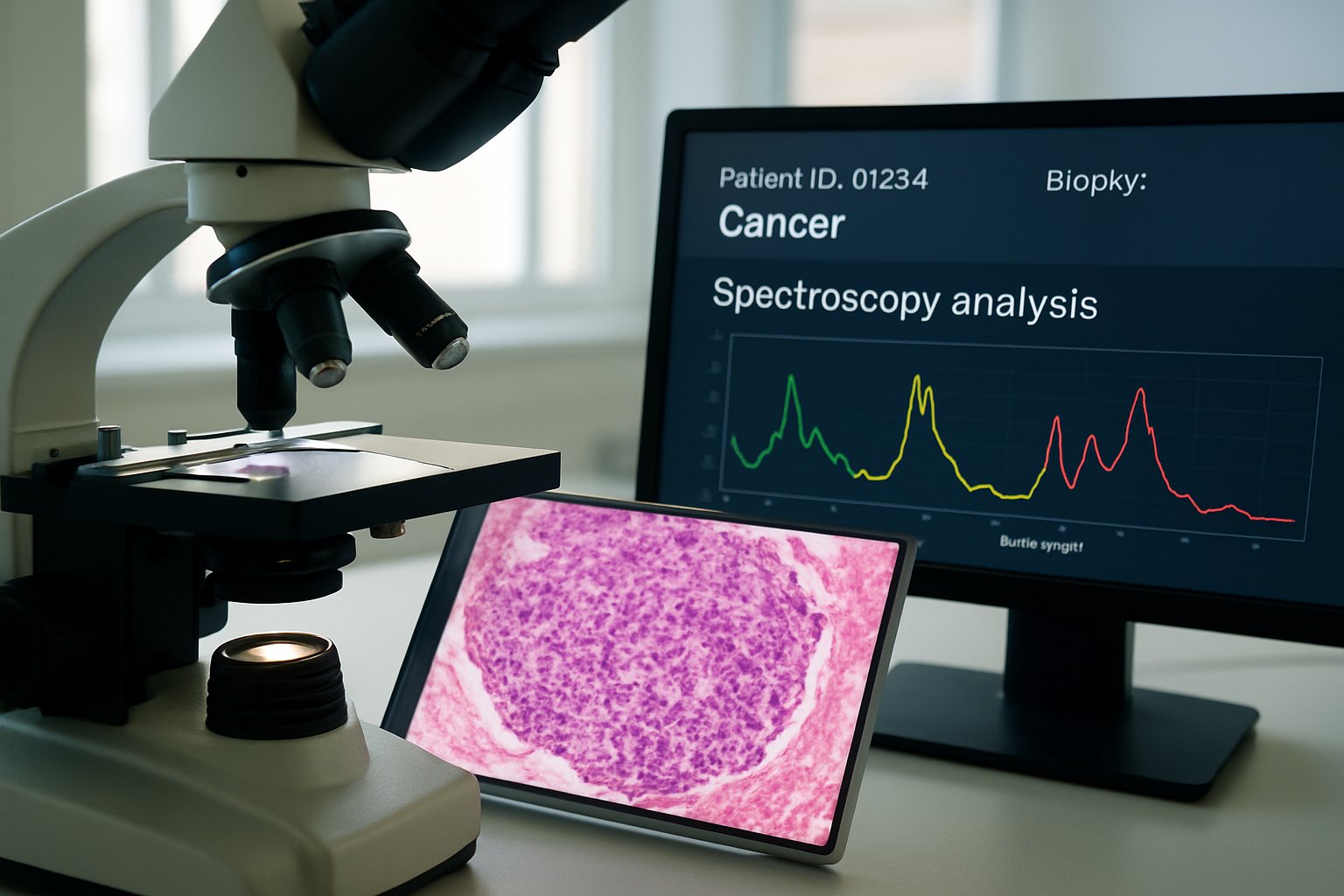
Key Market Momentum Drivers
Venture funding surged after peer-reviewed accuracy reports approached traditional pathology thresholds. Moreover, the 2025 GI Raman study reported 97.2 percent accuracy with 90 percent sensitivity. Such numbers fueled headlines across mainstream financial press. Consequently, Spectroscopy oncology diagnostics began appearing in investor pitch decks and hospital technology assessments. Precision market analysts estimate label-free optical tests could capture billions in biopsy spending. In contrast, reimbursement clarity still lags definitive FDA approvals. Nevertheless, Category III CPT codes for Vita Imaging signal payer interest.
These financial catalysts highlight robust top-line promise. However, technical adoption barriers require equal attention. Therefore, the following primer demystifies the optical foundation behind the headlines.
Essential Core Technology Primer
Raman spectroscopy directs laser light onto tissue and captures vibrational fingerprints. Additionally, coherent variants like SRS accelerate imaging by amplifying signals. Surface-enhanced substrates further boost weak scattering, enabling serum detection at femtomolar levels. However, substrate reproducibility remains challenging across laboratories. Meanwhile, hyperspectral cameras collect dozens of bands per pixel and deliver real-time chemical maps. AI pipelines manage this torrent through preprocessing, feature engineering, and probabilistic classification. Consequently, Spectroscopy oncology diagnostics can output clear malignancy scores at the point of care. Such analysis often leverages LightGBM and CNN ensembles.
Health systems value tools that integrate seamlessly with surgical workflows. Therefore, vendors bundle handheld probes, AR overlays, and cloud dashboards. This hardware-software stack underpins the incoming clinical evidence. Subsequently, performance data clarifies real-world utility.
Clinical Evidence Snapshot Today
Published results now span gastrointestinal, lymphoma, brain, and skin indications. Key studies report accuracy metrics nearing gold-standard histopathology. Moreover, Spectroscopy oncology diagnostics often excel in specificity, reducing false positives that trigger unnecessary biopsies. Nevertheless, many datasets remain retrospective and single-center. External validation across demographic groups is still limited.
Key Performance Benchmarks Now
Current peer literature offers several reference points.
- GI Raman + LightGBM: 97.2 % accuracy, 90 % sensitivity, 98.1 % specificity (Analytical Methods, 2025).
- SERS lymphoma imaging: ≈ 91.7 % recognition rate with CNN (Journal of Nanobiotechnology, 2025).
- Vita Imaging AURA skin platform: ≈ 95 % sensitivity in earlier cohorts; PMA review ongoing.
Collectively, these numbers surpass many traditional visual inspections. However, prospective outcome studies assessing survival impact remain scarce. Consequently, understanding systemic barriers is essential.
Major Barriers Facing Adoption
Signal noise, substrate variance, and fluorescence background can confound spectra. Furthermore, small training sets invite overfitting despite sophisticated algorithms. In contrast, Spectroscopy oncology diagnostics require reproducibility across instruments to satisfy regulators. Standardization bodies have not yet defined universal calibration phantoms. Additionally, reimbursement remains uncertain until CPT III codes convert to permanent listings.
These hurdles slow multi-site trials and investor confidence. Nevertheless, stakeholders are crafting mitigation strategies. Therefore, the commercialization roadmap deserves closer review.
Viable Path To Commercialization
Companies now mirror successful AI pathology submissions when approaching the FDA. Consequently, de-risking plans include multi-site prospective trials with locked algorithms. Spectroscopy oncology diagnostics appear in Pre-Market Approval dockets alongside cloud analysis modules. Furthermore, Vita Imaging aligns its PMA with a Category III CPT timeline to speed payer engagement. Instrument vendors partner with academic centers to assemble external datasets and share risk.
Health executives often demand clear return projections before capital purchase approval. Moreover, hyperspectral add-on cameras integrate with existing microscopes, reducing upfront costs. Subsequently, strategic recommendations become invaluable for decision makers.
Strategic Recommendations Moving Ahead
First, stakeholders should demand rigorous external validation plans before funding or piloting. Secondly, integrating physics-informed denoising will enhance generalizability across scanners. Third, Spectroscopy oncology diagnostics vendors must pre-align datasets with FDA guidance on real-world evidence. Moreover, executive teams can upskill staff through targeted AI certifications. Professionals can enhance their expertise with the AI Essentials™ certification. Additionally, hospitals should negotiate shared-savings contracts tied to biopsy reduction metrics.
These actions align technical rigor with financial incentives. Consequently, adoption curves could compress from decades to single-digit years. Nevertheless, stakeholders must monitor evolving evidence continually.
Spectroscopy oncology diagnostics stand at a pivotal inflection, balancing promise against validation demands. Early results show high sensitivity, yet regulators await outcome-based evidence. Nevertheless, market drivers, including rising precision care budgets, remain persuasive. Furthermore, multidisciplinary collaborations accelerate standardization and reimbursement efforts. Therefore, readers should monitor upcoming FDA decisions and multi-site trial publications. Consequently, adopting Spectroscopy oncology diagnostics early may secure competitive advantage as evidence matures. Consider acting now by evaluating pilot partnerships and enrolling staff in specialized AI courses. Finally, explore the linked certification to bolster internal talent pipelines and drive informed decisions. Moreover, consistent data sharing across institutions will sustain community trust and accelerate coverage. Broad health coalitions already plan post-market registries.


