

AI CERTs
2 hours ago
Spatial interior intelligence engines redefine workspace use
Hybrid work left offices half empty, yet leases still drain budgets. Consequently, commercial real-estate leaders crave precise evidence before downsizing. Spatial interior intelligence engines now supply that evidence through 3D capture and live sensors. Furthermore, the tools simulate new layouts, energy profiles, and service schedules within minutes. Early adopters report double-digit savings and faster leasing decisions. This article unpacks market forces, technology stacks, risks, and implementation playbooks shaping 2026 strategies. Moreover, professionals will find certification guidance to strengthen career prospects.
Market Forces Accelerate Adoption
Office utilization averaged thirty-five percent worldwide during 2024, according to CBRE benchmarks. Therefore, unused space represents vast financial waste and carbon overhead. Sensor vendor Density showed similar peaks near twenty-seven percent across its U.S. portfolio sample.
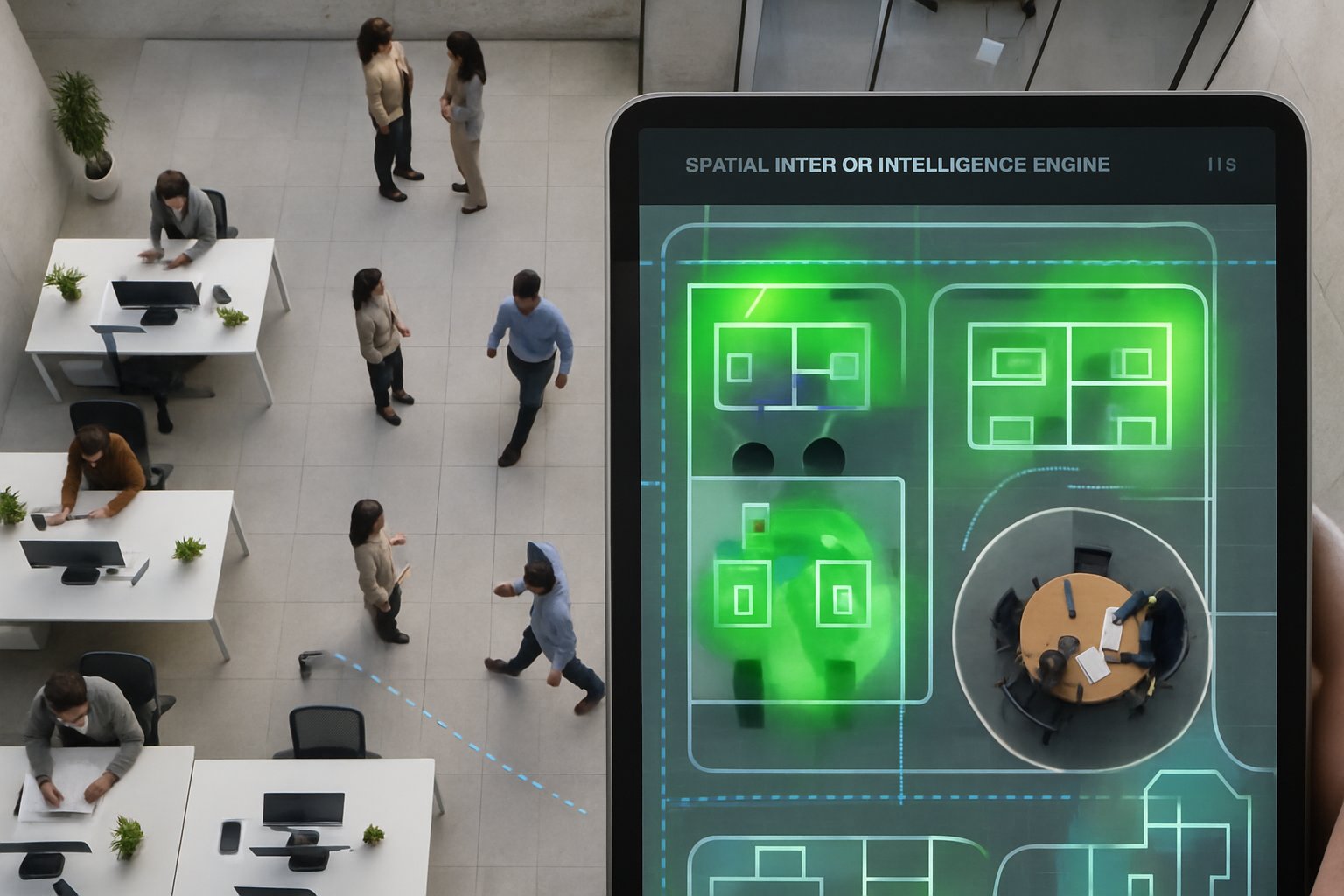
Investors responded quickly. Moreover, AstuteAnalytica projected the building digital-twin market to exceed USD 26 billion by 2033. MarketsandMarkets forecast even steeper compound growth across broader twin segments. Consequently, venture funding and mergers intensified during 2024-2025.
CoStar’s USD 1.6 billion purchase of Matterport highlighted the momentum. In contrast, smaller sensor start-ups partnered with cloud providers to reach enterprise buyers. These trends underline climbing demand for spatial interior intelligence engines across global portfolios. The acceleration sets the stage for deeper technical discussions ahead.
Adoption surges because data exposes underused space and rising costs. However, grasping the technology stack remains essential before procurement.
Technology Stack Explained Clearly
At the core, spatial interior intelligence engines integrate three technical layers. Firstly, reality-capture devices create metrically accurate 3D geometry. Matterport Pro3 LiDAR, NavVis mobile scanners, and survey drones gather billions of points each day. Secondly, occupancy sensors collect anonymous footfall, dwell, and movement signals. VergeSense, Density, and Butlr employ edge AI to safeguard privacy.
Thirdly, cloud analytics merge geometry and telemetry into constantly updated digital twins. These twins power occupancy modeling algorithms that predict demand hour by hour. Meanwhile, machine vision extracts furniture, walls, and circulation paths for layout optimization suggestions. Many platforms now embed generative AI to propose new seating charts or cleaning schedules instantly.
Azure Digital Twins, NVIDIA Omniverse, and AWS IoT handle real-time data orchestration. Additionally, open APIs allow integrators to connect CAFM, BMS, and HR systems. Therefore, spatial interior intelligence engines deliver unified insight across design, operations, and finance.
The layered stack converts raw pixels and pulses into actionable workplace metrics. Subsequently, consolidation trends reveal how vendors package these layers for scale.
Consolidation Shapes Competitive Landscape
Mergers accelerated as capital sought platform breadth. CoStar’s acquisition of Matterport fused marketplace data with capture hardware and AI. Moreover, NavVis integrated its scans into Azure Digital Twins to expand enterprise reach.
Spatial interior intelligence engines now arrive bundled with listing analytics, lease comparables, and financing tools. In contrast, sensor specialists pursue alliances instead of outright sales. Density collaborates with Siemens and IBM IWMS modules for deeper occupancy modeling.
Analysts warn consolidation may reduce integration choices and drive vendor lock-in. Nevertheless, buyers benefit from more stable roadmaps and bundled pricing.
Industry shake-ups concentrate resources around fewer, richer platforms. However, deployment success still hinges on clear use cases.
High Value Use Cases
Corporate portfolio teams start with occupancy modeling to decide renew, sublease, or exit options. VergeSense dashboards compare daily patterns against lease commitments. Consequently, one tech firm cut 18 percent of seats while raising peak utilization four points.
Facility teams then apply layout optimization to reconfigure remaining floors. AI simulations test desk ratios, meeting room mixes, and amenities before contractors arrive. Moreover, twin data triggers dynamic HVAC schedules, reducing energy use up to 20 percent.
- Cleaning crews receive sensor-driven task routes, cutting overtime hours.
- Security teams pinpoint congestion hotspots for emergency drills.
- Leasing agents embed 3D tours to shorten deal cycles.
- Employees access wayfinding apps that show live desk availability.
These scenarios showcase the versatile reach of spatial interior intelligence engines. Subsequently, leaders must balance advantages against emerging risks.
Benefits Outweigh Notable Risks
Organizations pursue quantifiable savings first. Studies report ten-to-fifteen percent space reduction after data-guided redesigns. Furthermore, automated HVAC and lighting sequences cut energy bills and carbon reporting headaches. Better wayfinding lifts employee experience metrics and retention.
Layout optimization also delays expensive construction by maximizing existing footprints. Occupancy modeling supports staggered cleaning and catering, preventing waste. Nevertheless, privacy regulations impose strict controls on personal data. Some employees fear surveillance despite anonymization claims.
Governance frameworks, audits, and consent policies mitigate distrust. Additionally, open standards reduce lock-in while simplifying future integrations.
Tangible returns are compelling, yet risk management remains mandatory. Therefore, a structured roadmap helps firms move confidently forward.
Implementation Roadmap For Leaders
Start with a clear question, not technology hype. For example, target lease reduction or service automation goals. Subsequently, run a four-week sensor pilot across representative zones. Capture baseline occupancy modeling data and user feedback concurrently.
Combine pilot scans with layout optimization scenarios to build business cases. Finance teams validate cost projections against landlord clauses. Meanwhile, privacy officers craft governance and retention policies before expanding sensors. IT integrates digital twins with CAFM, BMS, and identity systems through APIs.
Finally, executive sponsors compare scenario savings against measured results quarterly. Consequently, portfolio decisions rest on defendable evidence, not seat-of-the-pants intuition. Professionals can enhance their expertise with the AI Engineer certification.
A disciplined roadmap speeds deployment while safeguarding trust. Moreover, such discipline ensures spatial interior intelligence engines realize promised value at scale.
Conclusion And Next Steps
Spatial interior intelligence engines have shifted from novelty to necessity in corporate real estate. Market consolidation, cloud partnerships, and steep energy prices accelerate adoption worldwide. Moreover, occupancy insights now guide leases, services, and capital projects with unprecedented precision. Layout optimization simulations reduce remodeling waste while boosting user satisfaction. Nevertheless, privacy, interoperability, and governance demand disciplined oversight. Therefore, leaders should pilot small, audit often, and scale deliberately. When executed thoughtfully, spatial interior intelligence engines unlock sustained savings and ESG gains. Finally, professionals who master spatial interior intelligence engines will command growing influence across facilities, finance, and technology teams. Explore certifications and deepen expertise to lead tomorrow’s intelligent workplace initiatives.


