

AI CERTS
2 weeks ago
Space Transportation AI reshapes rocket lifecycles
Industry veterans still remember repeated Launch delays caused by late hardware discoveries. However, AI-powered digital twins flag such issues virtually, weeks before steel meets flame. In contrast, early adopters like Relativity Space share cycle-time cuts near 30 percent. These gains appear across design, factory, and mission operations.
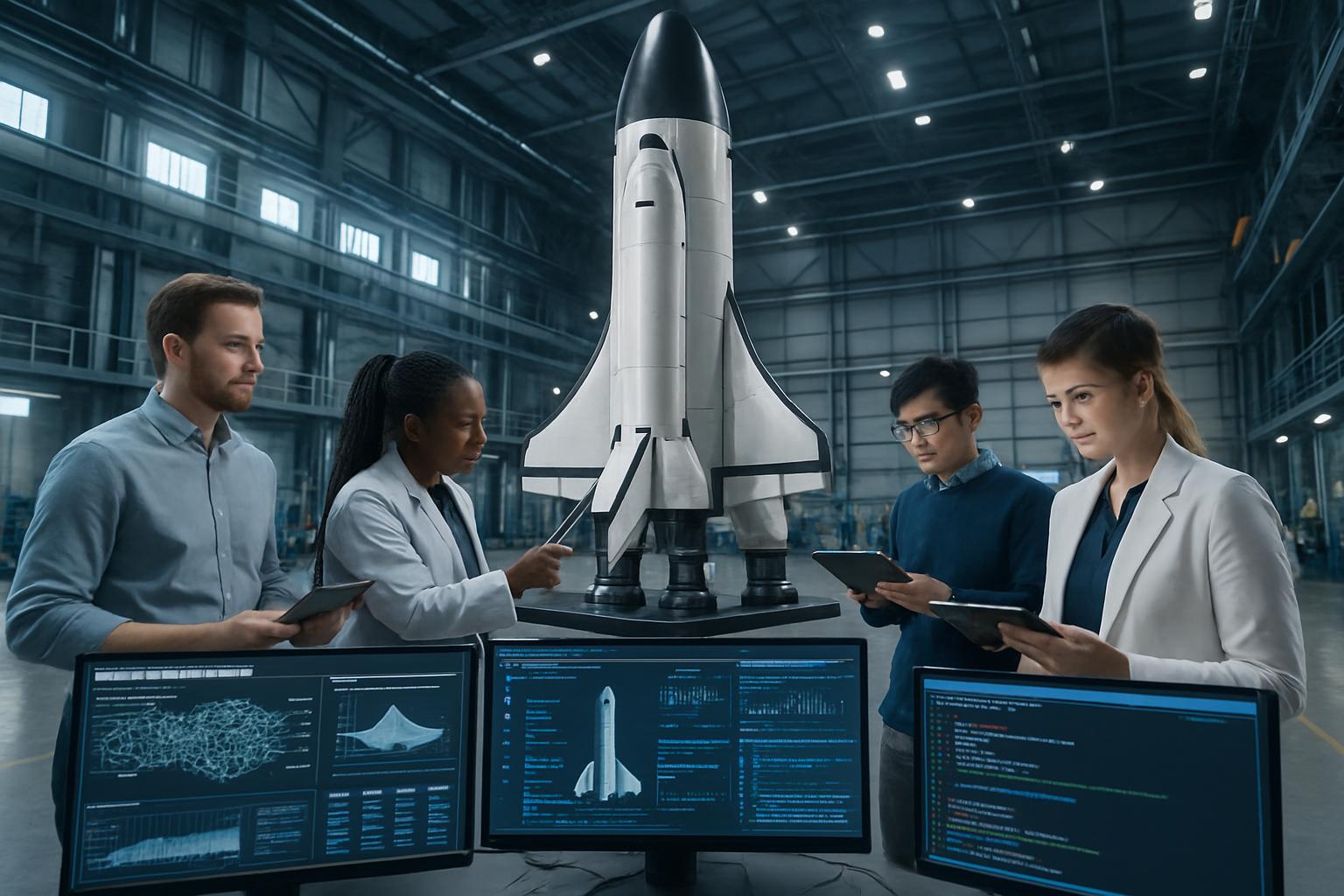
Nevertheless, new Bottlenecks surface around data quality, model verification, and certification evidence. Therefore, executives need a clear map of benefits, gaps, and next steps. The analysis below distills 2024-2025 developments reported by SpaceDaily, NASA, and private firms. Each section ends with key takeaways and a bridge forward.
AI Transforms Rocket Lifecycles
Digital twin concepts matured rapidly over the past two years. Furthermore, integrated physics models and machine learning now run in real time. Space Transportation AI pairs those twins with optimization agents that explore millions of design permutations. Consequently, engineers gain instant feedback on mass, loads, and thermal margins.
Rocket Lab’s ODySSy environment provides a public example. Moreover, NASA and VERSES AI demonstrated twin interoperability for lunar logistics. Capgemini surveys show forty percent investment growth in aerospace twins last year. Such momentum indicates lasting commitment beyond prototypes.
AI-driven twins already influence daily engineering decisions. However, scaling them across enterprises demands new workflows. Subsequently, attention shifts to early design optimization.
Design Phase Optimization
Generative algorithms propose fuselage lattices, turbopump channels, and composite ribs automatically. Additionally, surrogate neural models cut CFD iteration time from hours to minutes. Relativity uses similar loops to evolve alloy recipes for its Stargate printers. The Space Transportation AI engine searches both geometry and material parameters simultaneously, shrinking concept studies. Space Transportation AI also recommends optimal supplier combinations based on historical quality data.
McKinsey benchmarks estimate 20 percent non-recurring cost reductions when twins guide early trade studies. In contrast, conventional spreadsheets rarely capture complex aero-thermal coupling. Consequently, later Launch changes snowball into schedule slips. Early AI guidance mitigates that risk.
Design AI reduces rework and protects margins. Nevertheless, flawless data foundations remain essential. Meanwhile, factories must translate digital intent into flawless hardware.
Manufacturing Gains And Challenges
Smart sensors blanket additive, AFP, and milling workcells. Moreover, learning algorithms detect porosity, warping, and tool wear in real time. Relativity credits these loops with higher Reliability despite aggressive print rates. Rocket Lab leverages similar monitoring within its Electron composite tanks.
However, Bottlenecks emerge when models confront noisy plant data or novel alloys. Therefore, engineers retrain classifiers continuously to avoid false alarms. Cybersecurity rules also restrict cloud movement of proprietary print logs. These issues slow seamless Launch cadence improvements. Space Transportation AI feeds printers corrective parameters within milliseconds.
- Capgemini found 40% digital twin investment growth in aerospace in 2024.
- Grand View Research projects multi-billion digital twin market by 2030.
- Academic RL studies reported 90% landing success in simulation.
Factory AI improves throughput, yet integration overhead persists. Consequently, leadership teams allocate new roles for MLOps specialists. Next, digital twins extend into flight and sustainment domains.
Digital Twins Drive Operations
Operational twins synchronize with telemetry during ascent, orbit, and recovery. Space Transportation AI then forecasts structural fatigue and thermal cycles for each mission. Integrated Vehicle Health Management dashboards flag anomalies before they threaten Launch windows. Additionally, planners test contingency burns within high-fidelity clones before sending commands.
Satellite operators benefit as well, gaining predictive hall-effect thruster life estimates. Moreover, twin platforms share data with ground crew tablets, shortening inspection time. VERSES AI asserts these features enable multinational lunar logistics coordination. SpaceDaily reports growing demand for mission rehearsal in synthetic environments. Consequently, Satellite fleet managers integrate twin alerts with existing ground software.
Operational twins elevate Reliability and situational awareness. Nevertheless, certifiers scrutinize every algorithm behind automated decisions. Therefore, the next hurdle lies in formal assurance.
Certification And Assurance Hurdles
Existing DO-178C processes assume deterministic code, not learning agents. Consequently, FAA and EASA drafted AI roadmaps addressing explainability, runtime monitoring, and data provenance. Space Transportation AI stakeholders now prepare evidence packages combining simulation coverage, formal proofs, and flight tests. However, regulators warn that Bottlenecks appear when training data lacks representative off-nominal events.
Industry groups propose layered safety cases separating adaptive and fixed-logic modules. In contrast, academia pushes for differentiable simulators to generate exhaustive edge cases. Meanwhile, assurance frameworks like SAE G-34 evolve to include RL guidance controllers. Professionals may deepen expertise via the AI Project Manager™ certification.
Assurance remains the critical path for flight-critical ML. Moreover, early engagement with regulators shortens approval timelines. Subsequently, attention turns to market forces and talent supply.
Market Outlook And Skills
Analysts forecast billion-dollar growth for aerospace twins by 2030. Grand View values the 2024 segment near three billion dollars. Capgemini anticipates sustained double-digit CAGR despite macro Bottlenecks. SpaceDaily highlights rising venture funding toward autonomy simulation startups.
However, workforce gaps in ML, mission assurance, and Launch operations persist. Therefore, companies partner with universities and certification bodies to upskill staff. Space Transportation AI expertise now appears in executive job descriptions across primes. Additionally, cloud vendors offer sandbox credits for small suppliers. Venture decks now spotlight Space Transportation AI adoption rates as a valuation driver.
Market momentum favors early movers ready to scale. Nevertheless, success hinges on skills, capital, and cultural change. In closing, the field enters a critical maturation phase.
Space Transportation AI now threads through concept, factory, flight, and recovery. Digital twins, RL controllers, and predictive dashboards already cut costs and boost Reliability. However, data fidelity and assurance Bottlenecks demand persistent attention. Regulators are engaged, yet standards remain fluid. Consequently, organizations investing in robust pipelines may capture durable market advantages. Meanwhile, professionals should formalize skills through recognized programs. Therefore, consider the linked certification and position teams for the next era of reusable rockets.


