

AI CERTs
2 hours ago
South Korea-Italy Bilateral Ties Boost AI, Chips
Seoul and Rome advanced their relationship on 19 January 2026. President Lee Jae-myung welcomed Prime Minister Giorgia Meloni to the Blue House. The leaders vowed to deepen cooperation on artificial intelligence and semiconductors. Consequently, three memoranda of understanding (MOUs) were signed. These actions underscore rapidly expanding Bilateral Ties and rising strategic ambition. Moreover, the summit highlights growing interest in Tech Diplomacy as nations compete for digital advantage.
Summit Strengthens Bilateral Ties
The joint press statement outlined a 2026-2030 action plan. Additionally, the leaders pledged closer collaboration on critical minerals, aerospace, and cultural heritage. President Lee said, “Combining Italy’s science prowess with Korea’s technology DNA creates powerful synergy.” In contrast, Meloni praised Korea’s pragmatic approach to global tensions. These remarks framed the broader intent behind stronger Bilateral Ties.
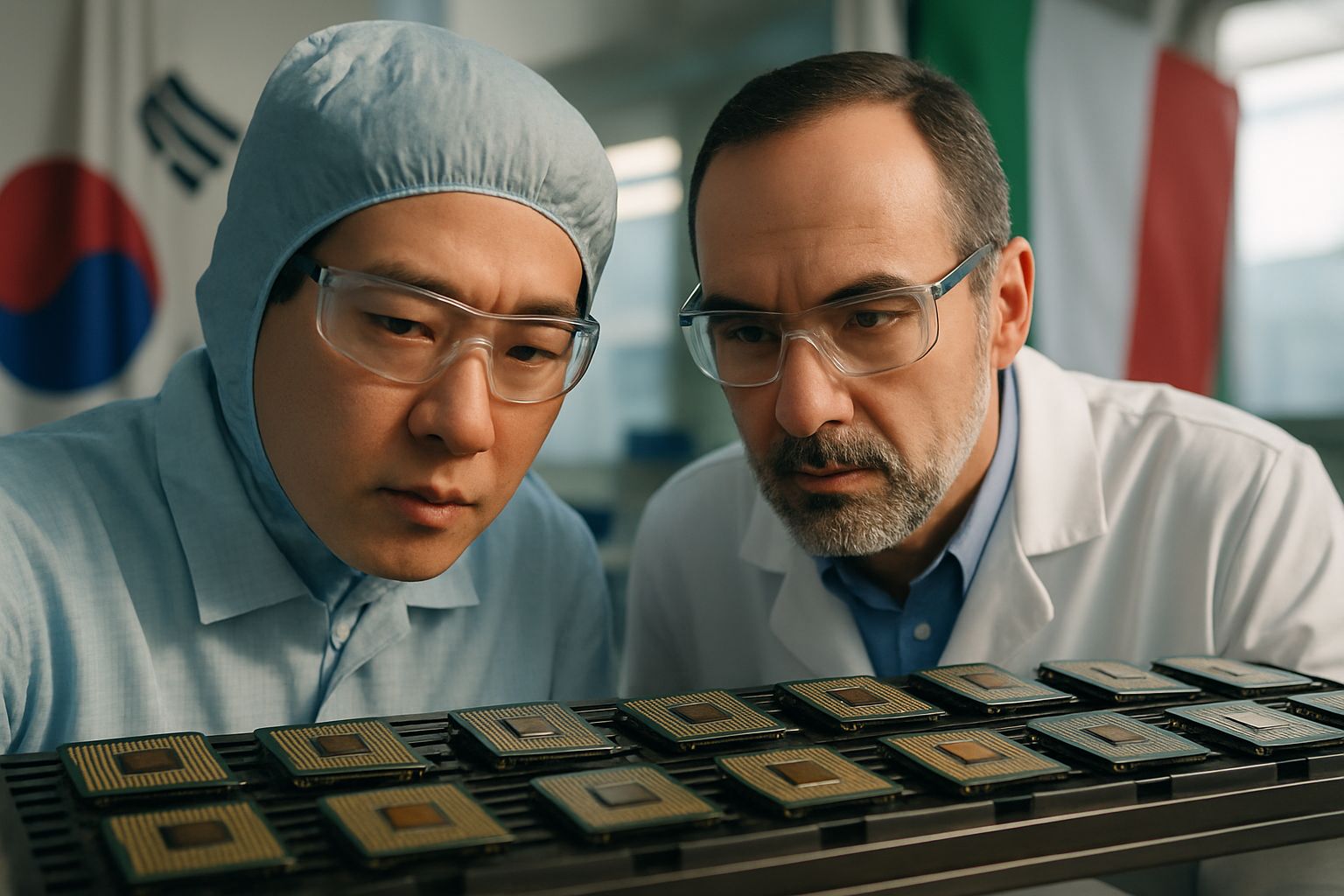
Key deliverables included re-launching the Korea-Italy Business Forum and expanding academic exchanges. Consequently, officials expect greater mobility for researchers and students. Such people-to-people channels often seed long-term industrial projects.
These announcements set the diplomatic tone. However, concrete implementation will determine success. Therefore, observers will track follow-up meetings and budgeting decisions.
Semiconductor MOU Key Details
Semiconductors sat at the summit’s core. The first MOU links the Korea Semiconductor Industry Association and Italy’s ANIE. Furthermore, it establishes information-sharing channels on supply, packaging, and R&D. Analysts note that South Korea holds roughly 21.1 percent of the global chip market. Memory leaders Samsung and SK Hynix dominate high-bandwidth memory used in AI accelerators.
Bilateral Ties promise Europe diversified access to advanced memory. Meanwhile, Italy hopes to leverage EU Chips Act incentives for local projects. Nevertheless, MOUs are non-binding. Financial commitments require separate contracts.
Key Market Data Points
- South Korea: ~21.1 percent global chip share
- SK Hynix 2025 DRAM share: ~36-39 percent
- Gartner forecasts AI spending: US$2.5 trillion in 2026
The figures reveal commercial scale. Consequently, the semiconductor MOU could unlock supplier agreements. However, export-control regimes may limit advanced node transfers. Thus, stakeholders will monitor regulatory approvals.
These factors highlight opportunities and hurdles. Subsequently, attention shifts to AI demand as a catalyst.
AI Demand Drives Partnership
Gartner predicts AI spending will hit US$2.5 trillion next year. Moreover, generative AI alone may exceed US$644 billion in 2025. Such growth heightens urgency for secure compute infrastructure. Therefore, Korea’s memory capacity offers critical leverage.
Italy seeks to embed local firms in that rising value chain. Additionally, European policy makers pursue resilience after recent chip shortages. Strengthened Bilateral Ties align with these objectives. Meanwhile, Tech Diplomacy provides a framework for balancing innovation and security.
Professionals can bolster risk-management expertise through the AI Security Level 2™ certification. The program covers threat modelling for AI workloads, complementing new supply-chain initiatives.
Demand forecasts justify the partnership’s focus. Nevertheless, economic benefits depend on concrete investment timelines. Consequently, the next section explores potential gains for both economies.
Benefits For Both Economies
Complementary strengths underpin the accord. South Korea offers high-volume manufacturing and packaging know-how. Italy contributes renowned research institutes and precision machinery. Furthermore, collaboration may accelerate joint R&D on AI-specific semiconductors.
The summit also enhances market access. Italian firms could secure reliable HBM supply, while Korean vendors gain European customers. Moreover, diversified sourcing supports EU resilience goals. Such positive feedback loops strengthen Bilateral Ties.
Potential advantages include:
- Faster tech transfer to small- and mid-sized EU manufacturers
- Shared participation in Horizon Europe semiconductor calls
- Expanded venture funding for cross-border AI start-ups
These prospects illustrate mutual upside. However, challenges may temper immediate results. Therefore, risks warrant careful review.
Challenges And Potential Constraints
Export controls remain a critical hurdle. Additionally, advanced lithography tools face U.S.-led restrictions. Consequently, some joint projects might stall without licenses. Analysts also warn that MOUs lack enforceable funding clauses.
Cost inflation presents another barrier. European fab construction can exceed Asian benchmarks by 40 percent. In contrast, leveraging Korean capacity abroad may lower risk. Nevertheless, transport distance and currency volatility add complexity.
Bilateral Ties must also navigate domestic politics. Italian labor groups demand local job creation. Meanwhile, Korean stakeholders prioritize shareholder value. Balanced governance mechanisms are essential.
These constraints emphasize due diligence. Subsequently, policymakers outline actionable next steps.
Next Steps And Outlook
Officials will draft a detailed 2026-2030 roadmap by mid-year. Moreover, working groups on semiconductors, civil protection, and culture will convene quarterly. The revived business forum intends to publish investment pipelines within twelve months.
Monitoring metrics will include project financing, R&D milestones, and student exchange volumes. Furthermore, regulators will align standards through continued Tech Diplomacy. Strengthened Bilateral Ties could even expand into quantum and clean-energy technologies.
Implementation progress will confirm the summit’s legacy. Nevertheless, transparent reporting will remain vital for investor confidence.
These planned actions signal forward momentum. Consequently, industry professionals should stay engaged as milestones emerge.
Conclusion
South Korea and Italy have reset their partnership around AI and chips. Consequently, three MOUs mark tangible first steps, though binding deals must follow. Moreover, soaring AI demand and supply-chain pressures intensify the pact’s relevance. Nevertheless, export controls and financial hurdles could slow momentum. Therefore, continued vigilance is necessary. Professionals should monitor roadmap releases and consider certifications like AI Security Level 2™ to capitalize on emerging opportunities. Stay informed, stay certified, and seize the advantages created by evolving Bilateral Ties and dynamic Tech Diplomacy.


