

AI CERTS
3 months ago
Sony’s Edge Sensors Advance Industrial Vision AI in Factories
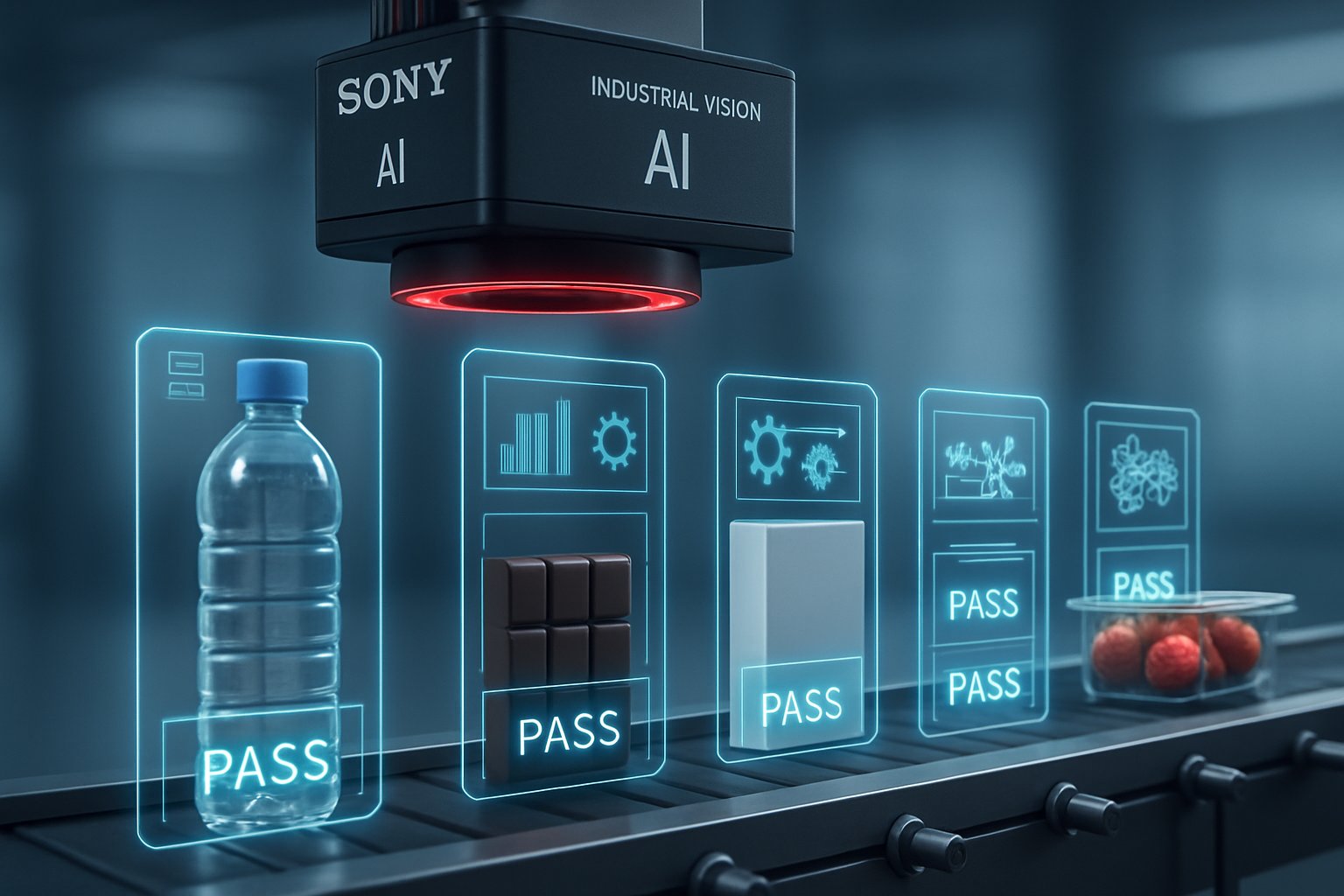
The initiative combines the IMX500 family with the AITRIOS edge platform.
Together they create an Industrial Vision AI architecture that processes data directly on the silicon.
Consequently, businesses can cut latency, bandwidth, and governance risk.
This article dissects the technology, ecosystem, benefits, and remaining hurdles for professionals evaluating deployment.
Additionally, we map market numbers and highlight upskilling paths for teams.
All insights derive from Sony disclosures, analyst briefings, and partner announcements through December 2025.
By reading, leaders will gain actionable perspective before their next camera refresh cycle.
Edge Sensor Breakthrough Explained
Sony’s IMX500 and IMX501 integrate pixels and logic on one stacked die.
Moreover, the design embeds DSP cores that handle AI inference at roughly 30 frames per second.
Therefore, metadata can exit the camera without streaming raw 4K video.
Key specifications include 12.3 megapixels, 1.55-micron pixels, and 4K60 capture capability in the sensors.
Nevertheless, the on-sensor compute envelope suits lightweight classification or detection models only.
Complex segmentation workloads still require auxiliary edge modules or cloud resources.
In contrast, conventional smart cameras rely on separate NPUs or GPUs, raising power budgets.
Consequently, Sony promises lower bill-of-materials and easier thermal design.
Privacy also improves because personal images never traverse external networks.
These sensor advances anchor Sony’s Industrial Vision AI value proposition.
Next, we examine the platform that operationalizes those pixels.
Platform Powers Vision Ecosystem
AITRIOS wraps the hardware with SDKs, device management, and a growing marketplace.
Furthermore, the Console tiers let developers push models, monitor fleets, and update firmware securely.
Marketplace listings now feature Neurala Brain Builder, StratosMedia signage apps, and several traffic analytics modules.
Subsequently, integrators can assemble end-to-end solutions without bespoke plumbing.
For example, StratosMedia demonstrated dynamic content triggers at ISE 2025 using live occupancy metadata.
Meanwhile, municipal partners Lakewood and San José showcased parking dashboards fed by edge cameras.
Sony positions AITRIOS as a recurring revenue engine, shifting from pure component sales.
Grand View Research expects computer-vision spending to reach 58.3 billion by 2030, reinforcing the strategy.
However, the platform needs broad third-party adoption to capture that growth.
The ecosystem layering turns Industrial Vision AI into a service, not merely a sensor.
With infrastructure covered, use cases can now scale quickly.
Use Cases Expanding Rapidly
Retail chains pilot shelf-stock detection using sensors that perform on-sensor inference.
Consequently, staff hours drop while on-shelf availability climbs.
Neurala reports optimized models reaching useful accuracy within days.
Smart-city trials integrate traffic, parking, and pedestrian analytics into municipal dashboards.
Additionally, privacy controls rely on metadata export, easing surveillance debates.
Sony’s August 2025 demonstrations underscored these advantages for civil planners.
Manufacturing floors deploy cameras to monitor conveyor flow and detect anomalies in real time.
Meanwhile, logistics operators track warehouse shelf status, accelerating pick rates and reducing miscounts.
These deployments confirm Industrial Vision AI delivers measurable productivity boosts.
Field evidence shows diverse verticals embracing the approach.
Next, we quantify the benefits for factory leaders.
Benefits For Smart Factories
Latency drops because inference occurs inside each sensor, eliminating round-trip cloud calls.
Therefore, robotic arms can react within milliseconds, improving quality control yields.
Lower network loads also free bandwidth for critical control traffic.
Moreover, metadata export addresses intellectual property concerns around proprietary product images.
Power budgets fall, reducing cooling requirements in manufacturing and other constrained enclosures.
Consequently, automation designers can embed cameras where GPUs would never fit.
- Lower latency for robotics
- Reduced bandwidth consumption
- Tighter quality control with instant anomaly alerts
- Trusted sensors support C2PA signatures
- Manufacturing lines see 15% scrap reduction
- Seamless automation integration
Sony argues these factors translate into a lower total cost of ownership across three-year periods.
Independent benchmarks remain scarce, yet early reports from partners align with the narrative.
Collectively, these strengths make Industrial Vision AI attractive for continuous improvement projects.
Still, potential pitfalls warrant careful evaluation.
Challenges And Market Outlook
Model size remains the most visible constraint.
In contrast, cloud GPUs can crunch larger networks that the sensor cannot host.
Consequently, hybrid topologies may persist for complex inspections.
Vendor lock also concerns CIOs who prefer hardware-agnostic frameworks.
However, Sony counters with open marketplace tooling and C2PA-based authenticity features.
Regulators will scrutinize city surveillance regardless, demanding transparent governance processes.
Market share targets show Sony pursuing 60% sensor revenue by 2025.
Grand View’s 19.8% CAGR suggests ample demand despite competition from Samsung and OmniVision.
Nevertheless, success hinges on developer support and reliable performance metrics.
The outlook stays promising yet contingent on ecosystem momentum.
Therefore, workforce upskilling becomes critical for execution.
Skills And Next Steps
Edge AI projects need engineers versed in embedded vision, model quantization, and security.
Additionally, cross-functional managers must align OT, IT, and compliance teams.
Professional development programs can close these gaps swiftly.
Professionals can enhance their expertise with the AI Prompt Engineer™ certification.
Moreover, Sony offers developer kits like the Raspberry Pi AI Camera for hands-on experimentation.
Automation managers also value deterministic timing from on-board inference.
- Evaluate workloads against on-sensor compute limits.
- Engage marketplace partners for pre-built models.
- Plan governance around metadata retention.
Consequently, teams can move from pilot to production with fewer integration surprises.
Meanwhile, early certification holders will stand out during project staffing discussions.
Upskilling and disciplined planning ensure Industrial Vision AI initiatives succeed.
Finally, a concise recap consolidates the insights.
Final Takeaways And Outlook
Sony’s approach proves that Industrial Vision AI can live directly on commercially viable silicon.
Moreover, early retail, smart-city, and manufacturing rollouts showcase tangible gains.
Lower latency, stricter quality control, and leaner automation architectures emerge as consistent themes.
Nevertheless, limited model capacity and ecosystem maturity demand realistic planning.
Professionals who master Industrial Vision AI tooling will guide roadmap decisions with confidence.
Certification paths, including the linked program, accelerate that readiness.
Consequently, companies can launch Industrial Vision AI pilots that scale securely across thousands of sensors.
Start evaluating Industrial Vision AI now to capture the competitive edge before rivals automate first.


