

AI CERTs
2 hours ago
Smart Media Evolution: YouTube Trials Gemini AI Chat on TVs
Televisions now dominate the platform that once thrived on phones. Consequently, YouTube says viewers stream more than one billion hours daily on connected screens. This migration explains why Google is testing Gemini-powered chat directly on living-room displays. The initiative also illustrates how Smart Media evolves when artificial intelligence meets shared habits.
Furthermore, the early experiment reaches only a slice of Premium subscribers through the YouTube Labs program. Nevertheless, analysts see the test as a harbinger for mainstream deployment across every major TV platform. Moreover, Smart Media strategies hinge on increasing engagement without complicating remote controls. Therefore, embedding conversational AI directly inside the player could shorten discovery journeys and raise advertising yields. In contrast, rival platforms such as Amazon Fire or Roku still route many searches through separate overlays. Subsequently, Google wants to lock loyalty before competitors replicate similar living-room assistants. Consequently, the test provides an ideal lens for evaluating the future of Smart Media on the biggest screen.
Living Room Viewing Shift
Nielsen reported that YouTube captured 12.4% of total U.S. television audience time last April. Moreover, CEO Neal Mohan revealed viewers now log over one billion TV hours daily.
This surge confirms a decisive Smart Media pivot toward shared screens. Consequently, advertisers and product teams treat the living room as the next growth engine.
In contrast, mobile watch time has plateaued, forcing Google to prioritise bigger formats. Therefore, the Gemini rollout aligns with an urgent need for richer Interaction on the couch.
These numbers underline why televisions matter most. However, understanding the tool itself requires a technical detour.
Conversational AI Tool Mechanics
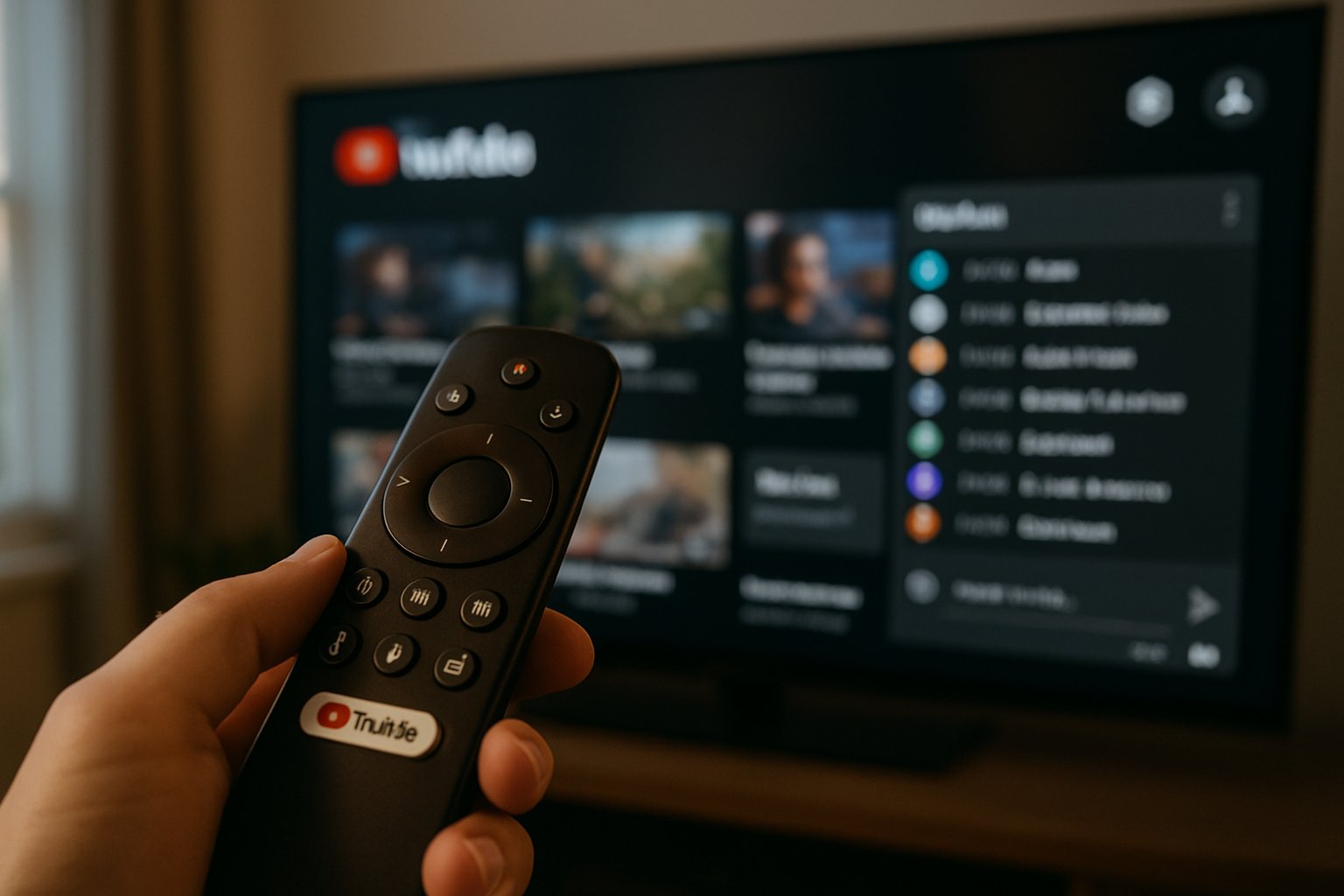
YouTube's experimental "Ask" button sits directly on the playback screen. Additionally, viewers can press the remote microphone and speak naturally.
The underlying Gemini model pulls context from the current video and wider web sources. Consequently, answers appear beside the stream without pausing content or blocking vision.
Key Feature Summary Points
- Produces chapter summaries and recommended follow-up videos in seconds.
- Surfaces timestamps when viewers ask for specific moments or ingredients.
- Enables quick fact checks by combining YouTube metadata with Google Search snippets.
- Supports English, Hindi, Spanish, Portuguese, and Korean during the trial.
Moreover, Premium members gain first access through the Labs toggle. Meanwhile, the company stresses that availability may shift as feedback arrives.
These mechanics promise frictionless Interaction on devices where typing remains tedious. Nevertheless, privacy considerations demand equal scrutiny before mass adoption.
Privacy And Data Risks
YouTube's support page admits responses come from large language models that might hallucinate facts. Furthermore, the document warns that replies may occasionally display offensive material.
In contrast, Google highlights automatic deletion of conversations after forty-five days when accounts stay linked. However, chats selected for human review can persist for three years once disconnected.
Privacy researchers question whether microphone activations on TV hardware are processed locally first. Consequently, advocates seek clarity on storage, transmission, and model-training practices.
Moreover, creators remain wary about their videos training Gemini without direct compensation. The European Union already probes Google over potential antitrust angles here.
These open questions underscore sensitive trade-offs. Therefore, companies must prove that Smart Media innovation respects audience trust.
Competitive Market Moves
Amazon recently expanded Alexa to Fire TV for contextual Q&A. Similarly, Roku and Netflix test on-screen assistants that narrow search friction.
Consequently, Google cannot afford complacency while rivals retrofit living-room hardware with voice agents. Additionally, Smart Media parity influences advertising negotiations with global brands.
Industry analysts note that premium hardware partnerships often decide which assistant becomes default. Therefore, early integration can lock users into a chosen ecosystem for years.
Nevertheless, differentiation will hinge on accuracy, latency, and perceived neutrality of answers. Subsequently, user loyalty may migrate to whichever assistant demonstrates superior Interaction quality.
Competition keeps innovation brisk in Smart Media ecosystems. However, economic value also depends on creator collaboration and monetisation formats.
Opportunities For Creators
YouTube positions the Ask feature as a discovery catalyst that surfaces niche channels. Moreover, contextual answers can embed deep-link cards that drive traffic directly to source videos.
Consequently, creators may enjoy higher session lengths and improved affiliate conversions. Premium program members could see early analytics dashboards measuring query-to-watch ratios.
In contrast, some artists fear algorithmic summaries will cannibalise long-form views. Nevertheless, Google insists the assistant amplifies rather than replaces creator voices.
Professionals can enhance their expertise with the AI Government Specialist™ certification. Such credentials help creators negotiate product placements with data-driven authority.
These opportunities illustrate value flowing in every direction. Therefore, strategic planning remains vital for sustaining Smart Media ecosystems.
Strategic Next Step Roadmap
Enterprises considering similar deployments should pilot limited cohorts before scaling. Additionally, clear opt-in messaging reduces privacy pushback from early participants.
Subsequently, teams must benchmark latency, hallucination frequency, and user sentiment. Moreover, integrating revenue metrics helps quantify the Smart Media uplift beyond novelty.
In contrast, regulators will demand transparency on training datasets and retention periods. Consequently, documentation should mirror YouTube's publicly posted help pages.
Meanwhile, hardware partners must update remote firmware to prioritise low-latency wake words. Nevertheless, continuous voice listening must remain disabled until an Interaction request is explicit.
These tactical guidelines shorten learning curves for any organisation. However, sustained success hinges on aligning Smart Media goals with user trust and measurable value.
Conclusion And Key Takeaways
YouTube's Gemini experiment signals a pivotal juncture for Smart Media on the biggest screen. Moreover, massive TV watch time and competitive pressure accelerate conversational deployments.
Nevertheless, privacy, accuracy, and creator revenue questions remain unresolved. Consequently, careful governance must accompany every algorithmic advance.
Therefore, industry leaders should trial, measure, and refine before a global rollout. Explore certifications such as the AI Government Specialist™ to elevate strategic competence today.


