

AI CERTS
2 months ago
Sharpa’s Leap in Humanoid Robotics Development at CES
Sharpa claims real-time visuo-tactile control powered by its hierarchical CraftNet model. That architecture underpins the robot's human-level Dexterity across long manipulation sequences. Meanwhile, SharpaWave's 22 degrees of freedom promise greater in-hand adaptability. Card Dealing accuracy appeared immaculate, with individual cards placed within two millimeters. Finally, the company promised rapid commercialization, stirring debate over adoption timelines.
Sharpa CES 2026 Spotlight
Sharpa grabbed headlines on day one of CES 2026. The startup staged continuous Table Tennis matches against volunteer attendees. North returned serves with a reported 0.02-second reaction time. Additionally, SharpaWave picked single cards from a deck before graceful Card Dealing sequences. Such multitasking demonstrations helped position the firm as a fresh force in Humanoid Robotics Development. Media outlets including Engadget and Interesting Engineering praised the sensor density and smooth motions.
Nevertheless, Gizmodo cautioned that some online footage appeared accelerated. Consequently, analysts urged verification through independent benchmarks before large-scale deployment. Sharpa’s showmanship delivered undeniable buzz and early mindshare. However, the next section explores CraftNet, the claim behind those precise moves.
Inside CraftNet Control Stack
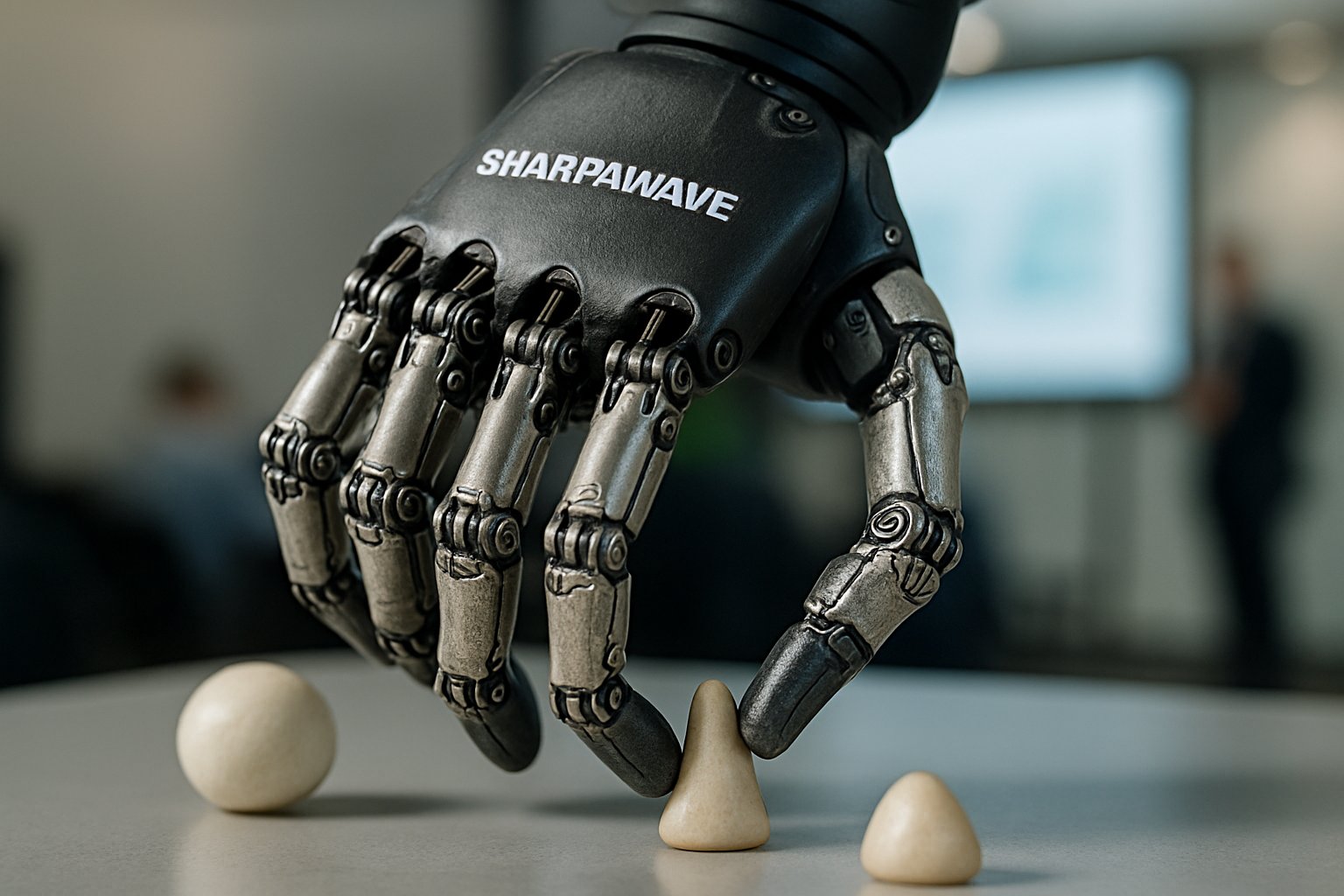
CraftNet separates planning and tactile reflexes across three hierarchical levels. At the highest tier, System 2 interprets language tasks, like "assemble a paper windmill", using semantic embeddings. Following that plan, System 1 generates coarse trajectories through visual context. Finally, System 0 fires at roughly 100 Hz, adjusting force every millisecond. Moreover, each fingertip combines over 1,000 taxels with a miniature camera for visuo-tactile fusion.
Sharpa says this stack eliminates "tactile blindness" that plagues many robots. Consequently, the hand avoids slip while maintaining sub-millimeter alignment during Card Dealing. Field experts agree the architecture looks promising for improved Dexterity. However, they want open datasets to confirm latency and stability under noise. CraftNet integrates language semantics with high-frequency tactile loops in an elegant hierarchy. Next, we examine the physical hardware enabling those control ambitions.
Hardware Edge And Limits
North's skeleton uses aerospace-grade aluminum for strength without excess mass. The SharpaWave hand offers 22 active degrees of freedom across wrist, thumb, and fingers. Additionally, fingertip force reaches roughly 30 Newtons, matching light human pinches.
- 22 DOF hand and 6-D force sensing per finger.
- Over 1,000 tactile pixels on every fingertip.
- 0.005 N force sensitivity for delicate contact.
- 0.02 second reaction time during Table Tennis rallies.
Such numbers impress, yet complexity invites durability questions. Moreover, thousands of taxels may degrade under oily industrial environments. In contrast, Boston Dynamics and Tesla choose simpler sensor arrays to ease maintenance. Sharpa counters that mass production started in December 2025 to validate longevity. Hardware specifications show clear advantages in touch resolution and adaptive grip. However, competitive context will further clarify the hand’s relative value. Therefore, the following section surveys rival humanoid efforts.
Competitive Industry Landscape Overview
Humanoids dominated CES 2026 aisles beyond Sharpa's booth. Boston Dynamics showcased a next-gen Atlas aimed at heavy factory tasks. Meanwhile, Tesla demonstrated the latest Optimus prototype with refreshed hands matching 22 DOF. Figure, Agility Robotics, and Unitree focused on logistics operations requiring repeatable lifting, not fine Dexterity. Consequently, Sharpa stands apart by emphasizing contact-rich manipulation like Card Dealing and Table Tennis. Market analysts predict at least five significant product launches in Humanoid Robotics Development during 2026. In contrast, only two firms claim dense fingertip vision today. Nevertheless, corporate resources and manufacturing scale could let incumbents close gaps quickly. Sharpa currently leads sensor resolution among public prototypes. However, sustained execution will determine long-term differentiation, as discussed next.
Deployment Risks And Gaps
Live demos rarely reveal failure rates or maintenance cycles. Sharpa has not released continuous uptime data across multiple robots. Moreover, independent labs have yet to publish controlled Table Tennis benchmarks for North. Cost also remains opaque, complicating capital budgeting for early adopters. In contrast, Tesla and Boston Dynamics share estimated price bands, easing procurement discussions. Additionally, the SharpaWave taxel matrix introduces thousands of potential failure points. Consequently, buyers need warranties, spare modules, and rapid logistics.
Professionals can enhance risk evaluation skills with the AI+ Data Robotics™ certification. That training complements technical knowledge within Humanoid Robotics Development projects. Nevertheless, transparent metrics could accelerate Humanoid Robotics Development adoption by conservative industries. Current information asymmetry hinders confident purchase decisions. Therefore, our final section outlines strategies for different stakeholders.
Strategic Outlook For Stakeholders
Investors should track production yields and sensor failure rates during 2026. Positive data would validate Humanoid Robotics Development scalability and unlock follow-on rounds. Meanwhile, system integrators must prototype high-mix tasks, including Card Dealing in hospitality. Manufacturers could begin pilot lines where SharpaWave assembles lightweight consumer devices. Training partners should embed the technology within curricula covering advanced Dexterity and safety standards. Moreover, regulators will draft guidelines for tactile-rich collaborative cells.
- Request transparent KPIs before purchase agreements.
- Run Table Tennis stress tests over 1,000 cycles.
- Audit firmware updates for CraftNet security patches.
Consequently, early movers could capture productivity gains and media attention. Humanoid Robotics Development leaders that share data will foster ecosystem trust. In contrast, secrecy may slow customer onboarding despite flashy CES 2026 showings. Strategic alignment across capital, skills, and regulation will decide market winners. Next, our conclusion synthesizes key insights and actions.
Conclusion Insights
Sharpa's CES 2026 debut signaled a serious leap in tactile performance. Moreover, real-time CraftNet control promises scalable Table Tennis and Card Dealing mastery. Yet unanswered durability, pricing, and validation questions temper immediate excitement. Nevertheless, disciplined Humanoid Robotics Development roadmaps can overcome these obstacles. Technology buyers should monitor sensor longevity reports and open benchmark scores. Investors must weigh capital needs against projected margins in emerging humanoid deployments. Professionals can future-proof careers through continuous education and specialized certifications. Therefore, explore the linked AI+ Data Robotics™ course to stay ahead in Humanoid Robotics Development. Timely skill building ensures readiness when Sharpa and its rivals scale production. Continued collaboration across academia and industry will ultimately shape responsible Humanoid Robotics Development.


