

AI CERTs
3 months ago
Samsung AI Companions Shift From Robots To Ambient Ecosystem
CES 2026 dazzled crowds with a new vision for connected homes. At its showcase, Samsung introduced Samsung AI Companions as the centerpiece of that ambition. Instead of isolated gadgets, the company pitched a unified, context-aware ecosystem spanning mobiles, TVs and appliances. Consequently, observers now debate whether software-first companionship will outshine clunky household robots. Meanwhile, Samsung quietly parked Ballie, its rolling robot, calling it merely an internal platform.
The decision underscores stubborn commercial, reliability, and privacy hurdles inside consumer robotics. However, the firm doubled down on embedded Ambient Intelligence across 430 million SmartThings residences. Early adopters welcomed seamless voice prompts, proactive reminders, and cross-device continuity. Yet privacy advocates issued stern warnings about pervasive sensors and opaque data flows. This article dissects strategy, metrics, risks, and opportunities surrounding Samsung’s bold domestic play.
Strategy Pivot Explained Clearly
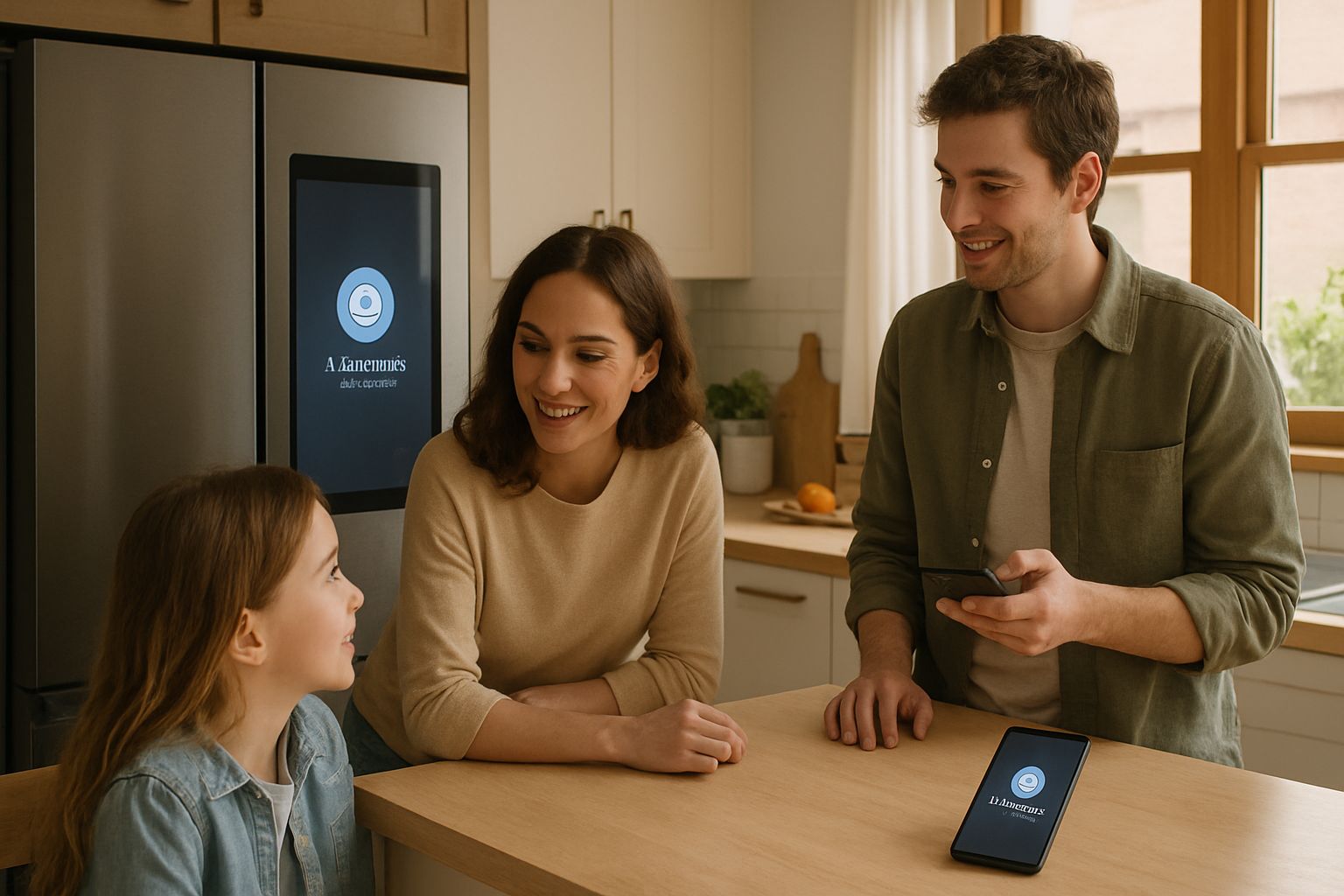
Samsung repositioned its consumer narrative during the First Look keynote. Moreover, executives framed devices as cooperative teammates rather than discrete purchases. Therefore, the Samsung AI Companions vision links phones, TVs, wearables, and appliances through Gemini-powered services.
Consequently, Ballie’s public retreat looks less like failure and more like resource reallocation. Samsung AI Companions now absorb Ballie’s spatial mapping insights into edge computing modules. Additionally, SmartThings data supplies real-time environmental context to personalize appliance behavior.
TM Roh emphasized cross-category synergy, citing Knox security as the privacy backbone. Meanwhile, Reuters reported plans to reach 800 million Galaxy AI devices during 2026. Furthermore, the pivot relies on Ambient Intelligence to anticipate household routines without intrusive hardware.
In short, Samsung redirected robotics R&D into ubiquitous services with strategic clarity. Consequently, we next examine hard metrics supporting that expansion.
Ecosystem Scale Metrics Rise
Samsung owns one of the world’s largest connected install bases. Statistically, SmartThings surpassed 430 million users by December 2025, according to company filings. Moreover, 800 million eligible mobiles will run Gemini features by year’s end, Reuters noted.
These figures matter because scale multiplies learning loops for Samsung AI Companions. Additionally, large datasets improve Ambient Intelligence models that optimize energy usage and content recommendations. In contrast, standalone robots seldom reach comparable telemetry volumes.
- SmartThings users exceeded 430 million in 2025.
- Samsung targets 800 million Galaxy AI devices by 2026.
- Domestic robot revenue may reach $22.8 billion by 2027.
Enterprise analysts predict domestic service robot revenue hitting $22.8 billion globally by 2027. However, software companions riding existing hardware could capture value faster and with lower bill-of-materials. Therefore, Samsung’s distribution advantage strengthens negotiating power with insurers, retailers, and content providers.
Robust device penetration fuels continuous context capture for Samsung AI Companions. Next, we explore lessons learned from Ballie’s detour.
Robot Lessons And Limits
Ballie debuted in 2020 as a friendly rolling orb with projector eyes. Nevertheless, early demos exposed navigation flaws, battery constraints, and cost uncertainty. Furthermore, meaningful Human-Robot Interaction requires reliable task completion under messy real-world variables.
Samsung engineers reportedly shifted Ballie’s vision stack into vacuum cleaners and laundry sensors. Consequently, the company reduced mechatronic complexity while preserving software breakthroughs. Samsung AI Companions now deliver contextual reminders through televisions rather than anthropomorphic robots.
Industry peers echo similar pivots; Amazon shelved Astro for Business during 2024. Moreover, LG still parades CLOiD, yet retail timing remains unannounced. Therefore, fruitful Human-Robot Interaction may initially flourish inside partial automation, not full autonomy.
Ballie’s journey reveals high hardware risk but valuable algorithm dividends. However, privacy remains the next pivotal battleground.
Privacy Trust Concerns Mount
Always-on microphones and cameras redefine domestic boundaries. Consequently, advocacy groups labeled Samsung’s AI fridge a “Worst in Show” surveillance risk. Cindy Cohn warned that Ambient Intelligence could quietly infer sensitive health or financial patterns.
Samsung counters with Knox encryption, on-device processing, and visible sensor indicators. Nevertheless, the effectiveness of those safeguards remains under audit. Samsung AI Companions will succeed only if consumers perceive transparent control and consent.
Insurers like HSB complicate data flows by tying policy discounts to sensor reports. Therefore, regulators may soon demand standardized disclosure for Human-Robot Interaction data retention. Meanwhile, right-to-repair advocates question component replacement costs and software locks.
Trust gaps could slow deployment despite technical maturity. Consequently, competitive pressures influence communication strategies, as the next section details.
Competitive Landscape Rapid Shifts
LG’s CLOiD robot grabbed headlines with articulated arms and vision-language models. However, supply-chain insiders doubt mass production within two years. Meanwhile, iRobot, Dyson, and Xiaomi iterate vacuum form factors and pet cameras. Effective Human-Robot Interaction remains a differentiator for companies persisting with mobile robots.
Samsung AI Companions differentiate by leveraging existing footprints instead of shipping exotic hardware. Moreover, Google’s Gemini partnership accelerates feature parity across regions. Additionally, Ambient Intelligence baked into fridges and washers reinforces stickiness beyond flashy demos.
The race may hinge on cloud inference efficiency and customer trust rather than robotics tricks. Nevertheless, visible robots still command marketing buzz at trade shows. Therefore, Samsung must balance spectacle with pragmatism.
Competitive signals validate Samsung’s software-centric route. Next, we analyze broader market forecasts.
Market Outlook And Forecasts
Verified Market Research expects domestic robot value to surpass $30 billion by 2030, reflecting 18% CAGR. Consequently, investors pour capital into computer vision startups and actuator suppliers. However, analysts note that software margins outstrip hardware profits across mature electronics segments.
Samsung AI Companions can monetize subscriptions, warranty upsells, and insurer partnerships without building new factories. AI insights could unlock dynamic energy pricing and eldercare monitoring paywalls. Nevertheless, sustained adoption hinges on convincing users that value exceeds privacy trade-offs.
Statista projects tens of millions of service robots to ship by mid-decade. In contrast, billions of connected appliances already sit in kitchens and living rooms. Therefore, hybrid approaches blending screens, sensors, and cloud APIs appear financially safer.
Forecasts reward scalable platforms over expensive humanoids. Finally, professionals should assess skills gaps opened by this shift.
Skills Growth Opportunities Ahead
Engineers, designers, and policy experts must grasp multidisciplinary principles behind domestic companions. Human-Robot Interaction literacy, edge computing, and privacy law knowledge top recruiter wishlists. Moreover, organizations seek prompt engineering skills to fine-tune Gemini or similar models.
Professionals may upskill through the AI Prompt Engineer™ certification. Additionally, Samsung AI Companions demand continuous testing protocols, creating roles for QA specialists. Consequently, early adopters of relevant skills could command premium salaries.
Talent pipelines will shape companion maturity and consumer trust. Therefore, closing skills gaps becomes urgent for enterprises eyeing domestic AI services.
Conclusion And Future Outlook
Samsung’s 2026 narrative shows pragmatic evolution rather than abrupt retreat. Moreover, software companions embedded in existing devices promise faster returns and wider access. Nevertheless, privacy skeptics and repair advocates will keep pressure high on execution. Consequently, transparent governance, clear consent flows, and reliable edge processing must remain top priorities. Meanwhile, competitors will continue showcasing dazzling robots, sustaining media excitement around physical automation. Therefore, industry leaders that balance spectacle with sustainable economics are likely to prevail. Professionals should monitor policy shifts, talent demand, and consumer sentiment to capitalize on the unfolding market.


