

AI CERTS
1 hour ago
Robotics Sensing: AI Radar Perception Reaches Market
Moreover, it reveals how physics-aware AI is closing historical performance gaps. Vendors such as Atomathic and Arbe now showcase sub-degree resolution and high-density detections in heavy rain. Meanwhile, researchers at MERL and Tongji demonstrate measurable gains on public benchmarks. Market forecasts predict a 25% compound annual growth rate for 4D imaging radar through 2030.
Nevertheless, challenges around ghost suppression, regulatory validation, and cost remain unresolved. This article explores those challenges, highlights breakthroughs, and outlines practical steps for Robotics Sensing teams.
Global Radar Market Momentum
MarketsandMarkets projects 4D imaging radar revenue will climb from $392.8 million in 2025 to $1.2 billion by 2030. Therefore, investors are moving capital from experimental LiDAR startups toward radar chip makers. In contrast, several Tier-1 suppliers emphasize balanced sensor portfolios rather than exclusive plays. Continental, Bosch, and Magna each announced new radar lines synchronized with camera updates. Moreover, NVIDIA offers simulation tools that accelerate validation cycles for emerging architectures.
Such ecosystem activity signals maturing demand for high-resolution Robotics Sensing solutions. However, analysts warn that regulatory clarity could dictate adoption speed. ETSI working groups still debate performance metrics for adverse-weather operation. Consequently, procurement teams hedge budgets across multiple sensor modalities. These dynamics underscore a vibrant yet uncertain market; similarly, they set the stage for technical evaluations next.
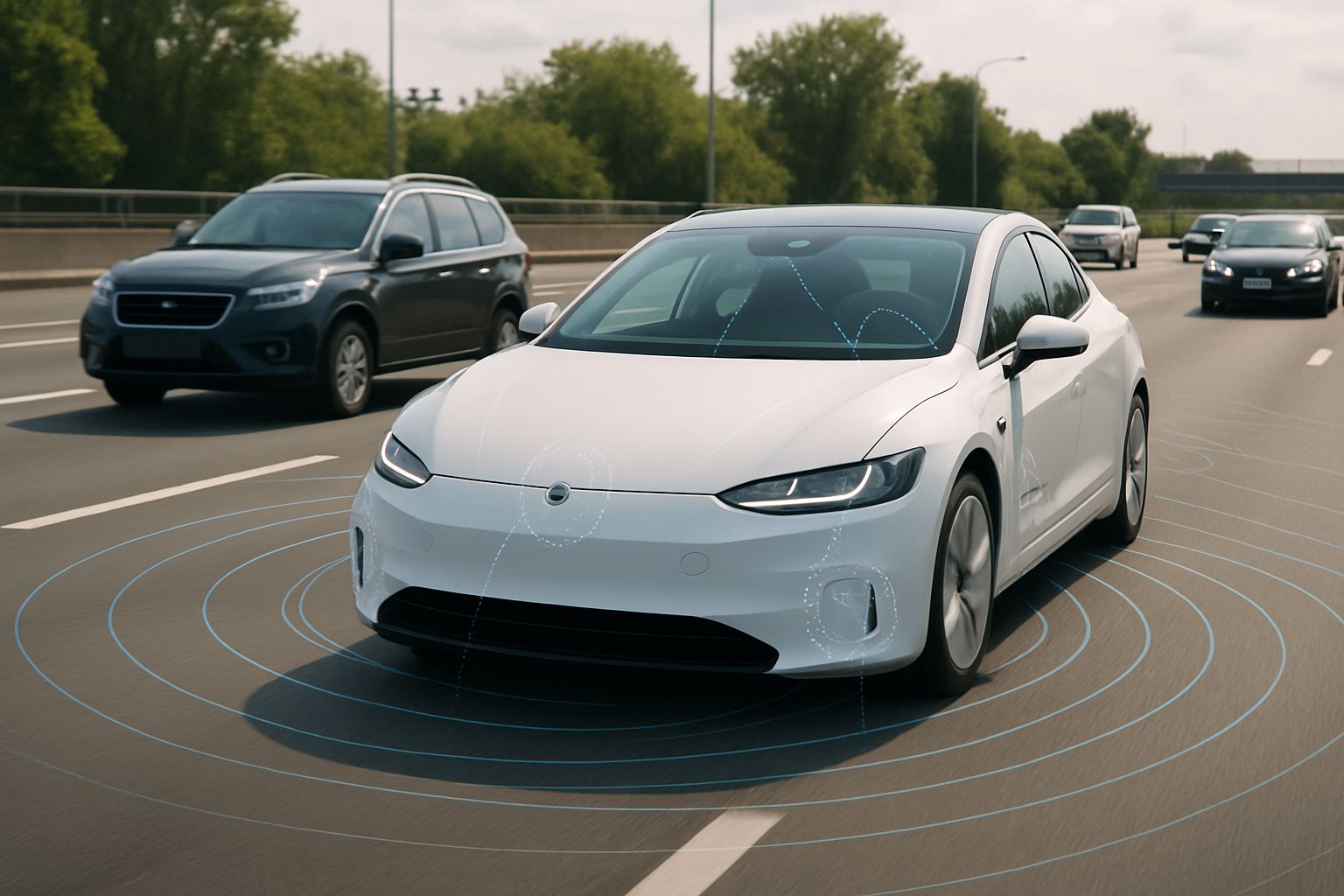
Physics Aware AI Gains
Physics-constrained networks now blend analytic radar equations with learned priors. Atomathic’s AISIR exemplifies the dual-system pattern of fast reconstruction plus generative reasoning. Behrooz Rezvani claims the software removes long-standing reliability roadblocks in high dynamic range clutter. Moreover, MERL’s SIRA shows that extended temporal associations lift radar-only detection by 4.11 mAP on Radiate. Moving-least-squares upsampling delivers a further 6-point gain when fused across frames.
Such algorithmic momentum is reshaping Robotics Sensing research roadmaps. In contrast, traditional radar stacks relied on heuristic filtering that struggled with ghost targets. Consequently, accuracy plateaued below Lidar resolution thresholds. Overall, physics-aware methods cut noise and lift metrics across datasets. Consequently, the impact becomes clearer when we examine public benchmark numbers next.
Key Algorithmic Benchmark Results
Benchmark papers offer quantified insight beyond headline demo claims. SIRA achieves 58.11 mAP@0.5 and 47.79 MOTA on the Radiate dataset, improving Perception consistency by 10%. Meanwhile, the Remote Sensing study reports 48.44 mAP after multi-frame fusion with moving-least-squares upsampling.
- SIRA: 58.11 mAP, 47.79 MOTA
- MLS fusion: 48.44 mAP on VoD
- Market forecast: 25.2% CAGR to 2030
That figure exceeds the single-frame baseline by six percentage points. In contrast, earlier classical trackers rarely surpassed 40 mAP on identical splits. Nevertheless, radar still lags Lidar resolution on small object localization. Researchers attribute that gap to point-cloud sparsity and side-lobe ghosts. Therefore, attention shifts to data densification and physics filters. Provizio reports sub-0.5° angular error using a single 77 GHz chip and software-defined antenna. These statistics confirm measurable progress. However, they also expose unresolved accuracy gaps, prompting a closer look at industry demonstrations coming up.
Recent Industry Demo Highlights
CES showcases provide valuable reality checks for datasheet promises. Arbe demonstrated over 20,000 detections per frame at 300 meters during heavy rain. Moreover, Provizio and Texas Instruments unveiled a single-chip platform delivering 0.5-degree horizontal accuracy. Atomathic ran live ghost-suppression comparisons between AISIR and legacy pipelines on the same intersection scene. Observers noted cleaner point clouds and fewer phantom walkers across ten consecutive frames.
Nevertheless, the demo lacked third-party adjudication or standardized metrics. Furthermore, none of the booths disclosed full sensor fusion stacking with camera or Lidar resolution baselines. Consequently, Robotics Sensing professionals should interpret impressive visuals cautiously. Independent driving runs across diverse geographies will deliver firmer validation. These demonstrations highlight tangible engineering progress. In contrast, they also reveal a transparency gap, which guides our look at persisting hurdles next.
Persisting Technical Radar Hurdles
Despite progress, radar faces stubborn physics limitations. Ghost targets result from multi-path reflections off signage and glass. Moreover, sparse point clouds hamper Perception of vulnerable road users at mid-range. Lidar resolution still outperforms radar on precise edge delineation, especially for small debris. Consequently, most OEMs rely on multi-sensor redundancy for safety certification. Atomathic argues that its physics reasoning layer filters out up to 80% of ghosts in clutter.
Nevertheless, the claim awaits peer-reviewed replication. Regulators also expect exhaustive corner-case testing before approving radar-first driver assistance. Therefore, Robotics Sensing leaders must design validation suites spanning fog, snow, and steel canyons. These hurdles emphasize that innovation alone is insufficient. Subsequently, strategic roadmaps must blend technical advances with practical adoption planning, addressed in the following section.
Practical Adoption Strategies Now
Engineering teams should first benchmark candidate radars against internal Lidar resolution baselines on local routes. Additionally, multi-frame fusion must integrate with existing SLAM or visual odometry stacks. Next, developers can apply open-source toolkits such as SIRA to bootstrap temporal Perception modules. Consequently, teams accelerate prototyping without excessive proprietary licensing. Furthermore, project managers should train staff in physics-aware machine learning concepts.
Valuable Certification Paths Forward
Professionals can enhance expertise with the AI Robotics Certification to align skills with next-generation Robotics Sensing initiatives. Moreover, cross-functional safety reviews must involve legal, cybersecurity, and human-machine-interface specialists. In contrast, siloed validation often misses edge interaction failures. Finally, phased deployment under driver supervision gathers real-world failure data while limiting liability. These practices translate research momentum into roadworthy products. Consequently, Robotics Sensing stakeholders move closer to commercial autonomy.
Radar technology has moved from experimental novelty to credible pillar within advanced driver systems. Moreover, physics-aware AI and multi-frame fusion now deliver benchmark gains that narrow spatial gaps. Vendor demos at CES confirm commercial readiness while highlighting transparency challenges. Nevertheless, ghost suppression, regulatory validation, and cost still demand rigorous attention.
Consequently, teams should adopt structured validation, open benchmarking, and targeted coaching. Interested leaders can future-proof skills through the linked AI Robotics Certification program. Act now to leverage Robotics Sensing breakthroughs before the market enters its rapid scaling phase. The road to safer autonomy depends on choices made today.


