

AI CERTS
2 hours ago
Robotics AI Powers Siemens Industrial AI OS Revolution
Consequently, design, simulation, and real-world execution will connect in one feedback loop. Analysts see the move as a turning point for Robotics AI applications inside heavy industry. Moreover, the first blueprint site will open at Siemens’ Erlangen electronics factory in 2026. The initiative blends Siemens’ Xcelerator software, shop-floor controllers, and digital-twin expertise with NVIDIA’s accelerated computing and Omniverse simulation libraries.
Therefore, leaders watching advanced Manufacturing projects now have a concrete roadmap. This article unpacks the strategy, pilot data, benefits, and open questions. Readers will also find certification paths that strengthen skills for the coming wave of intelligent factories.
Alliance Builds AI OS
January 2026 brought the pivotal announcement at CES. Roland Busch and Jensen Huang revealed the expanded partnership to build an Industrial AI Operating System, or AI-OS. Moreover, the stack will span design, digital twins, edge control, and cloud orchestration. Siemens contributes domain expertise and its widely deployed automation portfolio. NVIDIA supplies accelerated compute, Omniverse physics engines, and pretrained models.
Consequently, customers could run complex Robotics AI pipelines on premises while still tapping cloud innovation. In contrast, earlier solutions forced manufacturers to split simulation and execution across separate environments. The partners intend to close that gap by standardizing APIs and governance workflows. Busch stated, “Industrial AI is no longer a feature; it’s a force that will reshape the next century.” His remark underscores the scale of ambition.
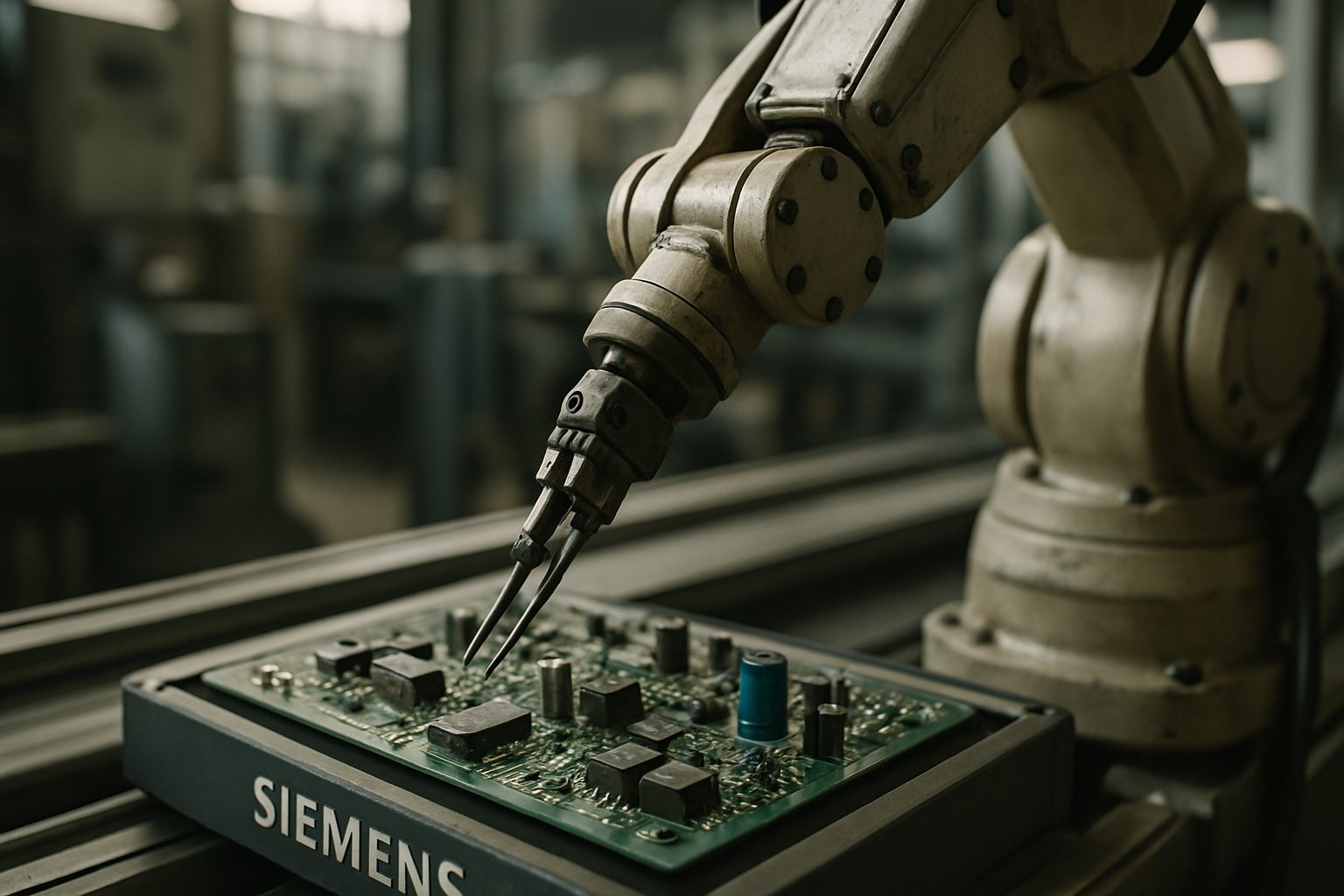
Digital Twins Drive Simulation
Digital twins sit at the heart of the proposed AI-OS. Furthermore, Siemens plans to release Digital Twin Composer to help engineers build high-fidelity models without deep coding. GPU acceleration inside Omniverse will then run multiphysics scenarios in near real time. Therefore, teams can test thousands of process variations before changing a single bolt on the floor.
Robotics AI algorithms will analyze outcomes and suggest optimal parameters. Additionally, the closed-loop design pushes validated settings back to programmable controllers, turning simulation into direct production guidance. This workflow promises sharper quality, lower scrap, and faster commissioning.
Early Pilot Results Emerge
Initial pilots already show traction. PepsiCo used the combined stack to stress-test a snack packaging line. Moreover, the virtual factory reportedly spotted 90% of potential issues before physical runs. Consequently, first-phase throughput jumped about 20%, and capital spending fell by up to 15%. Meanwhile, Industrial Copilot trials at thyssenkrupp trimmed reactive maintenance time by 30%. Robotics AI routines translated machine codes, identified faults, and proposed corrective steps. Nevertheless, these figures remain vendor-reported and await broader verification. Therefore, observers should track independent audits as deployments scale.
Benefits And Use Cases
Many factories still juggle paper procedures and siloed PLC scripts. In contrast, the new AI-OS aims to unify workflows and deliver measurable gains. Key advantages include faster engineering, adaptive orchestration, and resilient supply chains. The following list distills the headline benefits.
- Design acceleration: GPU-enhanced EDA loops promise 2–10× speed increases, according to Siemens.
- Throughput growth: PepsiCo’s pilot reported 20% higher output after closed-loop optimization.
- Downtime reduction: Industrial Copilot cut troubleshooting time by 30% in early trials.
- Capital efficiency: Digital simulations yielded 10–15% CapEx savings in select projects.
- Sustainability gains: Optimized energy schedules lower power peaks inside Manufacturing sites.
Copilots built on Robotics AI frameworks also enhance worker experience. Additionally, generative assistants can draft PLC code, translate alarms, and generate compliance reports in seconds. Professionals can enhance their expertise with the AI+ Robotics™ certification. Moreover, the credential validates applied skills required for upcoming AI-driven Manufacturing roles.
Copilots Boost Shopfloor Efficiency
Plant Copilot runs on NVIDIA NIM microservices. Consequently, inference happens close to machines, preserving latency budgets and data sovereignty. The agent surfaces contextual instructions through voice, tablet, or AR glasses. Robotics AI pattern recognition flags anomalies before they snowball into downtime. Therefore, technicians receive prescriptive steps rather than generic manuals.
These benefits illustrate tangible value beyond hype. However, every innovation carries trade-offs, leading to critical questions.
Risks And Open Questions
Cybersecurity tops the concern list. CISA warns that connecting AI agents to operational technology increases attack surface. Therefore, rugged segmentation, model governance, and continuous testing become mandatory. Additionally, legacy equipment often lacks modern encryption, complicating secure ingestion.
Energy demand presents another hurdle. GPU clusters draw heavy power and cooling, especially in Manufacturing environments already constrained by heat. Moreover, supply chain volatility could delay hardware deliveries.
Energy And Security Concerns
Siemens plans to publish a blueprint detailing sustainable layouts, liquid cooling, and grid balancing. Nevertheless, details on the OS scheduler, rollback mechanisms, and certification paths remain scarce. Robotics AI adoption will therefore depend on transparent governance and cross-vendor interoperability.
These risks underscore the importance of open standards and external audits. Consequently, leaders must weigh innovation against operational resilience as they chart next steps.
The Siemens–NVIDIA alliance signals a decisive shift toward intelligent, adaptive factories. Furthermore, digital twins, accelerated simulation, and closed-loop control now combine in a single Industrial stack. Early pilots hint at double-digit throughput gains and leaner capital spending. However, energy, security, and data hurdles still loom. Executives should monitor upcoming Erlangen results and demand independent validation before scaling. Meanwhile, professionals can future-proof careers by mastering Robotics AI principles and cross-disciplinary automation skills. Therefore, consider pursuing the linked certification and following ongoing standards work to stay ahead in this fast-moving field.


