

AI CERTS
3 months ago
Regulatory Confidence Hits Historic Low
Regulators are also turning up sanction pressure, citing repeated control failures. Meanwhile, investors link governance lapses to depressed valuations and capital costs. In contrast, agile organisations view the present moment as a catalyst for transformative strategy. They recognize that modern technology, data analytics, and targeted upskilling can rebuild trust quickly. However, success requires a holistic framework that addresses culture, accountability mechanisms, and third-party dependencies. This article unpacks the numbers, explores root causes, and outlines a pragmatic recovery roadmap. Professionals will gain actionable insights for restoring stakeholder assurance in highly regulated markets.
Compliance Confidence Metrics Collapse
Recent polling from governance institutes paints a stark picture. Only two percent of 2,300 senior compliance leaders reported strong Regulatory Confidence. Furthermore, 68 percent described their assurance as marginal, while 30 percent admitted near total uncertainty. The decline cuts across finance, healthcare, and energy sectors without notable regional variance. Analysts attribute the drop to accelerating rule changes, remote audit limitations, and data-privacy disruptions.
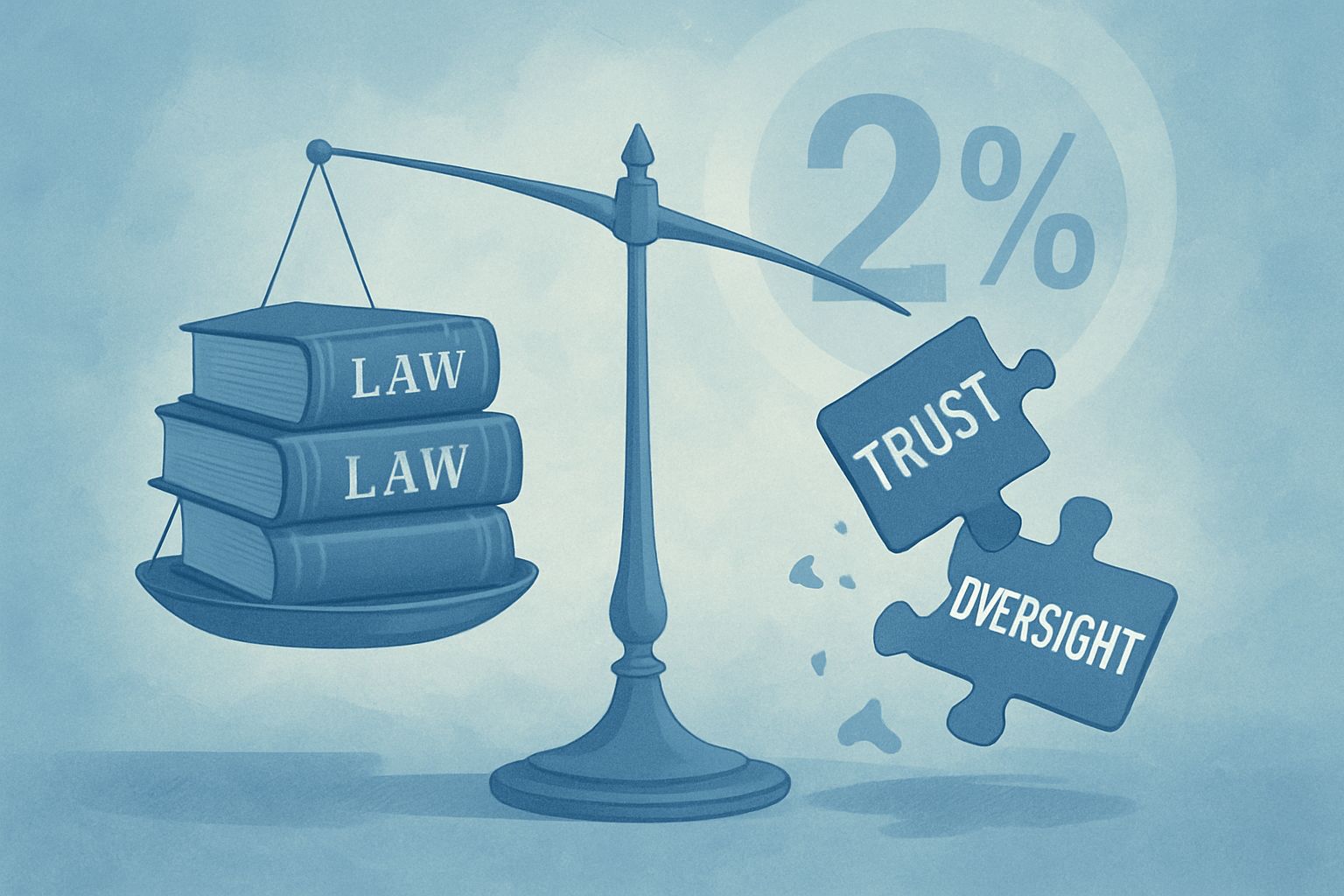
Historical averages place confidence near 40 percent, according to five-year trend data. Therefore, the current level sets a record low since systematic tracking began in 2010. Benchmark dashboards reveal corresponding spikes in remediation cost and operational risk losses.
These numbers confirm a severe perception gap within compliance functions. However, granular drivers must be dissected to craft effective remedies.
Root Causes And Pressures
Interviews with chief compliance officers reveal four dominant pressures eroding assurance. Firstly, multi-jurisdiction rulemaking has outpaced interpretation resources, creating constant Risk recalculations. Additionally, cloud migrations expanded data surfaces, complicating Oversight for access and retention controls. Secondly, work-from-anywhere models fragmented line management, weakening traditional Accountability hierarchies. Inadequate enterprise Strategy compounds these pressures by scattering ownership across functions. Thirdly, regulatory sandboxes have shortened product release cycles, leaving assurance teams reactive rather than proactive. Finally, whistle-blower platforms amplify exposure, accelerating Enforcement timelines.
Consequently, day-to-day practitioners spend 70 percent of effort on manual evidence collection. Meanwhile, predictive analytics adoption lags because legacy spreadsheets dominate key workflows. In contrast, peer functions like cybersecurity enjoy better budgets and board attention.
Root pressures converge to undermine operational resilience across complex organisations. Therefore, leadership must reassess Oversight architecture before confidence can return.
Oversight Shifts And Risk
Oversight responsibilities are migrating from legal departments toward integrated risk management centres. Moreover, boards now demand real-time dashboards that link Risk indicators to control evidence. Regulatory Confidence suffers when those dashboards lack reliable inputs.
- Only 12 percent automate evidence sampling across systems.
- Twenty-eight percent monitor third-party Risk in real time.
- Forty-five percent lack integrated policy version controls.
- Sixty-two percent cannot map controls to Enforcement citations.
Additionally, peer review highlights domain skill shortages that complicate Oversight governance. Nevertheless, several early adopters showcase tangible gains from AI-driven monitoring platforms. One multinational reduced audit preparation hours by 40 percent within six months.
Enhanced visibility demonstrably boosts assurance output and stakeholder trust. Subsequently, organisations must align technology roadmaps with evolving Regulatory Confidence expectations.
Enforcement Trends And Impact
Global regulators have escalated penalty volumes and publicity tactics during the past year. For example, financial watchdogs issued $7.2 billion in fines, a 35 percent increase. Meanwhile, data protection authorities doubled case referrals to criminal Enforcement units. Media coverage magnifies reputational Risk, further depressing market capitalisation post-violation.
Regulatory Confidence deteriorates when firms observe peers punished despite documented compliance programs. However, root analysis reveals gaps between policy design and field execution. Consequently, regulators urge continuous control testing and timely board reporting. Firms adopting those practices saw Enforcement actions drop 22 percent year on year.
Penalty patterns underscore the cost of reactive compliance cultures. In contrast, proactive data analytics limit infractions and rebuild Regulatory Confidence quickly.
Accountability Tools And Tech
Technological enablers now bridge Accountability gaps without inflating headcount. Furthermore, low-code automation platforms standardise evidence capture and retention workflows. Machine learning models flag anomalous user behaviour before regulatory thresholds are crossed. Practitioners may upskill through the AI for Everyone™ certification program.
Digital attestation portals assign individual owners to each control, increasing Accountability transparency. Moreover, immutable audit trails satisfy Oversight committees and external assessors. Therefore, integrated platforms directly elevate Regulatory Confidence among senior executives.
Smart tooling reduces manual workloads while elevating evidence integrity. Subsequently, firms gain capacity to focus on strategic risk mitigation.
Regulatory Confidence Rebuild Strategy
Leaders should adopt a phased Strategy anchored in governance principles. Phase one maps obligations, inherent Risk, and current control maturity. Next, phase two deploys automation to close high-priority lapses within 90 days. Finally, phase three embeds continuous learning loops for sustained Regulatory Confidence.
- Establish an oversight charter approved by the board.
- Align budgets with quantified risk appetites.
- Automate evidence collection and reporting dashboards.
- Monitor regulatory developments in real time.
- Review governance metrics quarterly.
Additionally, cross-functional workshops nurture shared Accountability and break departmental silos. Nevertheless, culture change requires sustained executive sponsorship and incentives.
The roadmap offers a clear sequence for restoring governance integrity. Consequently, disciplined execution accelerates Regulatory Confidence recovery within one fiscal quarter.
Conclusion And Next Steps
Record low Regulatory Confidence underscores an urgent call for action. However, leaders possess proven levers to reverse the slide. Enhanced Oversight, data-driven Risk analytics, and accountable culture create a resilient compliance foundation. Moreover, targeted automation reduces manual burdens while improving evidence quality. Adopting a phased Strategy aligns quick wins with sustainable governance maturity. Consequently, organisations can achieve measurable Regulatory Confidence within months, not years. Stakeholders will reward such progress through improved valuations and brand trust. Begin your transformation today by benchmarking controls and pursuing advanced certifications that future-proof your career.


