

AI CERTs
6 months ago
Predictive warehouse slotting algorithms speed fulfillment
Global e-commerce growth keeps straining distribution centers. Consequently, leaders seek faster paths from click to ship. One tactic now headlines conference agendas: predictive warehouse slotting algorithms. These AI-driven engines relocate SKUs before congestion forms. Furthermore, they align pick faces with real-time demand. Early adopters report headline improvements. Travel distances shrink, and picks per hour climb. Logistics optimization gains appear across sectors, from grocery to fashion. Meanwhile, streamlined inventory flow helps avoid costly stockouts. The following report unpacks the technology’s rise, evidence, and outlook.
Market Momentum Builds Fast
Adoption accelerated sharply between 2024 and 2026. Moreover, Gartner now lists AI slotting as a core WMS capability. Vendors embed predictive warehouse slotting algorithms within flagship releases. Independent surveys show 15–45% cycle-time reductions for mature sites. Consequently, investment follows results. Market researchers value the slotting software segment near two billion dollars. Analysts expect double-digit CAGR through 2030.
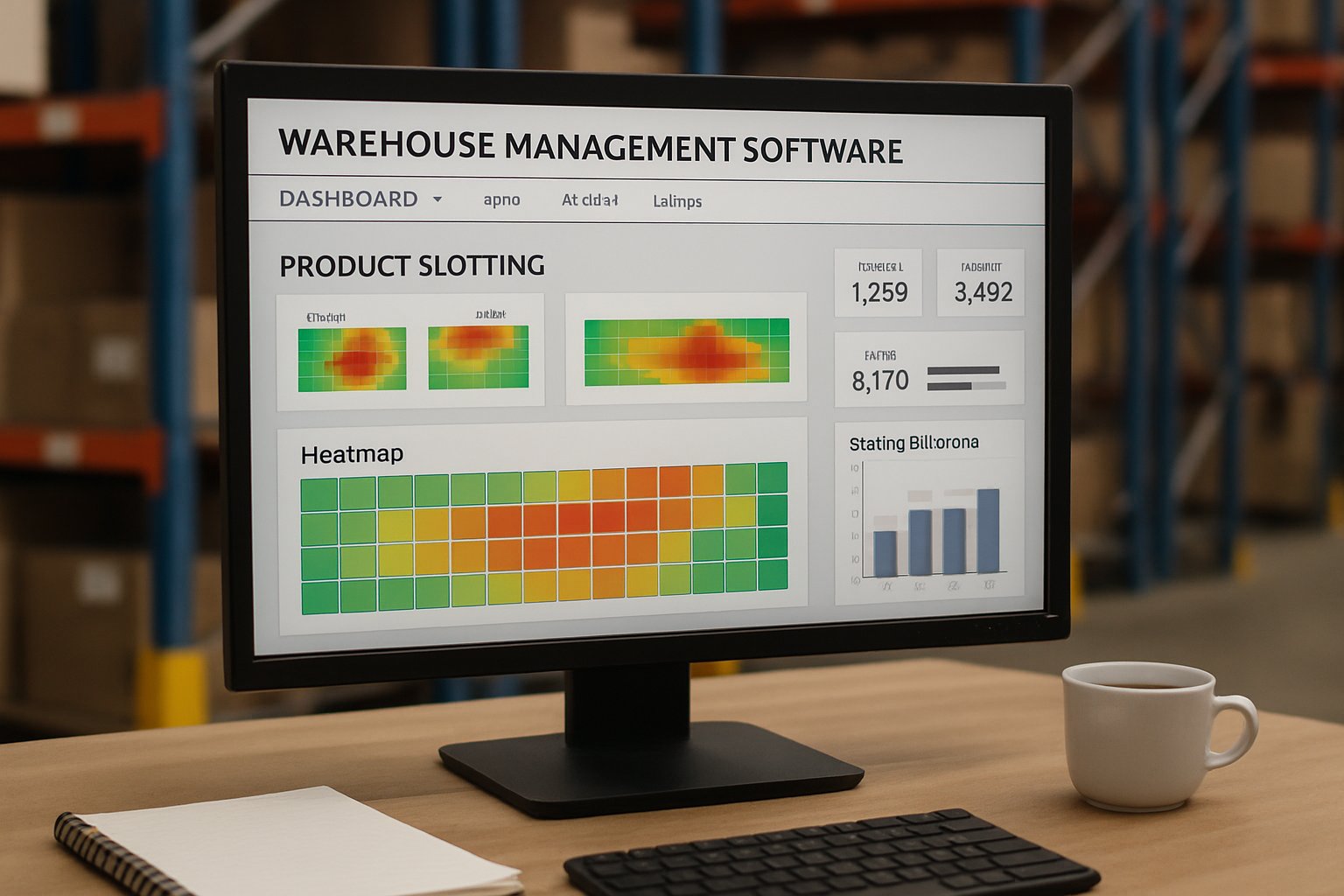
Meanwhile, service providers bundle logistics optimization consulting with dynamic slotting services to diversify revenue. Retailers facing daily SKU volatility embrace near real-time resequencing. Regional labor shortages further intensify the push toward throughput automation. Additionally, rising parcel costs amplify pressure to shorten dwell time inside facilities. These trends confirm the strategy’s mainstream arrival.
Core Algorithmic Principles Now
At the heart lie demand forecasts, velocity rankings, and order affinity scores. Therefore, algorithms propose new pick locations that minimize travel and replenishment. Most engines blend gradient boosting, clustering, and integer solvers. Reinforcement learning now tunes multi-objective trade-offs in complex nodes. Historical demand series often suffer seasonality and promotion spikes that obscure true velocity. Data scientists, therefore, apply feature engineering to highlight weekday cycles and weather effects. Subsequently, constraint solvers respect aisle width, weight limits, and ergonomic guidelines when suggesting moves.
Predictive warehouse slotting algorithms evaluate thousands of SKU moves within seconds. Additionally, they ingest continuous telemetry from scanners, AMRs, and ASRS. The loop recalculates daily, yet stability windows prevent picker confusion. In contrast, static slotting relied on quarterly spreadsheets. Effective models also monitor inventory flow to flag congestion risks earlier. Consequently, logistics optimization efforts can target labor hotspots with precision. Executives value this transparency when justifying automation budgets. Many WMS providers now market proprietary predictive warehouse slotting algorithms as differentiation.
Reported Efficiency Gains Surge
Case studies quantify the upside clearly. Kenco’s SlotDC trimmed travel distance by 27% and saved $247K yearly. Moreover, academic reviews cite 20–50% throughput improvements across sectors. Cycle-time reductions often reach 40% in e-commerce hubs. The following numbers highlight the recurring patterns:
- 25–45% average travel distance reduction reported in multi-site surveys.
- 30–40% picks per hour increase within six months of deployment.
- Accuracy rates surpass 99% in goods-to-person zones.
- Payback periods frequently fall below 12 months.
Predictive warehouse slotting algorithms underpin each statistic. Meanwhile, improved inventory flow prevents replenishment backlogs during peak. Consequently, logistics optimization metrics resonate with finance teams. Academic reviewers caution that not every facility measures gains identically. Some studies exclude replenishment labor, skewing comparisons with traditional layouts. Therefore, leaders should baseline metrics over comparable demand weeks before announcing results. Real-time dashboards translate those percentage gains into saved labor hours per shift. These gains validate dynamic slotting’s promise. However, execution quality dictates actual ROI, as the next section shows.
Implementation Best Practices Guide
Successful rollouts start with clean data. Therefore, teams audit inventory accuracy and interface latency before any algorithm runs. Digital twin simulations then stress-test proposed slot moves safely. Subsequently, pilots focus on high-velocity pick zones for fast wins. Warehouse engineers frequently build digital twins using standard simulation platforms like AnyLogic or FlexSim. These replicas let teams test staffing levels against new slot layouts safely. Meanwhile, cross-functional steering committees resolve policy conflicts between inventory control and operations. Clear governance accelerates approvals and reduces last-minute surprises during cutover.
Human-in-the-loop controls remain vital. Daily recommendations pass through supervisors who approve bulk moves. Visual cues, voice prompts, and mobile confirmations keep pickers aligned. Many organizations schedule slot changes once per shift to reduce churn. Professionals can enhance their expertise with the AI Learning & Development™ certification. Moreover, training drives cultural acceptance of predictive warehouse slotting algorithms. Consequently, logistics optimization benefits persist beyond the pilot phase. Structured rollouts mitigate risk and speed returns. In contrast, rushed deployments can erode trust, as the next section explores.
Key Challenges And Cautions
Data silos remain the chief obstacle. Furthermore, legacy WMS platforms lack real-time APIs for algorithm feedback. Frequent slot moves may confuse workers without strong change management. Nevertheless, clear visuals and training reduce mis-picks quickly. Integration with robotics introduces timing complexities. Battery cycles and pick path logic must sync with predictive warehouse slotting algorithms. Security teams also scrutinize AI transparency and auditability. Academic reviews warn about overstated benchmarks. Legacy barcode devices may also struggle with new location identifiers, causing scan delays. Therefore, hardware firmware updates or replacements can become hidden costs. Nevertheless, phased device upgrades spread expenditure across budget cycles. These pitfalls can stall projects. However, vendor roadmaps increasingly address them, as the landscape section details.
Evolving Vendor Landscape 2026
Blue Yonder, Manhattan, SAP, and Oracle all tout embedded slotting engines. Meanwhile, Fortna, Lucas Systems, and Kenco offer service-led modules. Startups target micro-warehouses with cloud APIs. Market consolidation favors platforms that bundle analytics, execution, and robotics control. Moreover, vendors differentiate through simulation accuracy and algorithm explainability. Lucas Systems, for example, layers voice picking with slotting logic for midsize warehouses. Meanwhile, robotics integrators like Swisslog tie AMR routing to dynamic pick faces. Such convergence blurs lines between planning and real-time execution layers. Predictive warehouse slotting algorithms now ship as default features in top-tier WMS plans. Choice expands yet integration ease matters most. Consequently, buyers should align technology roadmaps before contracts. Public reference customers still influence perception more than brochure statistics. Future research will clarify comparative performance.
Future Research Directions Ahead
Independent benchmarking remains scarce today. Therefore, researchers plan multi-DC trials using standard KPIs. Labor impact tracking also demands attention. In contrast, vendors focus on reinforcement learning extensions. Hybrid solvers promise smarter decisions during volatile peaks. Energy consumption metrics may soon join throughput and accuracy as core benchmarks. Researchers also intend to test cross-dock environments with perishable goods. In addition, ethics committees will examine algorithm bias regarding ergonomic constraints. Predictive warehouse slotting algorithms will increasingly coordinate with inventory flow models for network-wide benefits. Continuous experimentation will sharpen benchmarks. Consequently, decision makers should watch upcoming academic consortia. Ultimately, transparent peer-reviewed studies will anchor investment decisions.
Predictive warehouse slotting algorithms have shifted from pilot curiosities to mainstream enablers of agile fulfillment. Consequently, operations realize sustained cycle-time, throughput, and accuracy gains. Vendors now integrate AI decision layers directly inside WMS and WES suites, while consultants package proven playbooks. Nevertheless, success still hinges on data hygiene, change management, and aligned robotics control. Forward-looking leaders should pilot high-velocity zones, measure rigorously, and scale iteratively. Data dashboards should display slot stability indexes alongside labor allocation heatmaps. Consequently, supervisors react faster when pick face congestion reappears. Professionals seeking deeper mastery can elevate their skills through the AI Learning & Development™ certification. Act now to convert rising demand volatility into competitive advantage.
Disclaimer: Some content may be AI-generated or assisted and is provided ‘as is’ for informational purposes only, without warranties of accuracy or completeness, and does not imply endorsement or affiliation.


