

AI CERTS
3 months ago
Physical AI nears robotics GPT-3 breakthrough
Consequently, leading labs report unprecedented zero-shot performance across varied hardware. Start-ups have followed, raising hundreds of millions to build a universal robot brain. Meanwhile, skeptics warn that spatial data scarcity, safety, and costs still threaten timelines. This report examines evidence, players, challenges, and commercial signals behind the looming Physical AI moment.
Global Market Momentum Builds
Funding headlines underscore the rising belief in a swift shift toward Physical AI. Khosla Ventures partner Ethan Choi predicted a GPT-3 moment for robots by 2026. Similarly, NVIDIA researcher Jim Fan forecast breakthroughs within three years. Moreover, Skild AI secured a $300 million Series A at a $1.5 billion valuation.
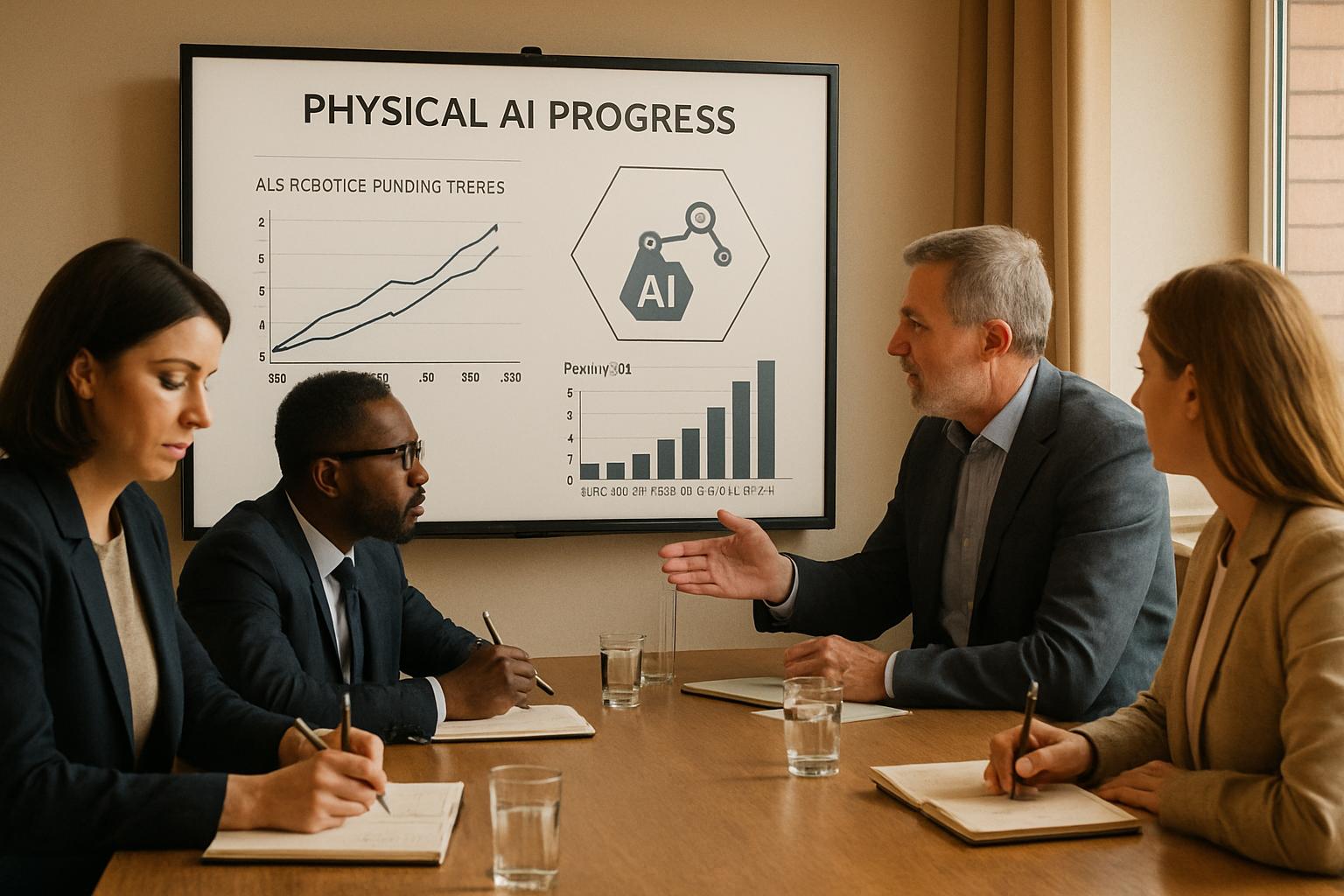
Investors frame these rounds as enabling a universal Foundation model for robots. Consequently, hardware makers like Apptronik and Agility align with cloud providers to woo enterprise pilots. Start-up pitch decks repeatedly cite spatial generalization across embodiments as the near-term differentiator. As a result, Physical AI startups attract premium valuations.
- Skild AI: $300 million Series A, valuation $1.5 billion
- Ethan Choi: Predicts GPT-3 moment in 2026
- NVIDIA Jim Fan: Breakthrough within three years
- DeepMind Gemini Robotics: Trusted tester program launched 2025
Investor momentum signals confidence in Physical AI and its commercialization path. However, technical advances must justify this capital wave. Next, we examine breakthroughs underpinning that optimism.
Critical Technical Breakthroughs Unveiled
Real progress in Physical AI stems from vision–language–action transformers training on diversified robot trajectories. Google’s RT-2 doubled unseen task success to roughly 62 percent, beating RT-1 convincingly. Furthermore, PaLM-E scaled to 562 billion parameters, showing embodied reasoning across images and commands. Consequently, enterprises view Physical AI as the glue between perception and actuation. Engineers compare the leap to GPT-3’s few-shot surprise in 2020. These advances suggest a unifying Foundation for embodied intelligence.
Recent VLA Model Milestones
DeepMind’s Gemini Robotics family blended web text, video, and real robot data into one model. Consequently, the system demonstrates cross-hardware transfer with minimal fine-tuning on partner machines. Researchers tokenized actions so transformers treat movements like words, simplifying control synthesis.
Funding And Vendor Signals
NVIDIA released reference stacks optimized for these workloads, branding them as 'Project Groot'. Moreover, Google opened a trusted tester SDK to selected hardware firms during 2025. Such moves accelerate integration paths from labs to factory floors.
Still, data scarcity challenges remain central. Teams augment physical trials with simulation to cover vast spatial permutations. Nevertheless, sim-to-real gaps persist, demanding continual calibration.
The latest models validate the feasibility of broad embodied generalization. However, unresolved data and transfer hurdles motivate deeper scrutiny in the next section.
Persistent Barriers Temper Enthusiasm
Despite hype, several technical and economic barriers slow scalable deployment. Data collection remains expensive because each robot episode carries mechanical wear and staffing overhead. Additionally, the spatial diversity of real homes or factories still dwarfs current datasets. In contrast, language models enjoy trillions of free web tokens.
Safety governance also lags, even with DeepMind’s Asimov benchmark and similar efforts. Ken Goldberg stresses that misaligned actions could damage property or people. Therefore, industry groups push for transparent evaluation and liability frameworks.
Hardware economics introduce further drag. Humanoid platforms still cost over $100,000, limiting mass trials. Consequently, only well-funded labs can gather required data volumes.
These constraints illustrate why Physical AI progress feels both rapid and fragile. Nevertheless, commercial roadmaps reveal practical strategies to bridge the gap. The next section explores how businesses plan rollouts.
Robotics Commercial Outlook Ahead
Enterprise pilots now focus on narrow, high-value tasks such as warehouse tote sorting and lab sample handling. Gemini Robotics testers reported setup times falling from weeks to days with pretrained policies. Meanwhile, contract manufacturers see robots as an answer to talent shortages and aging workforces.
Analysts expect service revenues to exceed unit sales during early Physical AI deployments. Subscription models mirror the cloud software playbook, lowering upfront barriers. Consequently, integrators bundle hardware, updates, and liability coverage into monthly contracts.
Early adopters pursue competitive differentiation rather than pure cost savings. Therefore, pilot metrics emphasize uptime, compliance, and brand perception. If those metrics stabilize, markets could scale swiftly.
Commercial signals indicate a measured but undeniable shift toward Physical AI at scale. However, executives still need concrete roadmaps and trained staff. Strategies for addressing that readiness appear next.
Essential Strategic Next Steps
CIOs must first audit existing data pipelines and sensor quality. Moreover, partnerships with model providers can accelerate experimentation while sharing risk. Enterprises should demand benchmark transparency before committing capital.
Skills shortages present another hurdle. Professionals can enhance expertise with the AI Architect™ certification. Additionally, internal training on robotics safety and spatial reasoning will remain vital.
- Adopt open VLA benchmarks for evaluation
- Invest in mixed reality simulation assets
- Negotiate shared liability clauses with vendors
- Track regulatory updates on autonomous systems
Following these steps positions firms to ride the Physical AI wave responsibly. Consequently, boardrooms can balance innovation with governance. The final section synthesizes main insights.
Conclusion
Industry momentum suggests the long-awaited Physical AI shift is finally within operational reach. Recent VLA breakthroughs echo GPT-3’s sudden ascent, yet hardware and data hurdles remain material. Nevertheless, investor capital, vendor toolkits, and open benchmarks are converging. Consequently, early movers can secure competitive advantages by piloting embodied systems today. Leaders should pair rigorous safety protocols with strategic upskilling initiatives. Therefore, exploring certifications such as the AI Architect™ credential will deepen organizational readiness. Act now to shape your firm’s role in the emerging embodied intelligence era.


