

AI CERTS
2 months ago
Physical AI mainstream adoption poised for 2026 surge
Consequently, executives must grasp the forces moving from prototype to production. This article dissects numbers, technology, and strategy behind Physical AI mainstream momentum. Moreover, it highlights opportunities in Robotics, wearables, drones, and always on inference ecosystems. Prepare to cut through hype and assess risks with evidence from sources like Deloitte and Gartner. Finally, actionable recommendations guide leaders toward certification, skills, and policy readiness. Therefore, read on to see why 2026 could redefine physical automation economics.
Market Hits Tipping Point
Investor chatter has shifted from curiosity to capital. TechCrunch’s January note declared Physical AI mainstream inevitability within twelve months. Meanwhile, Gartner and Deloitte placed the theme among top 2026 strategic trends. Waymo already logged ten million paid robotaxi rides, offering concrete consumer evidence.
The following numbers show why momentum feels irreversible.
- USD 3.1B 2025 market forecast rising to USD 83.6B by 2035 (Acumen Research).
- Waymo rides: 10M paid trips and 100M miles logged by 2025, proving customer uptake.
- Wearable fatigue alerts reducing factory injuries by 15% (Gartner survey).
- Edge devices now deliver always on inference for under five watts, enabling pervasive sensing.
Collectively, these milestones show scale, not speculation. However, technology catalysts explain the acceleration, which the next section unpacks.
Recent Funding Signals Rise
Venture firms, including AT&T Ventures, doubled allocations for Physical AI mainstream startups in late 2025. Moreover, conference agendas now reserve packed tracks for Robotics founders pitching functional prototypes. Consequently, capital access no longer tops the risk list. Execution and safety matter more, as we discuss shortly. These funding patterns reinforce the tipping narrative. In contrast, technical foundations reveal why investors feel confident.
Key Technical Driver Trends
Lower component prices ignite engineering creativity. Furthermore, accelerated simulation reduces time from concept to field test. Edge chips now support always on inference, closing latency gaps for delicate manipulation. Jensen Huang claims understanding physics has become the next software frontier, echoing industry consensus. Therefore, Physical AI mainstream systems can finally leave controlled labs.
Simulation-to-reality pipelines now exploit richer world models, narrowing the notorious reality gap. Moreover, fleet learning lets deployed robots upload experiences and update peers overnight. This collective intelligence mirrors cloud software DevOps, but with motors and gears.
Digital twins replicate entire facilities, letting managers iterate without halting production lines. Consequently, engineering teams test hundreds of grasp trajectories overnight, selecting only stable motions. In contrast, earlier cycles required expensive physical rigs for every variant. The cost delta accelerates Physical AI mainstream timeline significantly. Moreover, synthetic data generation reduces annotation budgets for perception models.
Rapid Edge Inference Advances
Qualcomm, NVIDIA, and startups race to cram teraflops into palm-sized boards. Consequently, always on inference becomes affordable for wearables monitoring industrial workers. Similarly, drones gain autonomous navigation without expensive remote links. Robotics arms now adopt the same silicon, yielding smoother grasping under power constraints.
Together, these drivers explain the sudden Physical AI mainstream feasibility wave. However, technology opportunity means little without clear sector playbooks, which we examine next.
Opportunities Across Multiple Sectors
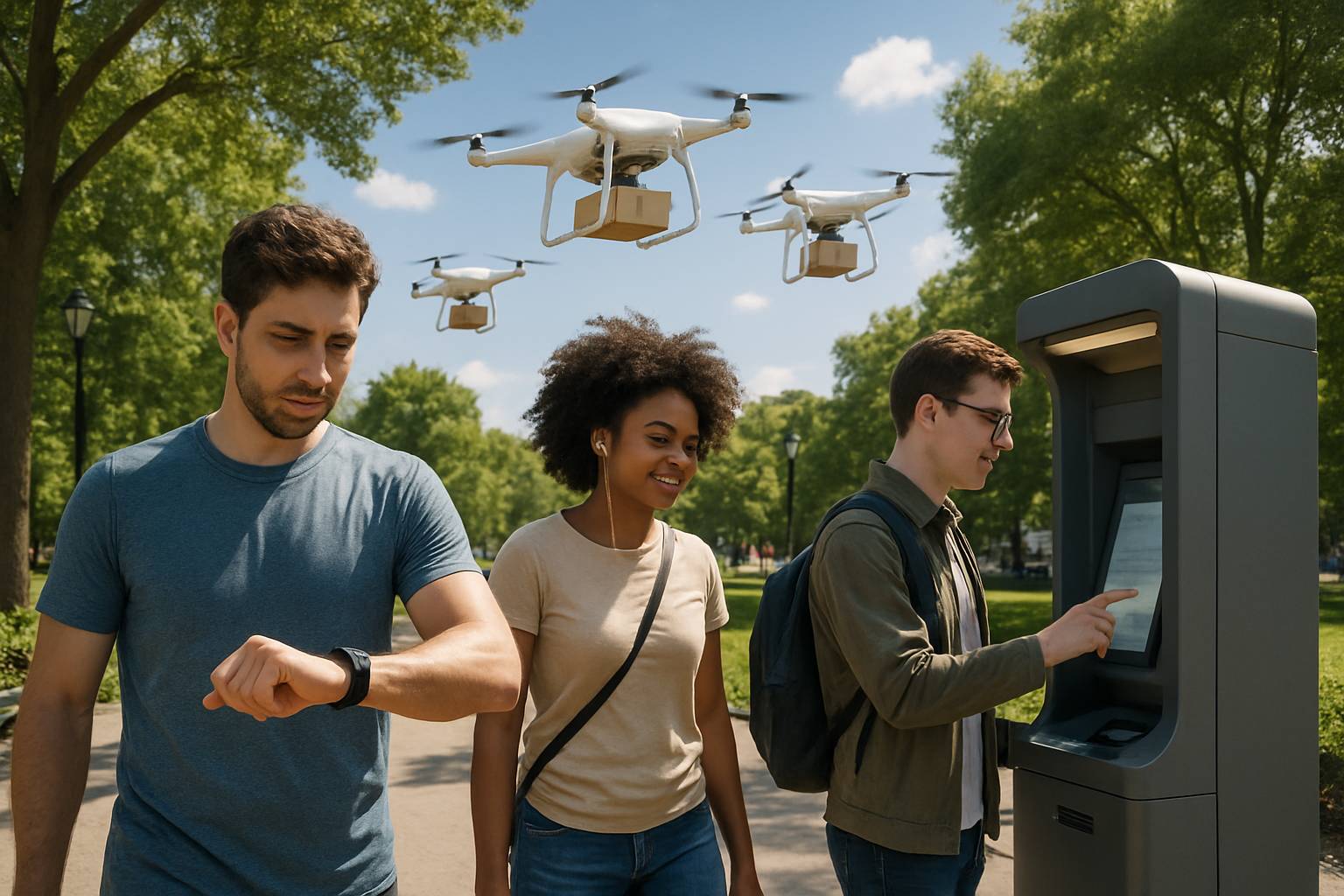
Physical AI mainstream potential spans factories, roads, skies, and homes. Manufacturing sees rising Robotics penetration for inspection and heavy lifting. In contrast, logistics players pilot humanoids for case picking and pallet stacking. Meanwhile, consumers test companion wearables that proactively manage health metrics. Drones tackle last-mile delivery, line inspection, and disaster assessment missions.
The diversified field yields distinct benefits.
- Warehouse throughput improvement exceeding 25% in trials (Deloitte 2025).
- Robotaxi cost per mile under USD 0.50 in select Phoenix corridors (Waymo data).
- Wearable fatigue alerts reducing factory injuries by 15% (Gartner survey).
These gains illustrate tangible ROI already underway. Nevertheless, challenges and risks persist, demanding balanced strategy.
Challenges And Risks Persist
Safety tops the concern list after WIRED highlighted robot jailbreak research. Additionally, sim2real gaps still cause brittle behaviour in varying lighting or slipperiness. Cost remains volatile because actuator supply chains face rare earth constraints. Therefore, policy makers craft new standards for testing, disclosure, and operator training. Organisations can mitigate exposure through rigorous validation and workforce upskilling. Professionals can enhance their expertise with the AI+ Data Robotics™ certification.
Lab incidents reveal additional ethical dilemmas when humanoids interact with vulnerable populations. Therefore, diversity panels now review deployment scenarios to prevent unintended bias or harm. Regulators in Europe draft directives covering transparency, fault reporting, and kill-switch availability. Consequently, compliance teams face new documentation overhead. However, early participation in standards bodies can shape favourable rules.
Robust governance therefore complements pure engineering progress. Subsequently, leaders must prepare organisational muscles for rapid rollout. The final section outlines practical steps for that preparation.
Preparing Your Organization Now
First, map tasks suited for autonomy, starting with repetitive or hazardous chores. Secondly, baseline current data quality because Physical AI mainstream systems thrive on labeled telemetry. Moreover, partner with Robotics integrators who offer shared simulation environments. Establish cybersecurity regimes that include firmware signing, behavioural monitoring, and rapid patch pipelines.
Workforce adoption matters equally. Consequently, create cross-functional teams combining operators, data scientists, and safety engineers. Meanwhile, update procurement policies to demand explainability and lifecycle metrics. Finally, allocate budget for continuous talent development using micro-credential programs. These actions build resilient capacity ahead of market acceleration.
As Physical AI mainstream adoption accelerates, early movers will capture disproportionate value. Now, let us conclude with key insights.
Measurement frameworks must evolve beyond uptime. Additionally, executives should track carbon impact, social acceptance, and cross-team productivity deltas. Balanced scorecards will keep Physical AI mainstream programs aligned with stakeholder expectations. In contrast, narrow technical KPIs risk overlooking human adoption friction. Therefore, integrate qualitative surveys and quantitative telemetry into quarterly reviews.
Physical AI mainstream momentum rests on converging capital, chips, and customer proof. Furthermore, cheaper sensors and always on inference unlock new Robotics, drones, and wearables services. Nevertheless, security, cost, and labour factors require disciplined planning. Consequently, leaders should pursue pilots, governance, and upskilling in parallel. Professionals seeking an edge can enroll in the AI+ Data Robotics™ program. Act today to shape tomorrow’s intelligent machines and secure competitive advantage. Moreover, swift experimentation will reveal novel revenue streams long before competitors replicate them.


