

AI CERTS
3 months ago
Pennsylvania Residents Challenge AI Infrastructure Impact Plans
Springdale residents, in contrast, challenge a developer aiming to transform a retired coal plant. Across Luzerne County, officials pre-emptively rewrite zoning codes to block future mega campuses. Furthermore, state legislation could strip municipalities of that authority, escalating tensions. This article dissects the conflict, presents data, and outlines pathways for industry and policymakers. Moreover, the coming legislative session could redefine every regional infrastructure forecast.
Assessing AI Infrastructure Impact
Global electricity demand from data centers could more than double by 2030, according to the IEA. Moreover, the agency cites artificial intelligence workloads as the dominant driver of that future load. U.S. facilities already consume nearly half of global data-center power, concentrating risk in specific regions. Therefore, analysts warn that Pennsylvania’s older grids will feel outsized stress from additional hyperscale clusters.
The AI Infrastructure Impact extends beyond megawatts, encompassing substation construction, transmission upgrades, and backup generation. Berkeley Lab estimates national facilities consumed about 17 billion gallons of water during 2023. Consequently, communities reliant on wells fear irreversible depletion during summer droughts. Understanding these intersecting pressures frames the technical and political stakes for every local hearing. These numbers convert abstract servers into tangible community burdens. However, investment advocates argue that modern designs can mitigate several of those burdens.
Residents Voice Mounting Opposition
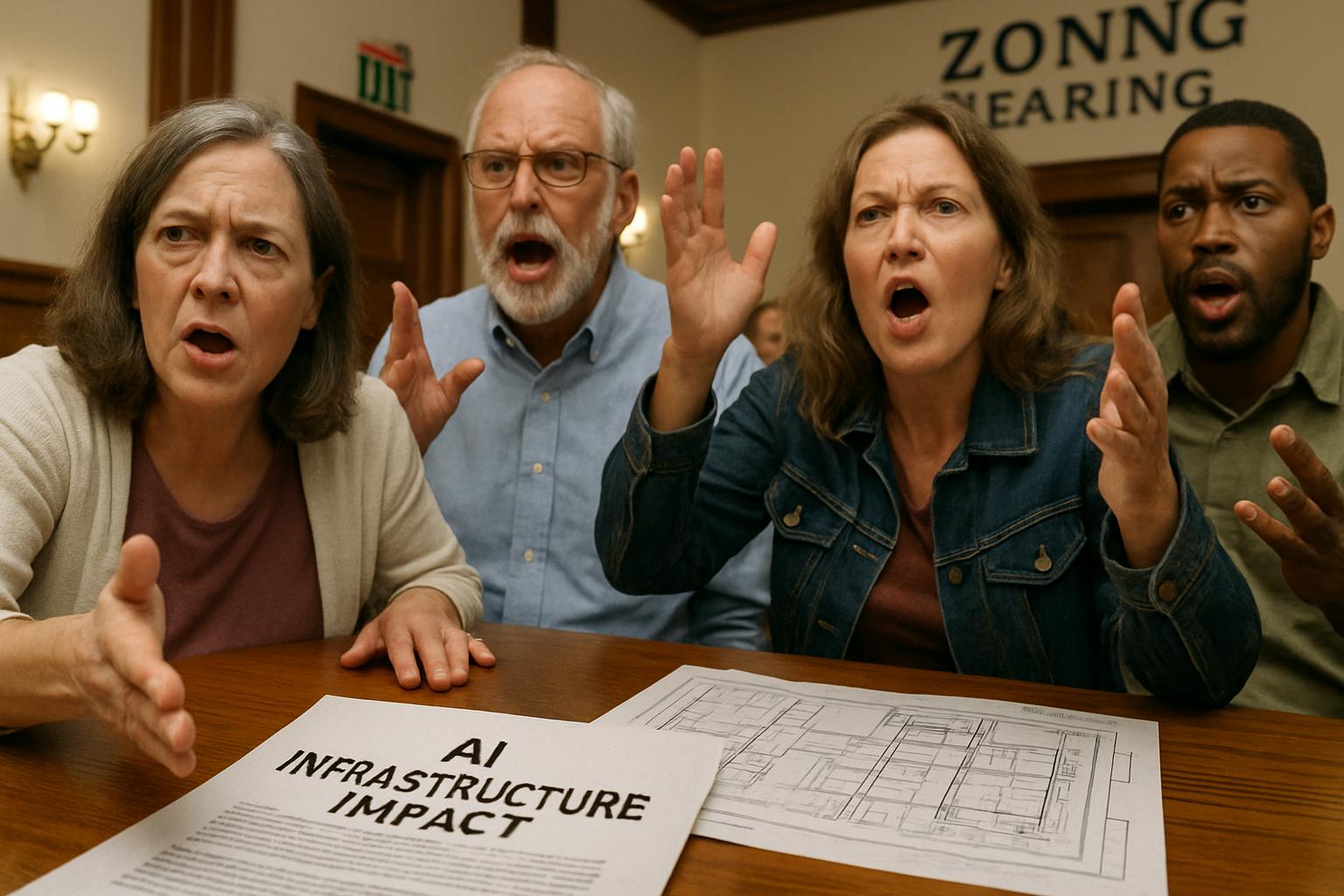
November’s Montour County meeting drew more than 300 people, filling every aisle and doorway. Additionally, speakers waited hours to denounce Talen Energy’s 800-acre rezoning request near fertile farmland. Sam Burleigh warned commissioners that industrial sprawl would erase the rural atmosphere residents cherish. Protect PT leads a similar charge in Springdale, where neighbors worry about nonstop generator hum. Noise pollution remains a potent rallying cry, especially for homeowners living within earshot of proposed cooling towers.
Moreover, parents cite water usage fears, noting their private wells already drop during dry August weeks. Local groups trade strategies, share legal templates, and monitor every planning agenda across Northeastern counties. Consequently, rezoning petitions increasingly stall as officials absorb political pressure from organized constituents. The collective activism demonstrates how technical infrastructure debates translate into grassroots power. Nevertheless, developers continue courting officials with economic projections, ensuring the conversation remains dynamic. These resident networks expand daily, reinforcing skepticism toward corporate promises. Therefore, the following section examines what those promises actually entail.
Energy And Economic Promises
Developers highlight billions in capital spending and hundreds of short-term construction jobs. For example, Allegheny PropCo touts 1,000 construction positions and 100 permanent technicians for the Cheswick site. Moreover, Talen Energy positions its Montour expansion as aligned with existing generation infrastructure, reducing incremental grid investments. County leaders envision fresh tax revenue funding schools and emergency services. In contrast, activists counter that automation slashes long-term staffing, leaving limited payroll circulating locally. The AI Infrastructure Impact narrative splits here, balancing macroeconomic gains against microeconomic sacrifices. Utilities, meanwhile, signal potential rate hikes to finance substations dedicated primarily to single corporate customers. Consequently, residential bills could rise even when family members never enter a server hall. These contested forecasts fuel ongoing debates in every borough council. Subsequently, environmental considerations intensify the scrutiny, as the next section explains.
Environmental Concerns Intensify Debate
Evaporative cooling systems can consume millions of gallons annually, depending on design and climate. Therefore, communities reliant on small aquifers see water usage as an existential threat. Montour and Springdale residents request binding caps that limit withdrawals during drought emergencies. Developers sometimes respond with closed-loop cooling proposals, yet watchdogs demand enforceable reporting. Noise pollution also sparks emotion because low-frequency hum permeates walls, especially during night maintenance.
Moreover, diesel backups emit particulates, compounding respiratory concerns near schools. Environmental groups list cumulative impacts, arguing that piecemeal permits ignore regional air basins. IEA analysts stress that cleaner energy portfolios plus efficient design can lower the AI Infrastructure Impact footprint. Nevertheless, inconsistent oversight means communities must negotiate safeguards project by project. These unresolved environmental questions motivate legislative action, discussed in the next section.
Legislative Battles Over Zoning
Pennsylvania Senate Bill 939 would designate data centers as high-impact infrastructure eligible for accelerated permitting. However, the draft simultaneously restricts municipalities from imposing stricter zoning conditions than for other industries. Local officials see that clause as an assault on home-rule authority. Consequently, Montour commissioners delayed a final vote on Talen Energy lands, awaiting legislative clarity. In contrast, Luzerne Township leaders proactively amended zoning codes, raising setbacks and demanding environmental studies. Industry lobbyists argue uniform standards streamline the AI Infrastructure Impact response statewide. Simultaneously, activists mobilize phone banks to pressure representatives into shelving the bill. These political maneuvers mirror battles unfolding in Virginia, Ohio, and Michigan. Therefore, investors track policy signals closely before finalizing procurement contracts. Next, national investment trends provide additional context.
National Investment Trends Context
Data Center Watch counts 64 billion dollars in projects stalled or canceled after local pushback since 2024. Moreover, Northern Virginia’s grid constraints illustrate how delays cascade into neighboring states. Consequently, corporations diversify site selection, seeking receptive jurisdictions with ample renewable capacity. Still, the AI Infrastructure Impact question follows them, because servers appear wherever fiber and power converge. Investors therefore weigh community sentiment alongside tax abatements during due diligence. Companies boasting transparent water usage reports and robust noise pollution controls now clear approvals faster. IEA guidance suggests integrated planning can prevent regional grid shocks while unlocking efficiency gains. Nevertheless, coordination demands time that quarterly earnings rarely grant. These national patterns influence Pennsylvania stakeholders preparing strategic responses. The final section distills actionable steps for each group.
Strategic Responses For Stakeholders
Stakeholders can move from conflict toward collaboration by adopting transparent metrics and verified skills. Furthermore, professionals can validate expertise through the AI for Everyone™ certification. Adopting that baseline fosters shared vocabulary during negotiation sessions.
- Publish quarterly water usage dashboards validated by third parties.
- Install noise pollution sensors with public real-time displays.
- Align permit applications with community vision plans before filings.
- Quantify AI Infrastructure Impact reductions from renewable procurement.
Moreover, counties can schedule joint workshops with utilities to map load growth transparently. Developers should finance independent groundwater studies before final site selection. Consequently, early data sharing can shorten approval timelines and safeguard community trust. These proactive moves ease friction and let investment flow where it delivers broad value. Subsequently, sustained monitoring maintains accountability beyond ribbon-cutting ceremonies. The suggested steps illustrate that compromise is possible. However, commitment from every party remains essential, as the concluding section underscores.
Pennsylvania’s data center wave encapsulates global tensions between digital demand and local resilience. Throughout the state, residents weigh promised prosperity against fears of water usage shocks and noise pollution. Legislators debate authority while corporations calculate timelines and public relations costs. Moreover, activists refine playbooks that have already delayed billions in investments nationwide. Therefore, collaboration anchored in transparent data, stringent safeguards, and certified expertise offers the most stable path forward. Take informed action today by pursuing recognized credentials and engaging constructively in your local planning process. Together, stakeholders can harness technology’s benefits without sacrificing community health or democratic control.


