

AI CERTS
2 months ago
Palantir Bootcamps Propel Defense AI Platforms Adoption
This article examines the program’s growth, revenue contribution, and future trajectory through 2025.
It synthesizes Palantir filings, analyst notes, and press coverage to offer a clear, data-driven view. Additionally, readers receive practical takeaways for scaling AI initiatives within sensitive public sector or commercial domains. Every claim here references public filings or on-record reporting to ensure factual integrity. Meanwhile, sentences stay concise to maintain readability for busy technical leaders. Let us explore how a five-day workshop now moves billion-dollar markets.
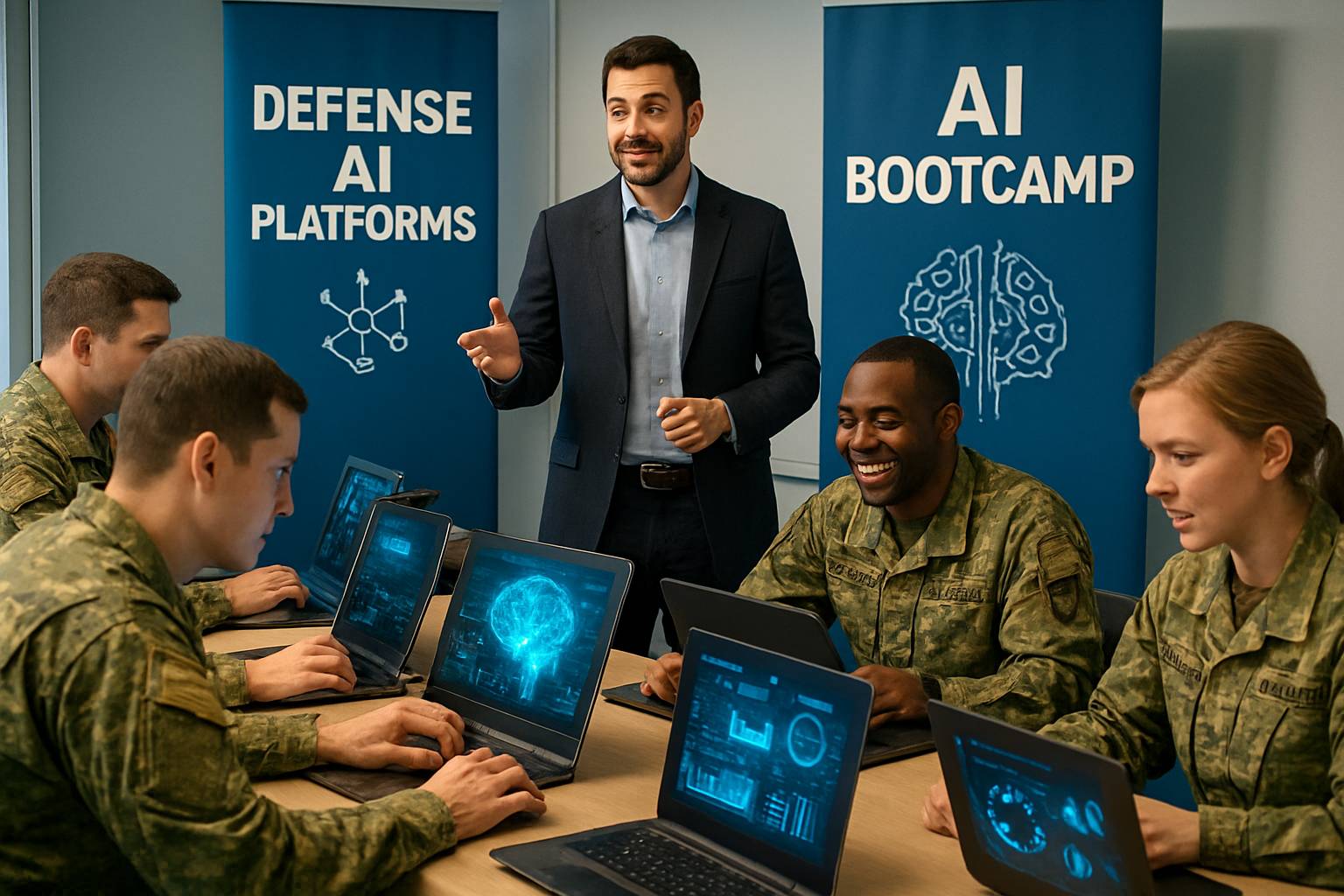
Scaling Defense AI Platforms
Bootcamps emerged after Palantir launched AIP in mid-2023. Subsequently, engineers spent two to five days inside customer environments ingesting live data. This hands-on sprint let prospects see secure workflows instead of slideware. Therefore, decision makers could judge fit without committing multi-month evaluation budgets. The approach resonated in Defense AI Platforms, where classified data cannot leave restricted enclaves.
Bootcamps run on-premise or within accredited clouds, preserving compliance while unlocking generative reasoning over fused data. Consequently, uniformed officers witness mission impact before signing procurement documents. In commercial sectors, executives appreciate the same immediacy though the security stakes differ. Loop Capital and Wedbush both cite the workshops as Palantir’s sharpest competitive spear. Moreover, management set public goals to complete hundreds of sessions, then repeatedly beat those targets.
Bootcamps translate abstract AI into operational demonstrations under real constraints. These proven outcomes set the foundation for the revenue analysis that follows.
Bootcamp Engagement Model Explained
A typical engagement starts with secure data integration on day one. Engineers connect source systems, build the ontology, and hydrate language models with live context. In contrast, legacy proofs often rely on synthetic datasets and static dashboards. Day two shifts toward operational workflows such as logistics optimization or maintenance forecasting.
Consequently, stakeholders from finance, operations, and security observe cross-functional value. Meanwhile, developers configure granular controls so auditors can trace every decision for compliance. Palantir reports that many bootcamps deliver at least one production-ready workflow by day five. Moreover, the company captures feedback immediately, translating it into license sizing and support scopes. Ultimately, Defense AI Platforms benefit when prototypes materialize within a single workweek.
- Median bootcamp duration: five days from ingestion to demo.
- Roughly 70% convert to paid contracts within one quarter.
- Average deal size exceeds one million dollars, according to Q1 2025 filings.
The engagement structure compresses risk while expanding perceived value. Therefore, revenue acceleration becomes easier to quantify, as the next section shows.
Quantifying Revenue Growth Impact
Palantir’s Q1 2025 results illustrate the financial payoff of disciplined bootcamp scaling. U.S. commercial revenue jumped 71% year over year to 255 million dollars. Furthermore, total contract value for commercial customers reached 810 million dollars, up 183%.
Management credited bootcamps and the broader Defense AI Platforms sales motion for the surge. In the same quarter, 139 deals exceeded one million dollars, including 31 above ten million. Moreover, U.S. revenue growth outpaced global gains, suggesting domestic momentum among regulated industries. Analysts note that many of those enterprises maintain ties to federal supply chains. Consequently, repeatable bootcamp playbooks appear to scale across sectors without diluting margins.
- Revenue Q1 2025: 884 million dollars, up 39% year over year.
- U.S. revenue reached 628 million dollars, rising 55% year over year.
- Completed bootcamps exceeded 1,300 by June 2024, per press release.
These figures confirm that bootcamps convert curiosity into quantifiable income. However, distribution partnerships may amplify results even further.
Partnerships Extend Defense Reach
August 2024 brought a pivotal Microsoft Azure Government alliance. Under the deal, Palantir will deploy AIP in Azure Government Secret regions. Additionally, both firms plan joint bootcamps for intelligence and military customers. The collaboration broadens access to accredited infrastructure without sacrificing data sovereignty.
Consequently, Defense AI Platforms gain a distribution channel that speaks native cloud language to procurement officers. Moreover, Azure adds automated scaling, which helps operations teams manage unpredictable wartime workloads. Reuters framed the partnership as a clear moat against smaller rivals lacking federal accreditations. In contrast, purely commercial SaaS vendors often struggle to pass classified security audits.
Cross-cloud availability removes a traditional adoption barrier. Therefore, the next logical question involves external validation from market observers.
Analysts Assess Current Momentum
Loop Capital calls Palantir’s bootcamp approach a competitive edge impossible to replicate quickly. Meanwhile, Wedbush projects multi-year upside as workshops unlock bigger wallet share. Barron’s highlighted five-day deployments as a decisive differentiator for Defense AI Platforms. Nevertheless, several commentators caution that valuation now bakes in flawless execution.
Zacks notes heavy exposure to spending cycles could pressure results during budget delays. Moreover, analysts want clearer disclosure on retained revenue after initial bootcamp enthusiasm subsides. They also request granular churn metrics across manufacturing, healthcare, and military accounts.
Wall Street enthusiasm remains high but not unqualified. Consequently, leaders must understand inherent risks alongside upside potential. Metric ambiguities present the most cited concern, as the following section details.
Challenges And Metric Clarity
Palantir uses different denominators when disclosing bootcamp statistics. For example, February 2024 cited 560 sessions, while June 2024 claimed over 1,300 completed. However, the first figure referred to unique organizations, not total events. Such variance complicates year-over-year comparisons for investors and auditors alike.
Moreover, long-term value hinges on converting prototypes into sustained operations at scale. Independent analysts therefore seek retention rates and revenue per deployed workflow. In contrast, Palantir emphasizes pipeline growth rather than backward-looking cohort data. Consequently, transparency on churn, renewal pricing, and data integration effort could reassure skeptical observers.
Metric clarity would strengthen already impressive momentum. Nevertheless, executives still control several levers to improve disclosure and adoption. The final section synthesizes those levers into practical guidance.
Strategic Takeaways For Leaders
Executives planning sensitive AI rollouts can learn three core lessons. First, accelerate decision cycles through immersive workshops modeled after Palantir’s bootcamps. Second, embed secure data integration from day one to avoid re-architecture later. Third, align success metrics with ongoing operations rather than one-time demos.
Moreover, partnership choices matter; accredited clouds unlock government and military demand without extra audits. Professionals can enhance their expertise with the Chief AI Officer™ certification. Consequently, structured credentials validate the governance skills buyers expect for Defense AI Platforms. Leaders should also schedule quarterly reviews to track conversion, retention, and margin trends.
These practices convert innovation theater into durable enterprise value. Therefore, disciplined execution sustains competitive advantage after initial hype fades.
Palantir’s bootcamps demonstrate how disciplined, data-driven engagements can accelerate artificial intelligence procurement. Revenue, deal counts, and market optimism validate the model across commercial, public, and military verticals. However, metric consistency and post-pilot durability remain areas to watch in forthcoming disclosures. Moreover, Azure partnerships and certifications suggest even broader horizons for Defense AI Platforms adoption. Leaders who replicate rapid workshops, secure data integration, and transparent metrics will gain similar momentum. Consequently, now is the time to formalize skills and governance through recognized programs and strategic pilots. Explore the linked certification and move your organization from experimentation to mission impact today.


