

AI CERTS
2 hours ago
OpenAI GPT-5.2 Ignites Model Competition in Enterprise AI
Furthermore, the accelerated release followed a reported internal “code red” after Google’s Gemini 3 leap. Therefore, industry professionals seek clear answers on capabilities, costs, and strategic implications. The following analysis dissects the rollout, benchmarks, business deals, and open questions shaping this expanding Model Competition.
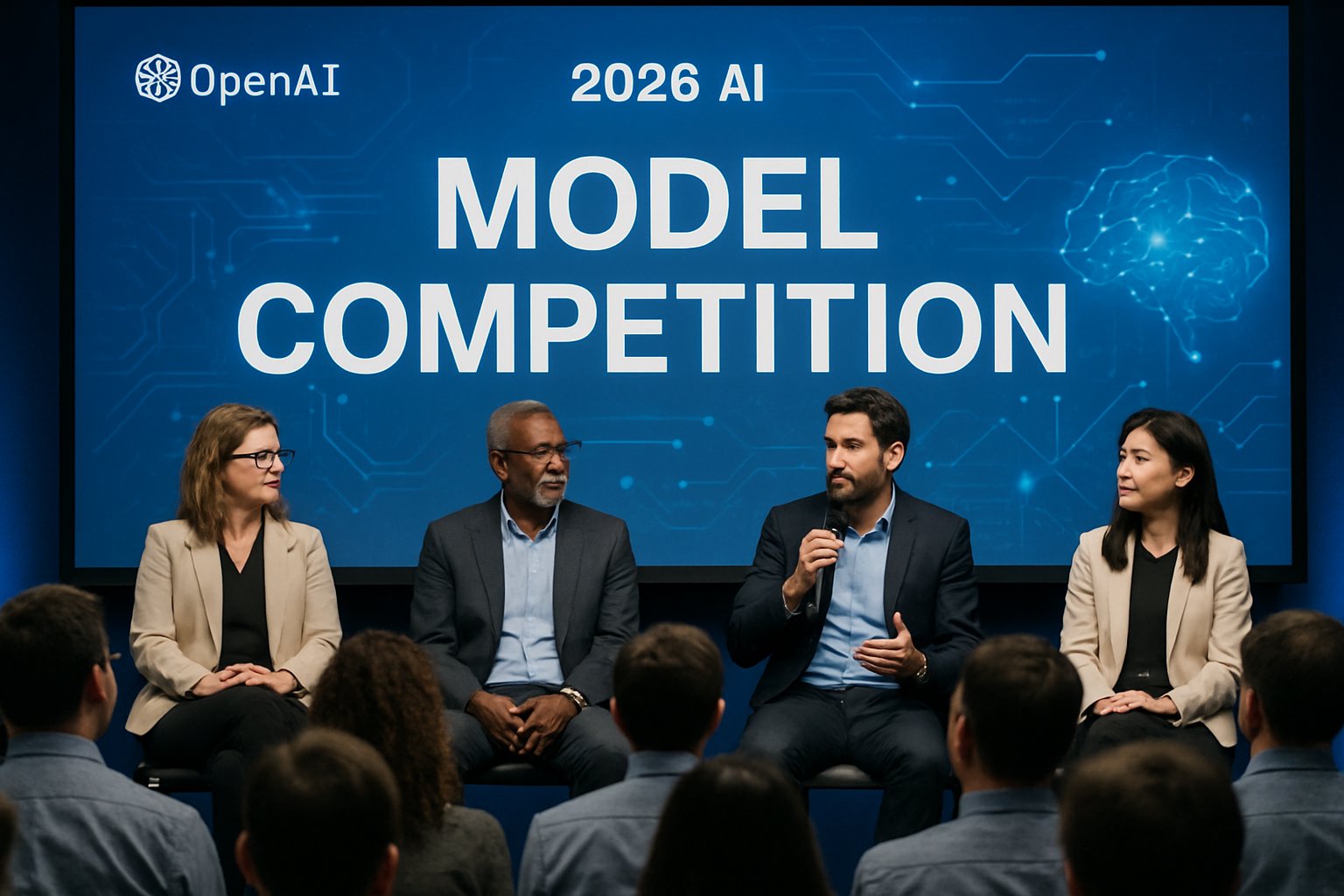
Moreover, the Disney partnership and a specialized Codex variant have widened the playing field. Meanwhile, independent reviews caution against over-reliance on vendor metrics. This balanced report explains what matters now and what signals to watch next in the ongoing Model Competition.
Release Timeline Explained Clearly
OpenAI announced GPT-5.2 on December 11, 2025, only months after GPT-5.1. In contrast, the specialized Codex variant arrived on December 18. Consequently, the compressed schedule underscored leadership urgency.
Subsequently, three public tiers—Instant, Thinking, and Pro—entered paid ChatGPT plans and the API. Additionally, OpenAI will keep GPT-5.1 available for three months, softening migration risks.
- Aug 2025: Knowledge cutoff extended to August 2025.
- Dec 11 2025: Frontier model general release begins.
- Dec 11 2025: Disney invests $1 billion in OpenAI.
- Dec 18 2025: Codex trusted pilot opens.
Analysts note that the condensed schedule mirrors smartphone release cycles. Consequently, enterprises must plan migrations well ahead of public announcements.
These milestones illustrate the rapid cadence driving the latest Model Competition.
The timeline shows OpenAI’s accelerated engineering rhythm. However, speed also fuels concerns discussed next.
Performance Benchmarks Key Overview
OpenAI touts significant gains on professional and coding benchmarks. For example, GPT-5.2 Thinking scored 70.9% on GDPval, up from 38.8%.
Moreover, SWE-Bench Pro rose to 55.6%, beating GPT-5.1’s 50.8%. Therefore, OpenAI claims double-digit jumps across reasoning, math, and long-context tasks.
Independent outlets applaud improvements yet warn that Model Competition can incentivize inflated marketing statistics. Such public data also spark wider competition among benchmarking groups.
Ars Technica urges outside labs to replicate results before enterprises lock budgets. Meanwhile, early testers noted slower latency in Thinking mode despite higher accuracy.
Furthermore, the context window reportedly reaches 400,000 tokens. Such capacity enables full-length compliance manuals or vast codebases to fit within one prompt. However, managing prompt length can increase release costs if teams ignore token efficiency.
Performance data appear promising but remain vendor-reported. Independent trials will shape the next phase of Model Competition.
Business Partnerships And Impact
The $1 billion Disney investment adds commercial heft and marketing reach. Furthermore, the deal licenses Disney, Marvel, Pixar, and Star Wars characters to Sora.
Consequently, other studios may pursue similar alliances, intensifying Model Competition in creative AI.
However, unions and IP lawyers question guardrails protecting character likeness and creative labor.
OpenAI also gains strategic distribution inside Disney workflows, potentially driving higher enterprise subscription revenue.
Additionally, the licensing framework includes guardrails restricting explicit content and political persuasion. Therefore, Disney preserves brand integrity while monetizing assets.
In contrast, competitors like Google and Anthropic may court other media giants, expanding the partnership chessboard.
Disney’s move validates high-value licensing models. Subsequently, rival firms will innovate new deals to stay relevant.
Competitive Pressure And Response
Reuters reported Sam Altman issued a “code red” to accelerate improvements after Google’s Gemini 3 performance leaked.
Therefore, the new flagship model was prioritized to defend ChatGPT market share and direct the narrative.
Meanwhile, venture analysts argue that constant crisis cycles can endanger rigorous safety testing.
This competitive cycle sharpens market competition but can shorten validation windows.
Nevertheless, the strategy succeeded in dominating headlines and refocusing Model Competition on feature richness rather than raw research breakthroughs.
Developers now compare context windows, reasoning depth, and cost across GPT-5.2, Gemini 3, and Claude Opus.
Cost remains fluid because OpenAI has not finalized production pricing. Additionally, early press cited $1.75 per million input tokens for standard throughput.
Consequently, Google is expected to answer with Gemini 3.1 early next quarter. That update could reopen headlines and intensify funding flows.
OpenAI’s pressure-cooker approach won early mindshare. However, long-term advantage depends on reliability, not speed alone.
Security And Certification Angle
Cybersecurity teams gained a dedicated variant through GPT-5.2 Codex. Moreover, trusted access limits misuse while enabling defensive research.
Professionals can enhance expertise with the AI Security Level 2 certification.
Consequently, certified practitioners can better evaluate prompt safety, tool integration, and regulatory obligations.
Strong security practices increasingly influence procurement decisions during high-stakes Model Competition.
Additionally, OpenAI highlighted token-level auditing features and improved red-teaming coverage.
Meanwhile, the vendor’s red-team brief emphasizes mitigations for prompt injection and data leakage. Nevertheless, many CISOs demand external attestations before production use.
Security accreditation creates trust signals for buyers. Subsequently, certified experts may sway adoption toward safer vendors.
Risks Issues Under Debate
Despite innovation, the launch faces criticism. Firstly, vendor benchmarks lack third-party verification.
Secondly, access remains gated behind paid tiers, raising equity concerns.
Thirdly, Disney’s licensing arrangement revives debates around fair compensation for creative labor.
Moreover, slower latency in Thinking mode may frustrate interactive workflows.
Consequently, leaders must balance opportunity against risk when navigating ongoing Model Competition.
- Benchmark transparency gaps
- Cost barriers for smaller teams
- Safety validation speed
- Intellectual property exposure
Finally, economic dislocation remains possible. Automation of spreadsheet modelling or presentation drafting may reduce junior staffing needs.
These risks could erode trust if ignored. However, proactive governance can convert challenges into differentiation.
Strategic Takeaways For Leaders
Enterprise strategists should pilot the updated model before scaling. Furthermore, teams must log latency, accuracy, and cost per deliverable.
In contrast, comparing Gemini 3 and Claude Opus offers perspective on evolving capabilities.
Additionally, track upcoming pricing changes and contract guardrails.
Therefore, use governance frameworks aligned with NIST AI risk guidelines and industry certifications.
Moreover, leaders should establish cross-functional task forces that include legal, security, and data science experts. Such collaborative governance accelerates responsible deployment.
Healthy competition often benefits buyers through faster innovation.
Structured pilots and governance provide clarity for decision makers. Subsequently, disciplined evaluation will separate hype from genuine value.
In summary, OpenAI’s GPT-5.2 arrives amid unprecedented pace, bold partnerships, and heated benchmarks. Moreover, the accelerated rollout exemplifies how rival advances can trigger fast pivots. While vendor metrics indicate strong gains, independent validation remains essential. Security considerations, including certifications like AI Security Level 2, will shape trust and adoption. Consequently, leaders who combine rigorous testing with strategic partnerships will gain a decisive edge. Act now: review pilot results, pursue relevant certifications, and monitor forthcoming updates to stay ahead in the volatile AI model arena.


