

AI CERTS
2 months ago
Nvidia’s Alpamayo Sets New Benchmark for Autonomous Vehicle AI
Moreover, early demonstrations showed chain-of-thought explanations that translate video input into clear driving intentions. Therefore, Alpamayo could redefine industry expectations around Autonomous Vehicle AI compliance. These narrated traces may help regulators audit digital decisions. Nevertheless, major challenges still shadow commercial rollouts. This article examines Alpamayo’s architecture, open-source approach, partnership roadmap, competitive dynamics, and outstanding risks. Readers will gain actionable context to navigate rapid shifts in Self-driving investment. Professionals can deepen leadership skills with the AI Executive™ certification.
CES Launch Details Summary
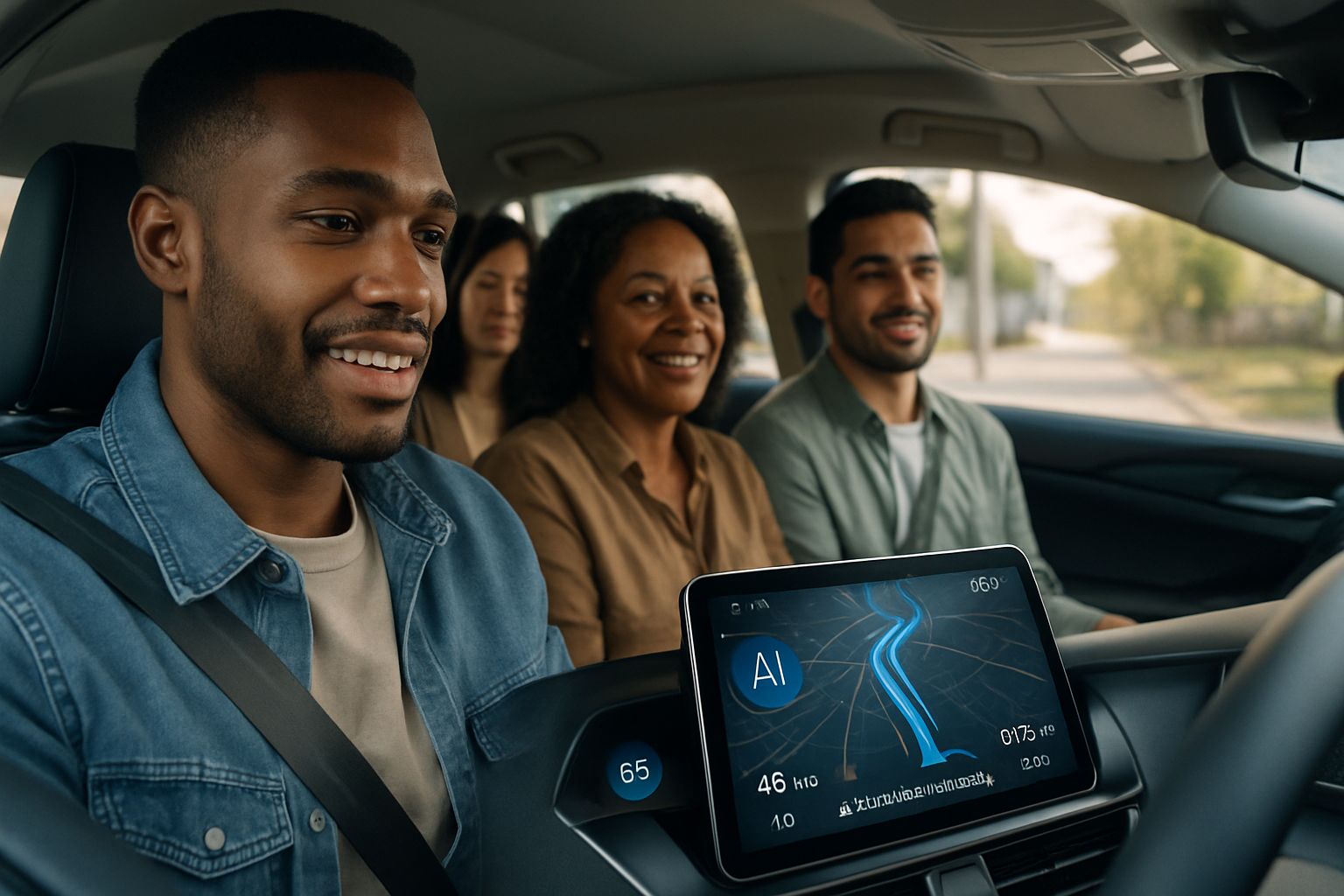
Nvidia’s keynote featured a live Mercedes-Benz CLA demo. Moreover, the vehicle executed city maneuvers while projecting text explanations on an interior display. Observers saw the system describe a construction detour, explain lane choice, and justify a cautious merge. Such transparency reflects Alpamayo’s chain-of-thought design.
During the keynote, CEO Jensen Huang compared the release to ChatGPT’s breakthrough for language. Consequently, he labeled it the “ChatGPT moment for Physical AI”. That framing aligns with Alpamayo’s goal: blend perception, language reasoning, and control into one VLA stack.
- Model size: 10 billion parameters, with 8.2 B reasoning core
- Open datasets: 1,700+ driving hours shared
- Simulator: AlpaSim released under Apache-2.0 license
- Availability: Weights hosted on Hugging Face, code on GitHub
These launch facts anchor Autonomous Vehicle AI progress in verifiable, open artefacts. Meanwhile, understanding the underlying architecture clarifies why reasoning promises safer control.
Alpamayo Model Architecture Insights
At its core, Alpamayo is a Vision-Language-Action network with 10 billion parameters. Furthermore, the backbone fuses video tokens with latent text that represents spatial context. This joint embedding lets the system generate both steering trajectories and human-readable rationales.
Developers will rarely deploy the full model on vehicles. Instead, Nvidia encourages distillation into smaller AI Models suitable for DRIVE Thor chips. Consequently, practitioners fine-tune specialist networks while keeping teacher supervision in the cloud.
The architecture stores intermediate “thought” vectors. Therefore, safety auditors can replay a scenario, inspect reasoning, and match decisions with regulatory rules. In contrast, many closed Self-driving stacks deliver only final control outputs.
Alpamayo’s technical schema thus merges Physical AI demands with language transparency. Consequently, the design could boost Autonomous Vehicle AI trustworthiness.
Open Source Strategy Roadmap
Nvidia published model weights as safetensors on Hugging Face. Additionally, AlpaSim’s complete simulator lives on NVlabs’ GitHub under Apache-2.0.
This openness lowers entry barriers for universities, tier-ones, and regional automakers. Consequently, new AI Models can evolve without expensive data centers.
However, releasing safety-critical code invites scrutiny. Independent labs must verify robustness, while regulators will demand evidence that distillations honour original constraints.
- Validate scenario coverage using standardized disengagement metrics
- Implement secure update pipelines to prevent malicious tampering
- Document parameter changes during downstream fine-tuning
Nevertheless, many partners welcome the strategy. Mercedes, Lucid, and JLR publicly endorsed the transparent path for Physical AI. Open distribution could widen Autonomous Vehicle AI research beyond dominant tech incumbents. Partnership timelines reveal how quickly these ideas may reach showrooms.
Industry Partnerships Rollout Timeline
Mercedes plans to ship a CLA variant with Alpamayo-enhanced Level-2 features during Q1 2026. Furthermore, internal roadmaps indicate staged upgrades toward Level-3 capability later that year.
Uber and the chipmaker target 100,000 robotaxi units by 2027. Meanwhile, Lucid and Stellantis joined early pilot programs focusing on urban corridors.
Analysts predict incremental deployment. Consequently, each fleet will begin with safety operators before progressing to unsupervised Self-driving service.
- Q1 2026: CLA customer deliveries begin
- Late 2026: Regional Level-3 certification trials
- 2027: Robotaxi pilots in multiple cities
- 2028+: Scale toward broader international markets
These staged milestones anchor investment expectations and hardware procurement cycles. Therefore, stakeholders tracking Autonomous Vehicle AI should monitor regulatory filings closely. Competitive reactions illustrate the broader strategic stakes.
Competitive Landscape Analysis Today
Tesla, Waymo, and Mobileye have long pursued proprietary autonomy stacks. In contrast, Nvidia’s open teacher approach resembles Android’s ecosystem play.
Elon Musk expressed skepticism, noting long-tail safety remains unsolved. Nevertheless, market commentators argue that community visibility accelerates fault discovery.
Furthermore, smaller OEMs can adapt Alpamayo without building foundational AI Models from scratch. Consequently, platform network effects may emerge.
However, incumbents own massive telematics datasets. Therefore, they may still outpace newcomers in rare corner cases. Access to shared AI Models could narrow that gap if validation proves sufficient. These dynamics highlight how Physical AI commercialization intertwines with cloud services and silicon supply. Ultimately, leadership in Autonomous Vehicle AI will hinge on safety metrics, not press releases. Yet safety assurance also carries regulatory and ethical challenges.
Risks And Challenges Ahead
Open code does not equal certified safety. Moreover, verifying reasoning traces requires standardized audits.
Regulators will ask who bears liability when a modified model causes harm. Consequently, governance frameworks must evolve.
Runtime constraints pose additional hurdles. Therefore, distilled networks must fit embedded power envelopes without losing fidelity.
Security specialists warn that exposed weights permit adversarial testing. Nevertheless, transparent testing could improve robustness. Self-driving failures attract intense media scrutiny and investor pressure. Physical AI failures, unlike chatbots, can injure passengers. Robust AI Models must therefore resist distribution shift across continents. Addressing these gaps remains critical for Autonomous Vehicle AI deployment at scale.
Collectively, these risks underscore the importance of cautious iteration. However, the conversation is already shifting toward practical next steps.
Alpamayo marks a bold inflection point for road autonomy. Moreover, the open release invites collaboration across academia, suppliers, and policymakers. The approach blends Physical AI transparency with scalable AI Models that partners can tailor. Consequently, competition will intensify as Self-driving pilots expand and safety data accumulates. Nevertheless, final verdicts will hinge on certified evidence, not aspirational demos. Industry leaders seeking clarity on Autonomous Vehicle AI trends should watch independent benchmarks, regulatory filings, and partnership progress. Mastering Autonomous Vehicle AI governance will define the next decade of mobility. Professionals eager to steer these developments can enhance strategic insight through the AI Executive™ certification and related resources.


