

AI CERTs
3 hours ago
Nvidia H200 Orders From China Boost Stock Momentum
Investors woke to fresh signals from Beijing that advanced GPUs may soon clear customs. Consequently, Bloomberg reported that Chinese regulators instructed Alibaba, Tencent, and ByteDance to prepare purchase orders. The news lifted Nvidia shares nearly 1.5 percent during the January 23 session. Such a modest uptick matters because every incremental access to China represents billions in potential revenue. Meanwhile, the central hardware character remains the Nvidia H200, a Hopper-generation accelerator tailored for demanding AI workloads. Market participants now ask whether a limited policy opening can satisfy explosive mainland demand yet avoid geopolitical backlash. Furthermore, supply chain partners like TSMC face pressure to expand capacity before mid-year. This article unpacks the timeline, policy mechanics, and strategic stakes around the pending shipments. Readers will also find data-driven insights, balanced risks, and practical certification resources for continued professional growth.
Chinese Order Signals Surge
Bloomberg’s Jan. 23 scoop described Chinese regulators giving three internet titans early purchasing permission. Consequently, traders interpreted the guidance as de facto clearance for initial import batches. Pre-market quotes showed Nvidia shares rising up to 2.6 percent before settling near a 1.5 percent gain. Analysts highlighted that even modest movement reflects outsized earnings sensitivity to mainland demand.
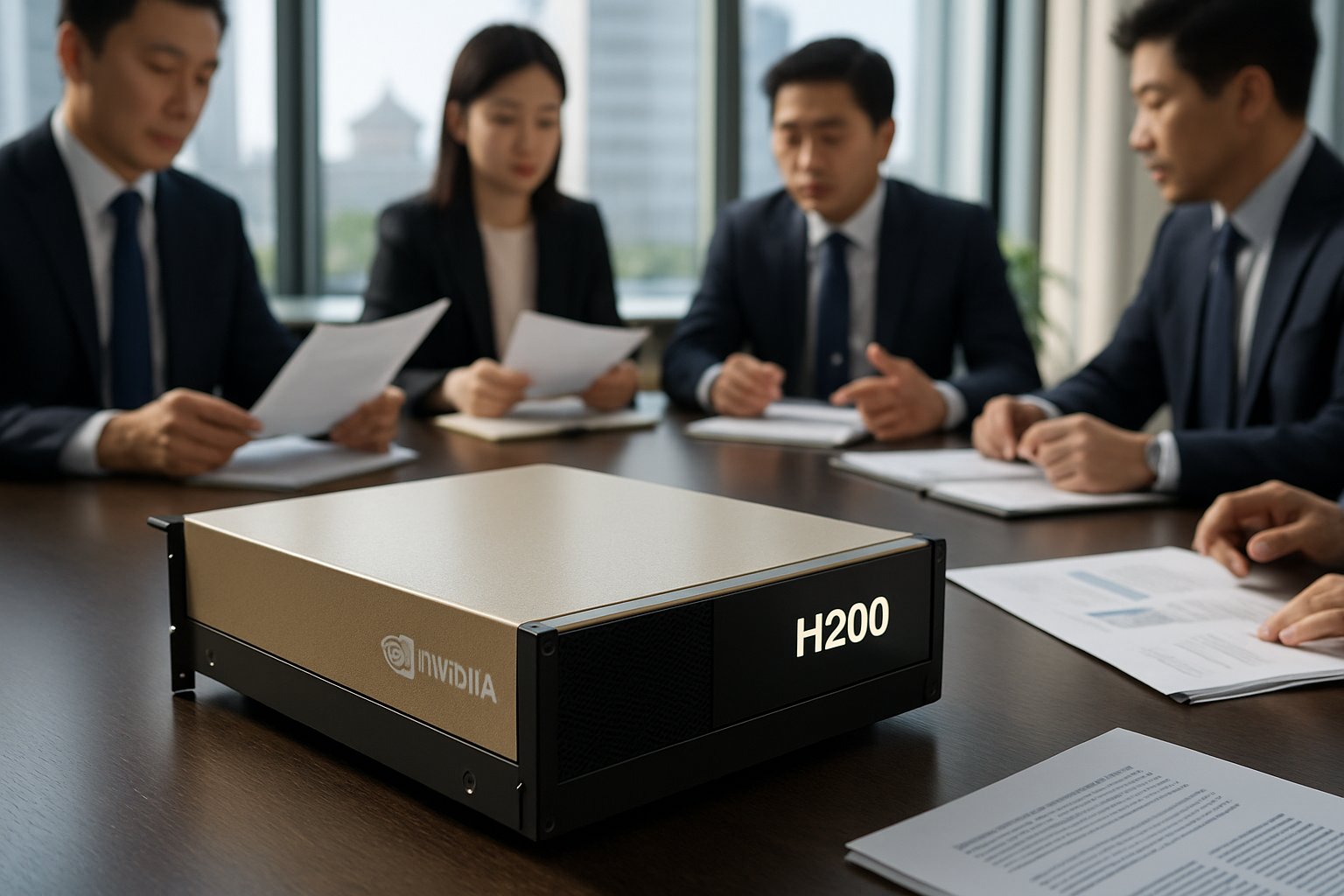
At the center of optimism sits the second-generation Nvidia H200 accelerator, still awaiting full license approval. Reuters earlier reported that Chinese customers had already booked more than two million units for 2026 delivery. However, Nvidia’s onsite inventory reached only about 700,000 units at year-end, creating a supply gap. Meanwhile, local media framed the purchase window as a tactical blow to domestic competitors in the crowded China AI Chips arena.
These early signals strengthened sentiment but left several execution questions unanswered. Consequently, stakeholders turned to hard data for clarity, as the next section details.
Key Statistics Recap Points
Compiled market data contextualize the potential revenue swing.
- Jan. 23: Shares rose 1.5 percent after order news.
- Two million units reportedly ordered by Chinese buyers.
- Inventory stood near 700,000 units including 100,000 GH200 modules.
- Initial 40,000–80,000 chips may ship before Lunar New Year.
- Export levy set at 25 percent under U.S. policy.
The figures illustrate both opportunity and strain for Nvidia H200 supply plans. Nevertheless, numbers alone cannot explain the intricate policy path, leading us to the timeline review.
Policy Timeline Overview Details
December 8, 2025 marked a pivotal shift. President Donald Trump announced licensed exports with a 25 percent levy. Moreover, the Commerce Department moved the part to case-by-case review. Subsequently, Nvidia filed license applications covering the first shipment wave. Reuters later revealed plans to send 40,000–80,000 chips before mid-February.
However, conflicting implementation reports emerged. Financial Times alleged customs briefly blocked incoming boards, while Reuters could not verify the blockage. In contrast, Bloomberg’s January report suggested regulators were now coordinating purchases. The mixed messages highlight fluid policy enforcement around China AI Chips imports.
This evolving chronology underscores the importance of constant monitoring. Therefore, supply dynamics deserve equal scrutiny in the following section.
Demand Supply Imbalance Risks
Chinese cloud providers crave accelerators to train ever-larger language models. Consequently, aggregate orders exceed Nvidia’s current stock by nearly threefold. The company approached TSMC about enlarging capacity, yet wafer starts require months. Additionally, the mandatory levy raises landed costs, potentially tempering short-term appetite for China AI Chips.
Meanwhile, global hyperscalers worry about allocation shifts. A sudden mainland surge could redirect limited parts away from existing commitments. Nevertheless, Nvidia H200 shipments to China remain capped by U.S. license volumes, providing some buffer.
Production Ramp Scenarios Ahead
Analysts model three production paths. First, a conservative plan ships only existing inventory. Second, a moderate path adds one extra TSMC tape-out tranche. Third, an aggressive move doubles monthly output by late summer. Each path carries cost, political, and yield trade-offs.
Supply modeling reveals tight margins for error. Consequently, geopolitical factors warrant closer inspection next.
Geopolitical Stakes Analyzed Today
Washington hawks warn that advanced GPUs could accelerate military AI systems. Conversely, commercial advocates argue that licensed sales keep Chinese developers on U.S. toolchains. Beijing also balances imperatives. Regulators appear willing to allow selected firms to import while still championing domestic China AI Chips makers like Huawei.
Regulatory Uncertainty Factors Explained
Approval scope, end-user monitoring, and future Congressional action remain open variables. Moreover, any renewed tension in Taiwan could disrupt TSMC logistics, indirectly throttling Nvidia H200 flow.
The interplay between security and commerce shapes every strategic decision. Therefore, investors need distilled action points.
Investor Takeaways Ahead Now
First, headline risk around export licenses will drive short-term volatility. Second, medium-term revenue upside depends on how quickly Nvidia H200 production scales. Third, long-term competitive positioning benefits from keeping Chinese developers on CUDA. Professionals can enhance their expertise with the AI+ Educator™ certification, which covers advanced AI deployment practices.
These insights equip readers for informed decision-making. Subsequently, the conclusion synthesizes core lessons and offers a clear call to act.
In summary, Chinese regulators signaled fresh openness, markets reacted, and the policy chessboard keeps shifting. Moreover, supply shortages and geopolitical friction inject ongoing uncertainty. Nevertheless, disciplined analysis reveals that controlled access could unlock sizable earnings while containing strategic risk. Consequently, staying current on approvals, production metrics, and levy impacts is crucial. Forward-looking professionals should deepen their technical acumen and policy awareness. Explore more insights and certifications to stay competitive in the rapidly evolving AI landscape.


