

AI CERTS
3 hours ago
Nvidia Groq Talent Move Reshapes AI Inference Market
Consequently, rival chipmakers watched closely as details emerged. Meanwhile, regulators noted the colossal price whispers and potential market impact. This article unpacks the transaction, the technology, and the stakes.
Deal Overview Snapshot Brief
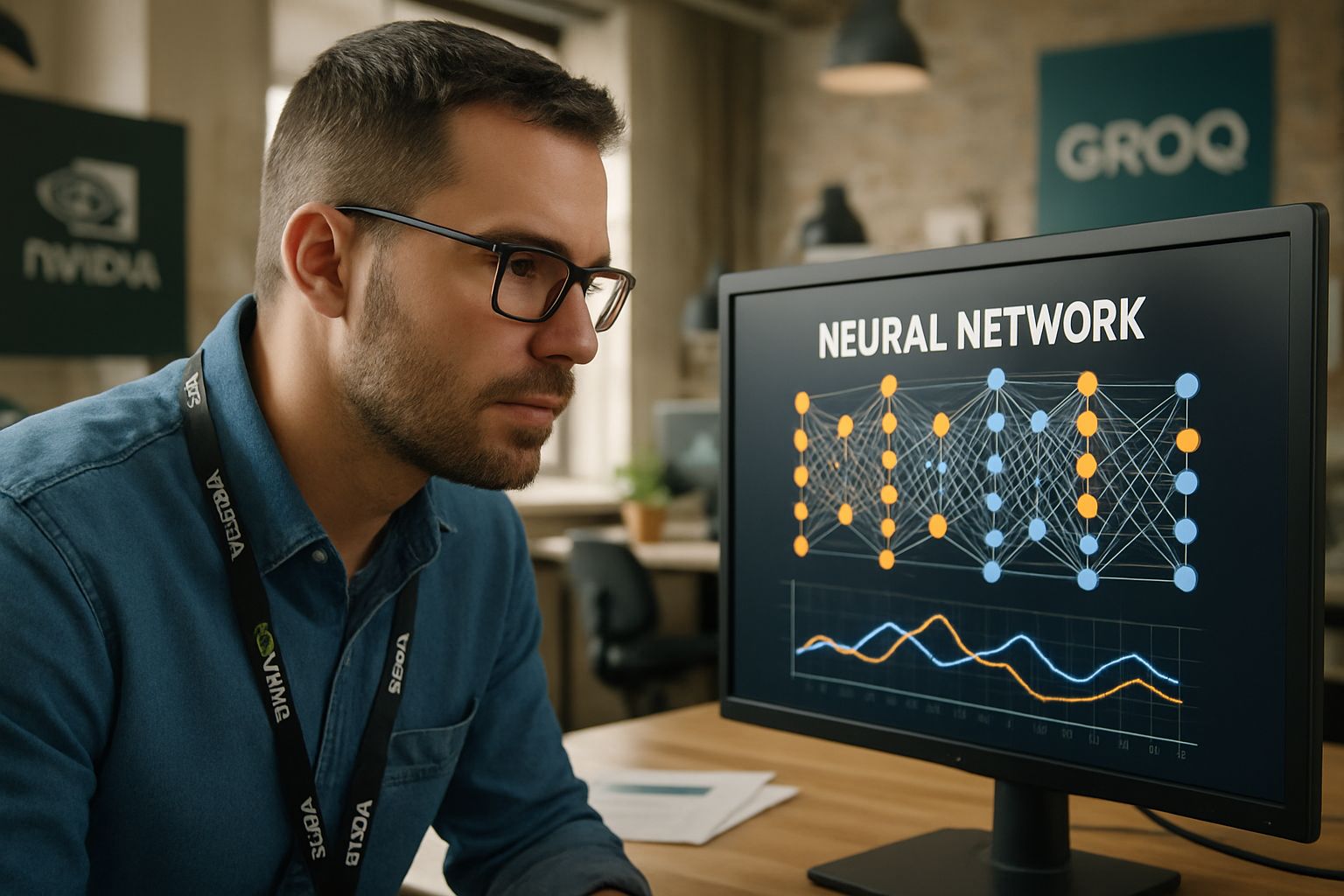
Groq framed the arrangement as a non-exclusive license. However, multiple outlets cited sources claiming Nvidia paid about $20 billion. Reuters added that cash reserves allowed Nvidia to execute quickly. Jonathan Ross, Sunny Madra, and several engineers will cross over. Groq remains independent with CFO Simon Edwards now CEO. Moreover, GroqCloud continues serving more than two million developers. Market watchers debated whether the structure masks a de-facto acquisition.
For context, Groq raised $750 million in September at a $6.9 billion valuation. Therefore, the rumored consideration represents a triple. Investors like BlackRock and Samsung likely welcome the outcome. Nevertheless, the absence of an SEC filing leaves final numbers unverified.
These fast-moving facts establish the headline scale. Subsequently, the personnel changes deserve equal attention.
Talent Acquisition Key Details
Nvidia explicitly targeted expertise rather than headcount volume. Jonathan Ross, once a Google TPU pioneer, now spearheads Nvidia’s new inference strategy. Ross will report directly to senior GPU architect Bill Dally. Additionally, Groq president Sunny Madra joins to oversee product integration. Nvidia Groq Talent migration extends to compiler, runtime, and silicon teams.
Industry investor Chamath Palihapitiya tweeted confidence in Ross delivering transformative results. In contrast, remaining Groq staff must recalibrate under Edwards. Furthermore, culture blending poses risks; small startup agility often clashes with corporate processes.
This leadership shuffle centers on specialized know-how. However, technology fit ultimately decides success, which we examine next.
Core Technology And Synergies
Groq’s signature Language Processing Unit accelerates inference using massive on-die SRAM. Consequently, token throughput remains deterministic and low-latency. Nvidia dominates training workloads with GPUs, yet inference demands different silicon traits. Integrating LPUs alongside GPUs could create hybrid racks balancing pre-fill and decode stages.
Moreover, Ross previously helped invent Google TPU v1, giving him rare ASIC depth. Combining that pedigree with Nvidia’s supply chain accelerates roadmaps. Analysts expect higher tokens-per-watt, reducing cloud operating costs.
- Groq targets 500 million dollars in 2025 revenue
- Nvidia holds 60.6 billion dollars in cash reserves
- More than two million developers run on GroqCloud
- Press reports cite a 20 billion dollar headline price
The silicon synergy promises efficiency gains. Nevertheless, market dynamics complicate any straightforward victory, as the next section reveals.
Wider Market And Competition
Cerebras, SambaNova, and Tenstorrent still challenge Nvidia in inference. However, absorbing Groq diminishes one independent rival. Consequently, hyperscalers evaluating custom ASICs might revisit build-versus-buy decisions. Google remains committed to internal TPU iterations, yet external alternatives shrink.
Meanwhile, cloud customers demand multi-vendor resilience. GroqCloud’s continued independence attempts to calm those fears. In contrast, some enterprises worry about future pricing leverage. Additionally, shareholders question whether Nvidia will stifle innovation by folding unique ideas into proprietary stacks.
Competitive pressures thus intensify scrutiny. Subsequently, regulatory hurdles surface.
Possible Regulatory And Risks
Bernstein’s Stacy Rasgon flagged antitrust as the primary threat. Therefore, structuring as a non-exclusive license could ease filings. Nevertheless, regulators may study whether talent transfer effectively removes a competitor. Financial opacity also raises compliance questions. Furthermore, cultural integration risk looms; failed onboarding could dilute value.
Customer contracts require clarity on service-level guarantees. Meanwhile, developers depend on GroqCloud availability for production workloads. Any disruption might push them toward alternative inference engines.
These uncertainties highlight non-technical hazards. However, strategic motives still drive the narrative forward.
Strategic Outlook Moving Forward
Nvidia Groq Talent absorption positions Nvidia across training and inference fronts. Consequently, product roadmaps may feature mixed GPU-LPU boards within twelve months. Groq investors realize returns while preserving a slimmed-down cloud business. Moreover, Ross gains manufacturing scale unavailable to a startup.
Professionals can enhance their expertise with the AI Engineer™ certification. The credential sharpens inference optimization skills valued by both firms.
Expect rival chipmakers to accelerate power-efficiency claims. Meanwhile, policymakers could demand data sharing before approving deeper integrations. Ultimately, customers will judge success by cost-per-token and latency improvements.
This forward view underscores transformative potential. Nevertheless, execution and oversight will determine lasting impact.
In summary, Nvidia Groq Talent consolidation, generous finances, and LPU innovation converge to reshape AI hardware. Moreover, secondary stakeholders must navigate competitive, cultural, and regulatory waves. Stay informed and prepare your teams for rapid change.


